I, Medusa
66 pages • 2-hour read
Ayana GrayI, Medusa
A modern alternative to SparkNotes and CliffsNotes, SuperSummary offers high-quality Study Guides with detailed chapter summaries and analysis of major themes, characters, and more.
Part 3Chapter Summaries & Analyses
Content Warning: This section discusses rape, sexual assault, graphic violence, physical and emotional abuse, cursing, sexual content, death, and gender discrimination.
Part 3: “Mistress”
Part 3, Chapter 19 Summary
The next morning, Meddy wakes up to discover that Appolonia has still not returned to the quarters. She finds a distraught Appolonia near the gates of the temple, injured, with her chiton ripped. Appolonia tells Meddy that she went looking for her towards the latrines the previous night and was accosted by soldiers. Though she told the soldiers she was an acolyte, they did not believe her. The soldiers raped her.
Meddy is filled with guilt and rage. She wants to report the incident to the priestesses, but Appolonia begs her to keep her secret. Meddy cannot understand Appolonia’s reluctance, since it is clear Appolonia was the one who was wronged. Nevertheless, Meddy helps her friend bathe and get dressed. Kallisto overhears their conversation and threatens to tell everyone.
Appolonia asks Kallisto for mercy. Kallisto agrees to keep quiet in exchange for Meddy kissing her feet. Meddy performs the humiliating action, but Kallisto informs the priestesses anyway. Soon enough, the priestesses summon Appolonia. To Meddy’s intense confusion, they accuse Appolonia of “serious misconduct” (261). Meddy is even more flummoxed when Appolonia apologizes for her actions. Confusion turns to horror when Euphraxia bans Appolonia from serving in the temple forever. Meddy begs the priestesses to reconsider their decision, but Appolonia is sent away.
Kallisto taunts a weeping Meddy that Appolonia deserved her punishment since she “slept” with the soldiers. Unable to understand Kallisto’s snide remarks, Meddy hits her in anger. Euphraxia stops Meddy and takes her to a sanctum inside the temple. Athena is sitting by the hearth in the sanctum, waiting for Meddy.
Part 3, Chapter 20 Summary
Athena tells Meddy to direct her anger against Athena herself, since it was the goddess who ordered Appolonia’s expulsion. An incredulous Meddy cannot understand why the goddess would punish the devoted Appolonia for the soldiers hurting her. Athena explains to Meddy that Appolonia had sexual intercourse with the soldiers, which means she lost the “chastity” that is demanded of a priestess of Athena. The concept of sex finally sinks in for Meddy, but she still cannot understand how the events of last night—clearly rape—were Appolonia’s fault. Athena tells Meddy that Appolonia showed poor judgement by roaming the streets and getting drunk. A woman of such poor judgement cannot be a priestess of Athena’s temple.
Though Meddy is still outraged at the injustice meted out to Appolonia, she is mollified when Athena compliments her for her service to the people of Athens. Athena also tells Meddy that she may visit her family for a week, as Phorcys has requested. Meddy feels happy that her father misses her enough to request her presence. Later, she notices that the seashell necklace given to her by her sisters is missing.
Part 3, Chapter 21 Summary
Back home, Meddy’s illusions about her father missing her shatter when Phorcys demands to know if she curried favor for him with Athena. When a bewildered Meddy replies that her father never asked her to do so, Phorcys yells at Meddy. He threatens to recall Meddy to the island permanently, since she has failed to fulfil her purpose in Athens.
A panicked Meddy lies that she has been praising Phorcys to Poseidon, the sea king, with whom she has had a private audience. When she returns to Athens, Meddy will further the case of the Sea Court. Phorcys is temporarily convinced enough to let Meddy return to Athens. Meddy’s meeting with her sisters is joyous, though she is upset with Stheno and Euryale for not explaining intercourse to her. Stheno and Euryale apologize to Meddy. Meddy learns that Euryale has been intimate with a forest nymph; the concept of same-sex intimacy intrigues Meddy.
Later, Meddy meets Theo and narrates the Appolonia incident to him. Theo immediately sees the unfairness of Athena’s actions. To her surprise, Meddy finds herself defending the goddess, telling Theo he cannot understand her code of conduct as he is too removed from the situation.
Later, Meddy finds Ceto by the shore, attending to a monstrous-looking sea-creature. Ceto explains to Meddy that the creature reminds her of her other children, Meddy’s oldest siblings. She finally reveals that her earliest children with Phorcys were unusual in appearance, such as Echidna, who had the torso of a woman and the tail of a fish, and Ladon, the dragon. Athena took away the children during the Gigantomachy, deeming them “monsters” and potential enemies to Zeus.
Ceto’s story makes Meddy realize the reason for her mother’s hatred of Athena, as well as her own mortality. It also raises uncomfortable questions about the goddess, but Meddy does not allow herself to dwell on them. A sobbing Ceto blames Athena for taking away Meddy as well and warns Meddy against trusting Athena.
Part 3, Chapter 22 Summary
Meddy’s parents throw a feast to celebrate her brief homecoming. To everyone’s surprise, Poseidon turns up at the dinner. Poseidon feigns that his arrival is a happy accident: He decided to visit Phorcys’s table as he was in the vicinity for work. He compliments Phorcys for his hospitality and suggests he can persuade the other Olympians, such as Zeus and Hera, to visit for the autumn feast. Phorcys is overjoyed at the prospect of such important guests and sidles up to Poseidon. Meddy feels Poseidon looking at her and recalls their passionate kiss.
Later that night, Meddy is awakened by a shadow outside her door. She steps out and sees Poseidon, who tells her he has been unable to stop thinking of her. Meddy walks to the gardens with Poseidon, flattered by his interest in her. When a lovelorn-seeming Poseidon tells Meddy she consumes his thoughts, she feels special and powerful. Poseidon returns to Meddy her shell necklace, which he found on the streets of Athens. As he draws close to her, Theo appears on the scene. Poseidon contains himself and bids a formal goodbye to Meddy.
Theo is immediately suspicious of Poseidon’s proximity to Meddy. He tells Meddy that Poseidon has a terrible reputation: It is rumored his charm hides a cruel streak, the sea king flooding entire cities on petty whims. He also cheats relentlessly on his wife Amphitrite, as Meddy and Theo witnessed when they saw Poseidon having sex with the nymph in the garden. Indignant, Meddy argues that Poseidon is her friend and he only wanted to return her necklace. She accuses Theo of misunderstanding Poseidon. Theo walks away, hurt. Meddy feels alienated from Theo and her family.
Part 3, Chapter 23 Summary
Given the turn of events, Meddy is happy to return to Athens a week later. She spends her days working alongside Kallisto and Amersa, the other two remaining acolytes. Kallisto often taunts Meddy about Appolonia and denigrates Meddy’s foreign origins, unaware of the fact that Meddy’s parents are gods.
On one such occasion, Kallisto is interrupted by the sound of a woman’s screams. The acolytes rush outside the temple and see an impoverished-looking older woman running towards the temple, with soldiers in pursuit of her. As the woman cries for help, Meddy rushes to her aid. The soldiers tell Meddy not to intervene, as the woman is wanted for stealing food. Kallisto decides to stay out of the matter, while Amersa watches helplessly. However, Meddy defends the cowering older woman, hitting the men with a broom when they try to use force.
Euphraxia appears on the scene and sends away the soldiers. She reveals that the acolytes just went through their final test: helping a woman in need. Only one acolyte passed the test, and that is Medusa.
Euphraxia asks the older woman if she agrees. The woman transforms into Athena and declares Medusa a priestess. Athena administers the vows, and Meddy promises solemnly. When it comes to the vow of chastity, Meddy briefly thinks of Poseidon’s kiss, but banishes the thought. The priestesses hug and kiss Meddy. Kallisto and Amersa are dismissed.
Part 3, Chapter 24 Summary
Despite being anointed a priestess, Meddy willingly continues to live in the acolytes’ quarters and performs tedious chores. A few days after her initiation, Meddy and the other priestesses visit Athens again to distribute food. To Meddy’s surprise, a group of citizens seek her out by name, asking her to pray on their behalf and bless them, the way she did Kallinikos, the charioteer. It is clear that a rumor has spread that Meddy has special powers. Meddy tells the people that she is just an ordinary priestess, but they press on. Meddy finally agrees to pray to Athena with them, asking the goddess to heal a gravely ill child.
Back at the temple, the priestesses are frosty with Meddy. Meddy can tell that they disapprove of the attention Meddy has attracted. Oppressed by the silence of the priestesses, Meddy heads to the shore to clear her head. Poseidon appears by her side, claiming that Meddy came to the shore seeking him. Meddy shares her troubles with Poseidon. He comforts her, calling the other priestesses fools for misunderstanding her. Poseidon tells Meddy that she is destined for greatness and kisses her, showering her with attention. Meddy feels worthy to merit the approval of such a powerful Olympian. Poseidon walks Meddy back to the Acropolis.
Part 3, Chapter 25 Summary
To pacify the priestesses, Meddy doubles up on her chores for the next few days. The priestesses thaw towards their youngest counterpart, praising Athena for her wise choice in anointing Meddy. However, matters take a turn for the worse again when a crowd gathers at the gate of the temple, shouting for Medusa to intercede with Athena. A displeased Euphraxia tells the crowd that any priestess can pray to the goddess on their behalf, but the people only want Meddy. As Medusa arrives at the gate, the people tell her that the child she blessed has healed fully. A farmer for whom Medusa also prayed says his crops miraculously revived. Medusa asks the people to form a line, and prays with them.
When Meddy returns to the temple, she runs into an incensed Athena. Athena accuses Meddy of playing god, despite being an ordinary mortal. Meddy cries that she never claimed to have power, categorically telling the people that she could only pray with them to Athena. It is Athena the people love, whom they credit for the miracles. Athena softens and tells Meddy never to forget her place.
A troubled Meddy visits the shore in the evening. She calls out to Poseidon and the god appears before her. Meddy asks Poseidon the reasons for his interest in her. Poseidon tells Meddy that he likes her because she is beautiful and smart, determined to make her own destiny. Meddy also wants to know about Poseidon’s tryst with the nymph. Poseidon replies that the tryst is long over; he only sought out the nymph because he is in a loveless arranged marriage with Amphitrite. Meddy feels terrible for the god, stuck in a bad marriage.
As the conversation turns to Meddy’s troubles, Poseidon reveals that he knows about the healed child and the revived crops. He confesses that he has been working miracles on Meddy’s behalf to help her out. One part of Meddy is filled with foreboding at Poseidon’s deceit: Just as he initially appeared to her in the guise of the young boy, Poseidon has once again kept Meddy in the dark. However, Meddy quells the warning voice in her head.
Poseidon claims he has never felt as intensely for any other woman as he does for Meddy. He begins to make sexual advances towards Meddy. Meddy responds, but then remembers her vow of chastity. She tells Poseidon that she cannot be intimate with him as she is a priestess. The god’s manner instantly grows chilly. He leaves the shore, bidding Meddy a curt goodbye.
Part 3, Chapter 26 Summary
Meddy visits the shore again and again, calling to Poseidon, but the god refuses to appear. Meddy feels guilty about spurning the person who helped her out. Her sense of alienation is compounded by the renewed coldness of the other priestesses. Thus, Meddy is happy to visit her island for the autumn feast, noting that this time the invitation arrives via a note, rather than Athena herself.
Back at the island, Stheno and Euryale work Meddy’s locs into a beautiful hairdo. The palace is done up exceptionally in anticipation of the arrival of the Olympians. At the feast, Meddy and her sisters observe gods such as Zeus, Hera, Dionysius, and Artemis. Athena and Poseidon are notably missing from the banquet. Stheno offers Meddy Olympian wine, brewed by Dionysius himself. The sisters drink and dance, the wine making everything appear more vivid. Meddy feels her troubles melt away.
Theo calls her aside to apologize for their last argument. Meddy reconciles with Theo, calling him her best friend. Just then, her head begins to spin. Theo goes to get her some water.
Alone, Meddy is accosted by Poseidon. Poseidon asks her to show him the gardens. Wanting to be a good host, Meddy agrees.
Part 3, Chapter 27 Summary
In the gardens, Poseidon and Medusa sit on the grass. Poseidon tells Medusa he misses her. He couldn’t come to see her earlier as he has been busy with family affairs. Meddy feels foolish for ever having doubted Poseidon. Moved by Poseidon’s beauty and ardor, Meddy tells him she cares for him deeply. Poseidon kisses Meddy, pulling her down to the grass. He touches her intimately. Meddy notices an owl’s eyes watching them and is reminded of Athena and her vows. She tells Poseidon to wait and tries to break free from his grip, but the god does not stop. He rapes Meddy. Afterwards, Meddy feels a sense of disgust.
To Meddy’s horror, Athena appears in the garden, reprimanding Poseidon for his indiscretion. When Athena realizes that the woman with Poseidon is Meddy, the goddess blanches with anger. She slaps Poseidon for touching one of “her” girls. In retaliation, Poseidon grabs Athena’s arm and forces her to the ground, threatening to rape her if she ever strikes him again. Meddy feels sick to see even a great goddess like Athena thwarted by a man. After Poseidon leaves, Athena directs her anger against Meddy, grabbing her by the hair and pulling her toward the banquet hall.
Part 3, Chapter 28 Summary
Athena brings Meddy before Zeus, claiming she has dishonored her by fornicating with Poseidon. For the crime of “damaging” her priestess, Athena wants Poseidon punished. A disoriented, panic-stricken Meddy watches her parents and sisters cower in fear, as Poseidon walks up nonchalantly to Zeus. Poseidon tells Zeus that he is blameless, claiming it was a drunk Meddy who begged him to have sex with her. Zeus asks Meddy if this is the truth. Meddy stumbles over her words and Poseidon uses her confusion to claim that she is untrustworthy. Poseidon also twists the story of his meetings with Meddy to suggest that she is a wanton maiden who has secretly courted him several times.
Zeus’s cross-examination of Meddy boils down to a single question: Did she say “no” to Poseidon during their encounter? Meddy explains that though she asked Poseidon to wait, Poseidon did not stop. However, in the eyes of Zeus and the other gods, Meddy is the one who is to blame for the incident. Zeus tells Athena she can punish Meddy in whatever way she sees fit. Castigating Meddy for disappointing and dishonoring her, Athena tells her that the very beauty Meddy weaponized will now become her curse. She touches Meddy’s scalp. At once, Meddy’s head begins to burn, her beautiful locs falling off. Meddy’s head begins to feel oddly heavy. Just then, Theo pushes through the crowd, promising help to Meddy. Meddy looks at him in gratitude, but Theo turns to stone before her horrified eyes.
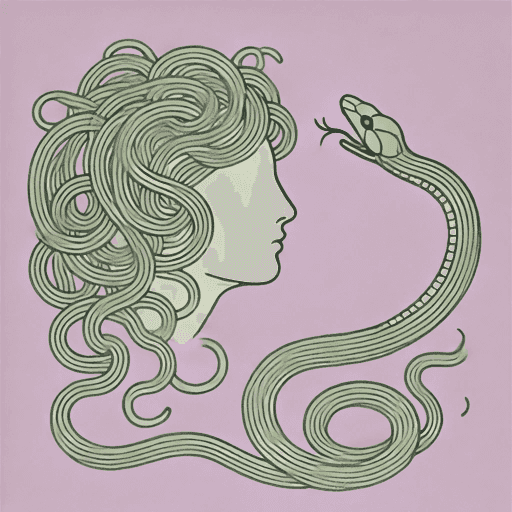
As people begin to avert their gazes from Meddy, she runs to find a mirror. Her reflection shows her Athena has turned her into a “monster”: Instead of her locs are coiling, hissing snakes and her eyes have turned yellow, with slitted pupils. An instinct tells Meddy to run out of the hall.
Part 3 Analysis
Transformation emerges as a key motif in this section, illustrating The Construction of Monstrosity to Silence Survivors. Through the examples of Appolonia and Meddy, the text unpacks how mainstream discourse “others” the oppressed. Although Appolonia is a survivor of violent rape, she is the one who is blamed and ousted from Athena’s temple, her banishment prefiguring that of Meddy. The ouster villainizes and “others” Appolonia, while the perpetrators of the crime against her go unpunished. Appolonia’s erasure begins even before Kallisto reveals her rape, since Appolonia knows that her silence is paramount to her survival. She begs Meddy not to report her assault. Later, she apologizes to the priestesses for her “actions” that “did not reflect the moral code befitting an acolyte or priestess of the Goddess” (261). Appolonia’s apology forces her to recast her bodily trauma as her own fault, with the elisions of language yet another form of silencing and erasure.
Appolonia acts as Meddy’s double, foreshadowing Meddy’s own eventual transformation into a being with “pus-yellow eyes […] slitted like a feral cat’s […] its hair […] made from snakes” (371). Meddy is so horrified at her own reflection that she refers to the person in the mirror as a “creature.” The horror which Medusa inspires is amplified by her petrifying gaze: Since her gaze turns people to stone, her extended kin run away from her. Thus, Meddy’s monstrosity ensures that no one comes close to her to understand her perspective. Her monstrosity is a weapon to silence her and ultimately reduce her to the shrieking bodiless head of traditional popular depictions.
Poseidon’s coercion of Meddy speaks to The Insidious Role of Manipulation in Power Dynamics, as Poseidon first manipulates Meddy by seeming besotted and respectful towards her, then rapes her once she refuses to have sex with him. Meddy is initially aroused by Poseidon, his kisses appearing to her “better than the most potent Olympian wine” (356), but she soon withdraws her consent as she does not want to break her vows of chastity to Athena. In response, Poseidon’s behavior quickly becomes aggressive: He initiates sex with the much-younger, sexually inexperienced, and heavily inebriated Meddy before she can think about what is happening. When Meddy asks him to wait, saying “I can’t” (357), he shushes her and “suddenly pins both [her] arms above [her] head” (357). Poseidon pays no heed to Meddy’s refusal and revulsion, turning their encounter into an act of rape.
Though the story unfolds in ancient times, the “trial” of Medusa in the banquet hall speaks to the tactic of victim-blaming used against survivors of sexual violence even in contemporary times. For instance, Zeus repeatedly asks Meddy if she ever said “no” to Poseidon, placing the responsibility on the survivor for the crime instead of on the perpetrator. Zeus’s response highlights how crimes against women are normalized through a system geared to silence survivors. Meddy also suffers from Athena’s betrayal: Instead of standing by her priestess, Athena sides with Zeus against her, cursing her by transforming her into a “monster” even though Athena has just had direct experience with Poseidon’s threats of sexual violence herself. Thus, Athena’s complicity speaks to how some women fail to support female survivors of sexual assault, upholding patriarchal assumptions around sexual violence instead of questioning them.
This section ends on a cliffhanger, with Meddy at her nadir, thus priming the narrative for her redemption and reclamation in the next section, with the physical transformation a precursor to Meddy’s internal evolution as she embraces Survival and Identity Forged Through Resistance.

Unlock all 66 pages of this Study Guide
Get in-depth, chapter-by-chapter summaries and analysis from our literary experts.
- Grasp challenging concepts with clear, comprehensive explanations
- Revisit key plot points and ideas without rereading the book
- Share impressive insights in classes and book clubs