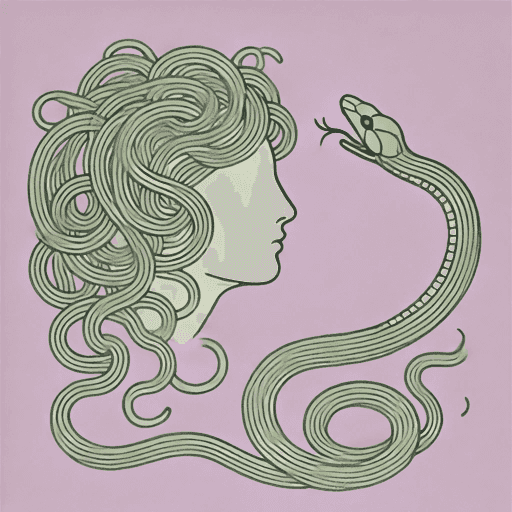
I, Medusa
66 pages • 2-hour read
Ayana GrayI, Medusa
A modern alternative to SparkNotes and CliffsNotes, SuperSummary offers high-quality Study Guides with detailed chapter summaries and analysis of major themes, characters, and more.
Part 4-EpilogueChapter Summaries & Analyses
Content Warning: This section discusses rape, sexual assault, death, graphic violence, enslavement, and gender discrimination.
Part 4: “Monster”
Part 4, Chapter 29 Summary
Meddy escapes into the gardens, crying with grief over Theo. He is the only one who offered her help, and she inadvertently turned him to stone with her gaze. Despair fills Meddy as the black snakes growing from her scalp bite her, drawing her red, mortal blood.
Euryale and Stheno come looking for Meddy. Meddy warns her sisters not to look at her, since her gaze can petrify them, but her sisters tell her they have suffered a similar fate. Meddy looks up to see Euryale and Stheno transformed, just like her. After Meddy ran out, her sisters chastised Athena. The vengeful goddess punished them as well. Phorcys and Ceto fled the spot and have probably gone into hiding.
The sisters sit together, Meddy apologizing repeatedly for bringing a terrible fate upon Euryale, Stheno, and their parents. Euryale and Stheno console Meddy, asking for the full story about her and Poseidon. As the truth spills out of Meddy, she expects her sisters to blame her. However, Euryale and Stheno show Meddy how the fault lies with Poseidon: The much-older god disguised himself as a boy to win Meddy’s confidence and manipulated her into falling in love with him. Then, that night, Poseidon ignored Meddy’s reluctance and continued to have sex with her even though she was drunk and disoriented. Meddy also learns that Poseidon lied to her about his marriage to Amphitrite. The match was not arranged—he chased the unwilling daughter of Nereus across the seas until she agreed to wed him. Suddenly, the truth about Poseidon becomes clear to Meddy.
As Stheno’s serpents try to bite her, Stheno grabs one and uproots it casually from her head, killing it. The other serpents immediately grow subdued. Stheno tells Meddy that the serpents, and even the petrifying gaze, can be controlled, if Meddy chooses to assert power over them. Taking the cue from Stheno, Meddy plucks out one of her own snakes. The hissing of the other snakes subsides.
Her sisters show Meddy Theo, whom they have respectfully placed as a statue in a sheltered corner of the gardens.
Part 4, Chapter 30 Summary
Most denizens of the islands flee after Athena’s curse, leaving it to the three sisters. As the weeks pass, Meddy learns the nuances of her condition. She can now control her gaze, choosing when to turn her eyes yellow and petrify someone. Meddy also finds Athena’s curse has given her greater speed and keener senses, though she remains mortal.
A consequence of her parents leaving the island is that its protective enchantments have lifted, making it easier for mortals to find. One day, the sisters spot a boat filled with men approaching the shore. On Stheno’s instructions, they cover their heads and go to the beach with food, acting modest. The captain, whose name is Linus, disembarks and asks for the man who rules the island. When Stheno tells Linus that the island is home only to the three sisters, Linus senses an opportunity to exploit it. He asks the women if his crew can camp on the island for the night. Stheno agrees.
Linus and his men feast with the sisters, offering them gifts from their travels. When Linus tells the sisters he plans to claim the island and found a kingdom called Linusia, Stehno warns him the island is not his for the taking. An angry Linus insults Stheno and attempts to grab her. Stheno uncovers her head, Euryale and Medusa following suit. Stheno turns Linus to stone. The crew runs towards their boat, trying to flee. Stheno and Euryale follow, petrifying the men. Medusa feels conflicted about killing the crew members at first, but knows she must take power for her own. The sisters leave a single crew member alive so he can return and warn others about the island.
Part 4, Chapter 31 Summary
The sisters had expected that the crew-member’s account about their island would deter others from seeking it. However, in the wake of the incident, more and more ships arrive at their shores, lured by the promise of a land they can easily seize. As a consequence, Stheno, Euryale, and Meddy have to kill and petrify many men. Meddy notes that in time, Stheno and Euryale turn cruel with their power, dashing the petrified men to smithereens on the cliffs of the island. Meddy usually refrains from such displays.
One day, Meddy is alone on the shore when a youth pulls in his raft. He tells Meddy that he has come to the island to slay the Gorgons (the name Meddy and her sisters have chosen for themselves). Meddy tries to dissuade the youth, but when he persists, she removes her head-covering and reveals herself as one of the Gorgons. Instead of turning the young man to stone with her gaze, Meddy engages him in battle. When the boy knicks her arm with a dagger, Meddy prepares to petrify him, but spots him wearing an owl-shaped pendant, and is reminded of Glaukopis and Athena. She feels pity for the young man and asks him to flee the island.
The boy starts to turn back, but Stheno and Euryale arrive on the scene and turn him to stone. They admonish Meddy for pitying the youth who sought to kill her, reminding Meddy that all men have the potential to be cruel. Sparing a man on the off chance that he may be decent is pure folly.
Part 4, Chapter 32 Summary
Meddy turns 18. Three months after the incident with the boy, yet another ship docks at the island. As the crew members trickle in, Meddy notices a young woman trailing behind the leader. The woman is Appolonia, her thick brown hair cut short. Before Meddy can speak to Appolonia, the leader, Sobekemsaf, makes an offer to Stheno. Fully aware of the power of the sisters, Sobekemsaf wants them to slay his unsuspecting enemies, whom he will send to the island, in return for food and riches. Unwilling to become a hired assassin for anyone, Stheno refuses Sobekemsaf’s offer. A thwarted Sobekemsaf tries to return to his ship, but Stheno kills him by slicing his throat. Euryale and Meddy finish off the rest of the crew, save Appolonia.
Meddy and Appolonia reunite. Appolonia tells Meddy her story. After being dismissed from the temple, Appolonia went to her father for help. Her father cast her out of his home, blaming Appolonia for “shaming” their family. He cautioned her brothers against helping her. Shunned by her family, Appolonia was forced to beg to survive, till Sobekemsaf, the well-known merchant from Alexandria, sent an offer for work on his ship. Appolonia accepted, assuming Sobekemsaf wanted her to work as a scribe. However, Sobekemsaf enslaved Appolonia by forcing her into sex work in exchange for food and money. Meddy’s heart aches for Appolonia. She embraces her friend, promising Appolonia that she is now safe.
Appolonia shifts into Meddy’s room, unable to sleep alone because of her nightmares. Over time, she and Meddy become lovers, their lovemaking tender and considerate. Appolonia tells Meddy that she does not like the indiscriminate killings of Meddy and her sisters. Appolonia fears the hatred and anger will corrode Meddy. She thinks she and Meddy should leave the island.
Meddy feels torn by Appolonia’s suggestion. Alone with Euryale and Stheno, Meddy asks them if they ever feel like leaving the island. The sisters are content with their lifestyle, partly because they are immortal and have infinite time. Meddy realizes she does not have the same luxury and must make her choices urgently. She returns to Appolonia and asks her to pack their things so they can leave the island the next day.
Part 4, Chapter 33 Summary
Meddy and Appolonia sneak out in a boat early in the morning, without bidding farewell to Meddy’s sisters. Meddy prays that Stheno and Euryale will one day understand her reasons for leaving. She and Appolonia are seaborne for several days before alighting on the shore of Cyrene, close to Egypt.
In Cyrene, Meddy and Appolonia find work managing an old widow’s tavern in exchange for food and lodging. Their days fall in a predictable rhythm, the women enjoying each other’s company. Meddy misses her sisters but tells herself that her new life is in Cyrene.
Things change dramatically when a distraught woman called Ephemia brings news that her 15-year-old unmarried daughter is pregnant, after the priest of Athena’s temple coerced her into sex. The priest often preys on needy young women who don’t have money to make an offering in exchange for his prayers. While Appolonia offers to help terminate the pregnancy through herbal remedies, Meddy is filled with a seething anger against the priest.
Alone with Appolonia, Meddy tells her she wants to kill the priest to protect the city’s girls. Appolonia protests that Meddy is bound to be discovered and executed. She begs Meddy to stop. Meddy lies to Appolonia that she has abandoned her plans.
Part 4, Chapter 34 Summary
That night, Meddy secretly mixes Melissa leaf, a powerful sedative, in Appolonia’s food. Appolonia falls into a deep slumber after dinner. Meddy leaves her and goes to the temple of Athena on the shore. The narrative converges with the scene in the Prologue.
After Meddy turns the abusive priest to stone, she drags out his statue so she can push it into the water. However, three young men on the beach see her, the serpents on her hair uncovered. Meddy can kill the men to protect herself but decides against it. Since the boys are bound to report their sighting of a monster to the king, Meddy knows the king will send soldiers for her and Appolonia. The only way to protect Appolonia is for Meddy to flee Cyrene.
Meddy finds a boat and rows away. She drifts in the sea for several days, overcome by hunger and thirst. Meddy finally pulls into her island, only to be greeted by Athena, sitting on a rock.
Part 4, Chapter 35 Summary
Meddy goes to Athena, fighting her exhaustion, and asks the goddess what she wants. Athena tells Meddy she knows all about her exploits, from aiding the ex-acolyte Appolonia to seducing and killing the priest in Cyrene. Although Meddy’s actions are ghastly, they prove to Athena that she was not wrong about Meddy. Athena always knew Meddy had powerful rage within, which Athena thinks is a beautiful thing. Even though Meddy disappointed her by her “deviance” (446), Athena thinks Meddy can still be useful to her.
Meddy is softened by Athena’s veiled praise, but is brought back to reality when Athena describes Poseidon’s sexual abuse as Meddy’s “deviance.” She tells the goddess that the abuse angered Athena only because she saw Meddy as her property, which Poseidon had “despoiled,” and that Athena never cared for Meddy. Athena does not refute the allegation, but tells Meddy she can give her a new purpose. Instead of her priestess, Meddy can be her tool of vengeance, travelling the world with Athena to punish her enemies. Meddy rejects the offer. An incensed Athena tells Meddy that the refusal has invited Meddy’s own cruel death, and leaves.
After Athena departs, Meddy spots Maheer’s lion on the shore. She nears the animal, nearly touching its nose, but stops herself. Feeling a kinship with the lion, Meddy says it is not a monster, but only what others made him. Meddy reunites with Stheno and Euryale, who are overjoyed to have their sister back. As time passes, Meddy participates less often in the killings, spending more time in the palace. Though she misses Appolonia, she also feels content on the island, excited to learn what her next purpose will be.
Epilogue Summary
Sometime in the future, Euryale enters Meddy’s chambers at dawn and finds her sister slain, her head severed from her body and taken away. Euryale wails so loudly the walls crack. Stheno’s grief erupts as anger and she uproots the island’s trees with her sheer power. The sisters know who murdered Meddy: The hero who is “a favored champion of the gray-eyed bitch” (451) Athena. (The champion in question refers to Perseus, patronized by Athena, but the novel chooses not to name him).
All the Olympians helped the cowardly champion slay Meddy, with Hermes giving him winged sandals, Hephaestus gifting him a sword, and Athena bestowing him her bronze shield. The champion snuck into Meddy’s room and killed her in her sleep, but will boast of his valor. Meddy’s head will be mounted on his shield “like some obscene prize” (452). Stheno and Euryale cannot stand the injustice. They decide to seek out their sister’s head.
Stheno and Euryale travel the world, turning thousands of men to stone, to look for Meddy’s head, but never find it. In the end, they return to their island. Time passes and the old gods begin to fade, including Zeus and Athena themselves. Stheno and Euryale remain young women forever on their island, watching in silence as Meddy’s story is corrupted and lost over the ages. However, they remember the true story, and that is sufficient.
Part 4-Epilogue Analysis
While Medusa’s physical transformation is a key plot point, the most important turning point is Medusa’s internal reinvention, speaking to Survival and Identity Forged Through Resistance. In traditional accounts, Medusa becomes a dreaded monster and is subsequently decapitated. In the novel, Medusa comes to term with her curse, reclaims her agency, and refuses to let Athena weaponize her. At a metatextual level, Gray’s Medusa resists traditional narratives that cast her as a villain or a monster. Instead, Medusa uses resistance to forge her individual self.
The first step of this resistance is seeing herself through her own eyes. Others may term Medusa a monster or an abomination, but she does not need to accept the definition, as Stheno tells Medusa in Chapter 29. Stheno and Euryale help Meddy see she is more than the roles in which she has been cast, whether mortal, maiden, mistress, or monster. They particularly unpack the label of “mistress,” helping Meddy see that her relationship with Poseidon was actually an act of deliberate manipulation and exploitation. Meddy experiences the truth “like pieces from a broken vase […] coming together with terrible satisfaction” (379). She uses a marine metaphor for Poseidon’s treachery, the god making her trust him till she became dependent on him and then letting her “drown” (379). Once Meddy sees through Poseidon, she is flooded with relief and vindication.
However, the narrative takes an intersectional approach to violence and resistance, with Meddy asking herself if all men are the same, irrespective of class and race. Meddy wonders if Linus’s “lowly crewmen” (391) are as complicit in the island’s plunder as their leader, or if they are merely exploited workers. Although Meddy participates in the killing of the men, she is never wholly convinced that all men are equally evil. Thus, Meddy even resists her sisters’ version of reality, showing her innate empathy for others and her reluctance to harm people who may not have done anything to deserve it.
The narrative conflates Meddy’s epiphany with her realization that her monster-status is liberating, invoking The Construction of Monstrosity to Silence Survivors. Officially outside the bounds of the mainstream, Meddy is free to break whichever rules she pleases. Being a monster is not a wretched state, but a reclamation of power. This reclamation plays out as a form of female rage, with the sisters killing all the men who alight on their island. The men are opportunistic, eager to colonize the body of the land as well as the bodies of the sisters, as seen in the case of Linus, who wants to name the island “Linusia […] a kingdom to rival the world’s greatest” (390). Since the men are so clearly covetous, murdering them becomes an act of righteous, purifying rage and self-defense.
Gray chooses to end Meddy’s first-person narrative with her return to the island and a state of relative contentment. Having resisted Athena’s attempts to manipulate her, Meddy finally feels like the master of her own destiny. Ending Meddy’s telling on a hopeful note is an act of reclaiming narrative agency from patriarchal myth, as is the narrative’s refusal to name Perseus, the killer of Medusa. The Epilogue shows how monsters are made and can be unmade. Perseus’s decapitation of Medusa illustrates how the Olympians get together to arm him because they want to see Medusa silenced. In Medusa’s telling, the Olympians are the true monsters, which is why they think she needs to be disembodied, co-opted as a head in the dominant tradition. The Olympians may try to claim Medusa, but Stheno and Euryale unmake the myth of the monster.
By refusing to name their sister’s killer, the sisters center the narrative of the Epilogue on Medusa. Even Stheno and Euryale’s revenge is framed as a quest for their sister’s head, rather than a hunt for the ignoble man who killed her in her sleep. They further reclaim narrative agency by asserting that the real Meddy is alive in their telling, since they are immortal. This is a metatextual comment on Gray’s novel itself, which presents a counter-narrative to the patriarchal myth of the monster, transforming her from a villain into a powerful heroic figure.

Unlock all 66 pages of this Study Guide
Get in-depth, chapter-by-chapter summaries and analysis from our literary experts.
- Grasp challenging concepts with clear, comprehensive explanations
- Revisit key plot points and ideas without rereading the book
- Share impressive insights in classes and book clubs