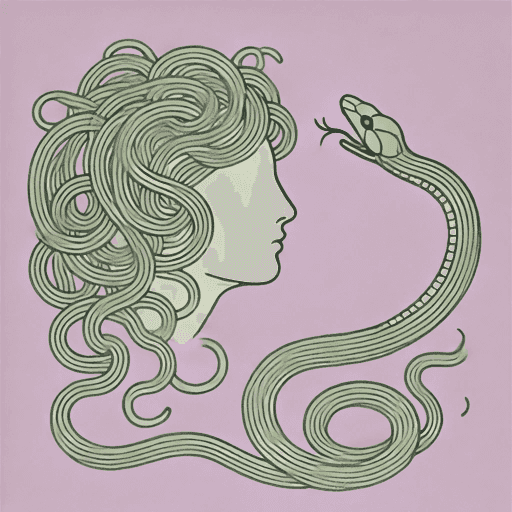
I, Medusa
66 pages • 2-hour read
Ayana GrayI, Medusa
A modern alternative to SparkNotes and CliffsNotes, SuperSummary offers high-quality Study Guides with detailed chapter summaries and analysis of major themes, characters, and more.
Prologue-Part 1Chapter Summaries & Analyses
Content Warning: This section discusses sexual assault, child abuse, child sexual abuse, domestic violence, enslavement, and gender discrimination.
Part 1: “Mortal”
Prologue Summary: “After”
Medusa approaches the temple of Athena on the beach in Cyrene, her hair hidden in a wrap. She notes that unlike the grand shrine in Athens, this small temple is unassuming, nearly hidden behind sand dunes. An elderly priest sweeps the temple courtyard, his paternal look reminding Medusa of her own father.
As the older man looks up, Medusa tells him she seeks a blessing but has no coin to offer in return. Replying there are other ways to pay him back, the priest closes in on Medusa, his paternal look now replaced by a lascivious expression. The priest pulls Medusa on top of himself on the ground, expecting her to have sex with him. Medusa looks down into the priest’s eyes and tells him she wants to show her true self. She removes her head-wrap, exposing the serpents coiled around her scalp. The priest barely has time to call her an abomination before he is petrified. Medusa gets up and reflects on how she came to be an abomination, a monster.
Part 1, Chapter 1 Summary
Told in her first-person voice, the narrative flashes back to Medusa’s girlhood. Medusa recalls the beginning of her journey to becoming a monster. She is 17 when her parents throw a feast for the Gods of the Sea Court, hoping to attract suitors for Medusa, and her older sisters, Stheno and Euryale. Medusa’s mother and father, Phorcys and Ceto, are primordial sea deities, who lost most of their former power and glory since the rise of the Olympian pantheon headed by Zeus. Unlike Stehno and Euralyle, Medusa was born a mortal, a truth she can never forget.
In the present moment, Ceto bids Medusa, nicknamed “Meddy,” to practice her dance steps for the performance before the gods. Meddy feels she cannot keep step with the more-graceful Stheno and Euryale, and she looks to them for help. When Euryale suggests to Ceto that they take a break, a drunk Ceto hits her with a wine goblet in anger. Golden ichor flows from Euryale’s wound.
Being an immortal, Euryale heals quickly, but Meddy can sense her deep anger toward her mother. Ceto apologizes to Euryale and leaves. As Meddy and Stheno comfort a weeping Euryale, Euryale vows to find a husband soon so she can leave their island forever.
Afterwards, Meddy meets her beloved friend Theo, a servant in the palace. Theo and Meddy share a love for scrolls and maps that wash ashore and have taught themselves to read from the documents. The friends dream of leaving the lonely island they inhabit.
Part 1, Chapter 2 Summary
The night of the banquet, Meddy and her family await the Sea Gods at the table. Meddy reflects that even though Phorcys has a palace, he is no longer a king. Finally, the visitors arrive, and the sisters are bidden to perform the welcome dance they have been practicing. To her surprise, Meddy finds herself dancing effortlessly, feeling graceful.
The musicians pause at the arrival of an unexpected, important visitor: Poseidon, the Olympian God of the Sea, the deity who presides over all the watery courts. As the other guests defer to Poseidon, Meddy notes the power he exudes. Phorcys introduces his daughters to Poseidon. Poseidon’s eyes seem to linger on Meddy. Later, Meddy has an uncomfortable conversation with Poseidon’s wife, Amphitrite, suspecting Amphitrite may have noticed Poseidon’s seeming interest in Meddy. Amphitrite is the daughter of Nereus, an old sea god who is kin to Meddy’s family. Like Meddy, Amphitrite is beautiful and brown-skinned, with lush locs.
Feeling claustrophobic at the crowded banquet, Meddy leaves the hall to get some air and runs into Theo. Being with Theo calms her. As they take a walk, they come across Poseidon having sex with a sea nymph in a garden (though Meddy does not understand the concept of sex at this stage). A hidden Theo and Meddy watch the couple and then leave quietly.
Part 1, Chapter 3 Summary
Over a month after the banquet, Stheno and Euryale braid Meddy’s locs in an elaborate hairdo: Meddy has beautiful locs, which her sisters have always tended lovingly. The sisters are preparing for the arrival of Prince Maheer, an illegitimate demigod son of the Olympian God Ares. Maheer intends to choose one of the sisters for his bride. Since Maheer is set to inherit a wealthy island in Aethiopia and has Olympian ancestry, he is considered a favorable match by Ceto and Phorcys.
Maheer arrives with a lion, whom he has trained to follow his commands, as a present for Phorcys. Maheer inspects Meddy and her sisters and chooses Euryale. At first, Meddy is excited about the upcoming wedding, but the pragmatic, honest Stheno tells Meddy that she suspects Maheer is a cruel man. His servants seem afraid of him, and Stheno fears Maheer fed some of them to the lion on the long sea-journey to their island. Meddy is filled with a sense of dread.
Part 1, Chapter 4 Summary
The next day, a worried Meddy takes a walk on the shore to clear her head. Euryale comes looking for her. When Meddy tells Euryale that she does not have to marry Maheer, Euryale tells her sister that the marriage is her way out of the oppressive clutches of their parents.
Meddy notices a rip in the neckline of her sister’s dress and a cut on her skin; Euryale confesses that Maheer hit her the previous night when she refused to have sex with him. Though Meddy is horrified, Euryale is pragmatic about the situation, claiming that she can put up with Maheer’s excesses in return for a life as his queen.
Part 1, Chapter 5 Summary
Fearing for Euryale, Meddy decides to bribe Maheer to leave her sister alone. Meddy steals two precious gemstones from her mother’s coffers and secretly enters Maheer’s chambers, armed with Theo’s knife for protection.
Maheer, who has been drinking, offers Meddy wine as well. She gives the gemstones to Maheer, asking him to return to his island so Euryale is not separated from her family. Maheer rejects the gems and makes a crude sexual advance at Meddy, telling her he likes her extreme youth and will now take Meddy as his wife as well. As Maheer pounces on Meddy, she strikes him with a goblet. A dazed Maheer stumbles around, hits his head against a table, and slumps to the floor, dead.
Meddy flees the room, forgetting that she has left behind the gemstones and Theo’s knife.
Part 1, Chapter 6 Summary
Maheer’s body is found by enslaved persons the next morning. At first, everyone assumes his death was an accident, the king fatally hitting his head in a drunken stupor. To Meddy’s surprise, Euryale seems upset by Maheer’s death. She realizes Euryale is mourning the freedom marriage would have offered her. Later, Stheno coaxes a confession out of Meddy. Meddy reveals the truth to her oldest sister, with Stheno sternly directing her to repeat it to no one else.
Trouble arrives the next day in the form of Athena, one of the most powerful Olympian Gods. Athena tells Phorcys that since Maheer was a son of Ares, Zeus himself has commanded her to investigate his death. Phorcys gives the Goddess unfettered access to his island and its inhabitants for her investigation, a move which upsets Ceto. Ceto seems to have an ancient enmity with Athena.
Later, Theo meets Meddy to express his worries that he will be unfairly blamed for Maheer’s death. A knife has been discovered in Maheer’s chamber, which sounds like one Theo lost. Meddy realizes her mistake in leaving the stolen knife behind and vows to herself to protect Theo.
Part 1, Chapter 7 Summary
Gathering her courage, Meddy confesses her role in Maheer’s death to Athena. To Meddy’s surprise, Athena finds her admission admirable and forgives her. Athena questions Meddy about her interests, pleased to know that Meddy has taught herself to read in four languages.
Calling Meddy valorous and intelligent, Athena makes an unusual proposal: Meddy should train to be a priestess in her temple at Athens. If Meddy accepts, she will enroll at the temple as an acolyte, training to pass a series of rigorous qualifying tests. Meddy’s heart swells at receiving the great honor, and she gladly accepts Athena’s offer.
Part 1, Chapter 8 Summary
After telling Phorcys that Maheer’s death has been deemed an accident, Athena leaves the island, promising to send for Meddy. Though Phorcys agrees to Meddy’s initiation in Athens, Ceto is livid at her husband for accepting Athena’s offer. Ceto admonishes Phorcys at the dinner table, accusing him of “selling” their daughter to the Olympians. Phorcys counters that he cannot risk offending Athena, Zeus’s favorite daughter.
The argument escalates, with Phorcys reminding Ceto that his decisions should not be questioned as he is “the lord and master” (109) of his household. When Ceto holds her position, Phorcys strikes her repeatedly. Meddy and her sisters shut their eyes in terror as Phorcys picks up Ceto by the throat, nearly strangling her before he throws her to the ground. Meddy and her sisters exit the dining hall, Ceto sobbing on the floor.
Later that night, Ceto visits Meddy in her bedchamber to warn her against Athena. Athena may appear wise and brave, but like the other Olympian gods, she cannot be trusted. When Zeus threw down the Titans, he gathered the old gods of the sea court under his brother Poseidon, promising them that they would retain their powers. The promise was false, because within a few centuries, the old sea gods, like Phorcys and Ceto, were stripped of all their powers. Worse, Zeus and the Olympians slayed the Giants—the children of Gaia, like the Titans—in a great war called the Gigantomachy. Athena was by Zeus’s side, mercilessly killing the Giants and other so-called monsters, removing all threats to her father’s throne. Since then, the Olympians have dominated the world order.
Meddy still cannot understand why Ceto would hate Athena, since the Giants have nothing to do with their family. Ceto remains evasive on the subject and leaves, warning Meddy that the worst monsters are those who don’t bother hiding in the dark.
Part 1, Chapter 9 Summary
On the day of Meddy’s departure, Euryale helps her dress in a silver-gray tunic. Touched by her sister’s kindness, Meddy tells her the truth about Maheer’s death. Euryale is angry at Meddy for interfering and reminds her that she never needed her younger sister to protect her. Meddy asks Euryale for forgiveness, but Euryale stays silent. Stheno gifts Meddy a necklace made of a single white seashell on a leather cord. The sisters say their goodbyes. Meddy bids farewell to Theo as well.
Phorcys accompanies Meddy to the shore, where Athena’s courier will be arriving to take Meddy to Athens. Phorcys asks Meddy to conduct herself well at Athens, since she will be representing all the Gods and Goddesses of the Sea Court. He also warns Meddy about revealing her divine origins to mortals, since mortals are jealous and fickle.
After Phorcys leaves, Hermes, the messenger God, descends from the sky to take away Meddy. She grabs his outstretched hand and together they soar upwards.
Prologue-Part 1 Analysis
Medusa’s first-person narrative is book-ended by the Prologue and Epilogue told in the third-person voice. The juxtaposition establishes Medusa both as an individual existing in her own timeline, as well as a figure situated outside time. Even though Medusa-the-character is mortal, the frame establishes that her legend is perennial. Further, the juxtaposition between Medusa’s first-person telling and the framing invites readers to consider the tension between lived reality and legend. For instance, even though Medusa is a violent, avenging figure in the Prologue, the predatory priest who drops his fatherly mask comes across as even more sinister. The depiction of the priest and Medusa raises questions around the selective branding of “monsters” in myth and legend, introducing the theme of The Construction of Monstrosity to Silence Survivors.
This dual depiction of Medusa is also mirrored in the contrast between her nickname, “Meddy,” and the name of the legend, Medusa, with the diminutive form of the name seeking to emphasize Meddy’s innocence and youth. The adolescent experiences of Meddy flesh out the girl and woman behind Medusa the “monster.” By giving Meddy a voice, author Ayana Gray highlights the text’s central subject of reclaiming narrative agency from patriarchal myth. In popular depictions, Medusa is most often represented as a severed head on the shield of Athena, a tool to petrify the enemies of the gods. As a severed head, Medusa has no voice or body, and becomes most “useful” only after she is rendered immobile and silent. The narrative choice of depicting her first-person voice thus reclaims her narrative agency and offers a retelling of the myth from Medusa’s own perspective.
Patriarchal violence is ubiquitous in the text, offering a feminist commentary on how the Greco-Roman myths are replete with instances of rape depicted as ravishment or abduction. The novel depicts a highly misogynistic society where violence against women is normalized and used to silence and limit women. The priest’s harassment of Medusa in the Prologue prefigures Maheer’s assault of Euryale and Medusa. Even Poseidon’s sexual encounter with the nymph—seemingly consensual—has a sinister undertone, as Meddy has just met Poseidon’s wife at the feast, a circumstance that draws attention to the god’s infidelity.
Meddy’s father Phorcys also oppresses his daughters, forcing them to appear before suitors as if they were prize livestock. Meddy knows that if she and her sisters don’t comply, they will suffer violence. On the shore waiting for Maheer, the smile on their father’s lips “is placid, but it doesn’t quite reach his eyes. I hear the unspoken threat behind it. Disgrace me, and you will suffer” (49). Their mother is also abusive, lashing out both physically and emotionally against her daughters while also experiencing domestic violence at the hands of her husband, Phorcys. The narrative thus depicts patriarchal violence as systemic, posing a threat both within the divine hierarchy of the ancient world and in the household dynamics that grant the father and husband total control over his dependents.
The narrative also describes Medusa and her sisters as brown-skinned women with locs, thus adding another layer of disenfranchisement to her depiction. Medusa’s depiction contrasts with the portrayal of the Olympian gods, most of whom are lighter skinned than Medusa and her family. The seizure of power by the Olympian Gods can be seen as an allegory for Eurocentric powers trying to subsume the agency of people of color.
Poseidon, the ruler of the sea courts, invokes the symbolism around the sea in the text, while his lurid interest in Meddy introduces the theme of The Insidious Role of Manipulation in Power Dynamics. Poseidon holds the “natural lure” (25) and power of the sea, but his hidden motives and manipulation represent the sea’s fickleness, its disregard of human life. From the outset, Poseidon seeks to control the emotions of the young Meddy, making her “bones hum under his gaze” (27). While Meddy believes she is spontaneously attracted to Poseidon, the narrative makes it clear that Poseidon deliberately baits her attention, singling her out with his gaze and gestures to make her feel special. Unlike Maheer, Poseidon does not abuse Meddy outright; instead, he coaches her into a trusting relationship so he can easily exploit her. Significantly, the text also examines grooming in a non-sexual context, as in the case of Athena and Meddy. Athena, too, wins Meddy’s trust so she can use Meddy as a weapon in the future. Again, she makes Meddy feel special—playing on Meddy’s insecurities as the only mortal in her family—and draws her into her orbit.
Ceto’s warnings offer an important alternative perspective on the Olympians, with Ceto’s mistrust of the Olympians foreshadowing the fate of Medusa. Since Ceto is a primordial female deity, she represents an earlier, matriarchal order, which the Olympians, and her own husband Phorcys, have tried to suppress. The old order persists in women’s memories and stories. An example of this memory is Ceto’s narration of the Gigantomachy, the great battle between the Giants and the Olympian Gods. Though the Olympians portray the battle as their successful restoration of the threatened world order, Ceto shows Meddy how it was actually a war to brutally take down the children of Gaia, the earth mother, and Uranus. Athena, who symbolizes wisdom and justice, “killed gleefully, brutally, without mercy” (116) during the great war, hunting down the enemies of Zeus to uphold the patriarchal order. Ceto’s warning note about Athena also establishes the textual dichotomy between supposed and real monsters, with the “real” monsters thriving in the open.

Unlock all 66 pages of this Study Guide
Get in-depth, chapter-by-chapter summaries and analysis from our literary experts.
- Grasp challenging concepts with clear, comprehensive explanations
- Revisit key plot points and ideas without rereading the book
- Share impressive insights in classes and book clubs