I, Medusa
66 pages • 2-hour read
Ayana GrayI, Medusa
A modern alternative to SparkNotes and CliffsNotes, SuperSummary offers high-quality Study Guides with detailed chapter summaries and analysis of major themes, characters, and more.
Summary and Study Guide
Overview
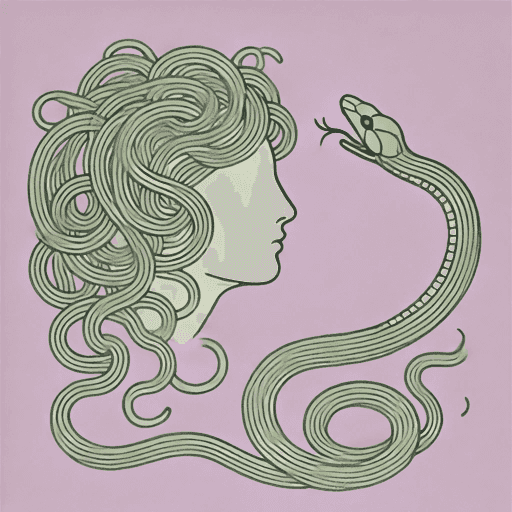
I, Medusa (2025) is Ayana Gray’s feminist reimagining of the Medusa myth, narrated by Medusa herself as she recounts her life before and after her transformation from a mortal girl into the infamous Gorgon. The novel reframes the classical story as one about power, violation, and the consequences of divine cruelty, positioning Medusa not as a monster but as a survivor whose voice has long been silenced. The novel examines The Construction of Monstrosity to Silence Survivors, The Insidious Role of Manipulation in Power Dynamics, and Survival and Identity Forged Through Resistance.
This guide uses the 2025 Kindle version of the book.
Content Warning: The source material and this guide contain depictions of rape and sexual harassment, domestic violence, emotional and physical abuse, child sexual abuse, racism, enslavement, gender discrimination, sexual content, and pregnancy termination.
Language Note: The names “Medusa” and “Meddy” are used interchangeably throughout the guide, as in the novel.
Plot Summary
Seventeen-year-old Medusa (“Meddy”) lives on an unnamed island with her sisters, Stheno and Euryale, and their parents, the sea-gods Phorcys and Ceto. Once mighty deities, Phorcys and Ceto are shadows of their former glory, their power depleted by the Olympian gods. All the courts of the sea now accept the rule of Poseidon, the trident-bearing sea-king and brother of Zeus.
Torn between the patriarchal authority of Phorcys and the mercurial temperament of Ceto, Meddy often feels trapped on her isolated island. She also worries about her mortality, which sets her apart from the rest of her family. At the same time, as the youngest of three sisters, Meddy is sheltered from the vicissitudes of the larger world. Meddy finds a sanctuary in her loving sisters and her best friend, Theo, a servant at Phorcys’s palace.
The first rumblings of trouble begin when Phorcys invites various gods and princes for a grand banquet, hoping to attract suitors for his daughters. At the banquet, Meddy seems to catch the eye of the married, much-older Poseidon, though Poseidon later feigns to ignore her. When Maheer, the demi-god son of Ares, the god of war, chooses Euryale as a bride, Phorcys is overjoyed. However, it is soon apparent that Maheer has a cruel streak, striking Euryale when she refuses to have sex with him. Worried for her sister, Meddy approaches Maheer to bribe him to leave the island. Her plan backfires when Maheer attempts to assault her. In the ensuing skirmish, an inebriated Maheer hits his head on a stone table and dies.
Meddy flees the room, hoping the death is deemed an accident. However, since Maheer was a son of Ares, Athena, goddess of wisdom and Zeus’s favorite daughter, arrives at the island to investigate the death. Since the crime is likely to be pinned on Theo, Meddy confesses the truth to Athena. Athena is impressed by Meddy’s courage and invites her to be an acolyte at her temple in Athens. Phorcys agrees to send Medusa to the city, but Ceto is enraged at the prospect. She warns Meddy to beware of the Olympians, since Athena is not as just as she seems.
In Athens, Meddy forges a friendship with Appolonia, the daughter of a high-born family. Meddy is also bullied for her “metic,” or foreigner status, and her locs by the acolyte Kallisto. When Meddy punishes Kallisto by frightening her with a non-venomous snake, Appolonia warns Meddy against indulging in her retributive streak.
Meddy passes the first two tests to be a high priestess, winning the appreciation of Athena. She soon discovers that Athena’s temperament is unpredictable when she strays into Athens without permission to rescue the owl that is the goddess’s sigil. Athena upbraids Meddy for breaking her rules; Meddy apologizes profusely, promising to follow the temple’s decorum.
What Meddy does not tell Appolonia or Athena is that she has met a young man her own age in Athens. The youth always seems to materialize whenever Meddy has a problem, helping her out or walking her back to the Acropolis, where the temple is located. Meddy often confides in the young man, deeming him a friend. At the festival of Panathenaia in Athens, Meddy and Appolonia participate in the revelries, dancing and drinking wine. Meddy gets separated from Appolonia, finds herself in a dangerous situation, and is rescued by the youth, who reveals himself to be none other than Poseidon.
Poseidon tells Meddy that he disguised himself so he could keep an eye on her, a daughter of the sea-court. He compliments Meddy on her courage and beauty, deeming her special. Meddy feels ecstatic at the great god’s appreciation of her, but her euphoria turns to horror when she finds Appolonia missing from the Acropolis the next morning. She finds Appolonia at the temple’s gates, injured. It is clear Appolonia was raped by soldiers the previous night. Meddy believes the soldiers will be punished for their crime, but instead, Appolonia is blamed for compromising herself and banished forever from the temple. Meddy bristles at the injustice, but Athena convinces her that ousting Appolonia was necessary.
As Meddy passes the final test, she takes vows as a high priestess of Athena’s temple, promising to remain chaste. Meddy becomes known for helping the needy people of Athens, and she continues to meet Poseidon, who, in Appolonia’s absence, becomes her confidant. Meanwhile, a series of miracles is attributed to Meddy, gaining her a reputation as Athena’s favored priestess. An incensed Athena excoriates Meddy for playing god, and their relationship begins to sour. Poseidon reveals to Meddy that he worked the miracles as a favor to her. He confesses his attraction to Meddy and kisses her, but Meddy refuses him, reminding him of her vow of chastity. Poseidon leaves Meddy in a huff.
Excluded by both Athena and Poseidon, Meddy is glad to go to her island for an autumn feast, reuniting with her sisters and Theo. However, she continues to miss Poseidon, with whom she is infatuated. Meddy is thrilled when Poseidon appears at the banquet and seeks her out. Finding Meddy inebriated with Olympian wine, Poseidon seizes the opportunity to seduce her. Recalling her vows, Meddy asks Poseidon to wait, but the god ignores her and rapes her. Athena discovers the crime and grows enraged at Poseidon and Meddy, blaming Poseidon for “damaging” her priestess.
Athena drags Meddy before Zeus, demanding Poseidon be punished. Poseidon twists the story and claims it was Meddy who seduced him. Zeus believes Poseidon’s testimony and spares the god, leaving Meddy to Athena’s justice. Athena curses Meddy, turning her beautiful locs into snakes and giving her a petrifying gaze. Meddy accidentally looks at Theo and turns him to stone. Her terrified parents flee the island. Athena also curses Euryale and Stheno for defending Meddy.
Euryale and Stheno help Meddy see that her relationship with Poseidon was not consensual but an abuse of power and manipulation. They also tell Meddy that her petrifying gaze can be controlled. The three sisters take over the island, petrifying the opportunistic sailors who come ashore with the intent of seizing it. When Appolonia shows up at the island, enslaved by a sea-captain, Meddy reunites with her friend, learning that Appolonia’s father cast her out after she was barred from the temple. Meddy and Appolonia become lovers, eventually moving away to Cyrene to pursue a new life, Meddy keeping her hair hidden.
In Cyrene, Meddy learns of a temple priest’s exploitation of young women, and kills him, revealing herself. She flees Cyrene to protect Appolonia and returns to Stheno and Euryale. Athena accosts Meddy and offers an alliance, wanting to use Meddy’s powers to defeat Athena’s enemies. Meddy refuses Athena’s offer, and the goddess swears revenge. As Meddy’s narrative ends, she is at peace with her sisters, looking forward to the future.
In the Epilogue, Stheno and Euryale find Meddy beheaded in her sleep by Athena’s champion. The grieving sisters travel the world to find Meddy’s head but are forced to return to their island. The immortal sisters watch as millennia pass, and even Zeus and Athena’s power fades. Medusa becomes known in stories as a monster, but the sisters know her true, complex story, and that is enough.

Unlock all 66 pages of this Study Guide
Get in-depth, chapter-by-chapter summaries and analysis from our literary experts.
- Grasp challenging concepts with clear, comprehensive explanations
- Revisit key plot points and ideas without rereading the book
- Share impressive insights in classes and book clubs