I, Medusa
66 pages • 2-hour read
Ayana GrayI, Medusa
A modern alternative to SparkNotes and CliffsNotes, SuperSummary offers high-quality Study Guides with detailed chapter summaries and analysis of major themes, characters, and more.
Symbols & Motifs
Content Warning: This section contains discussion of rape and sexual harassment.
The Gorgonian Head and Meddy’s Locs
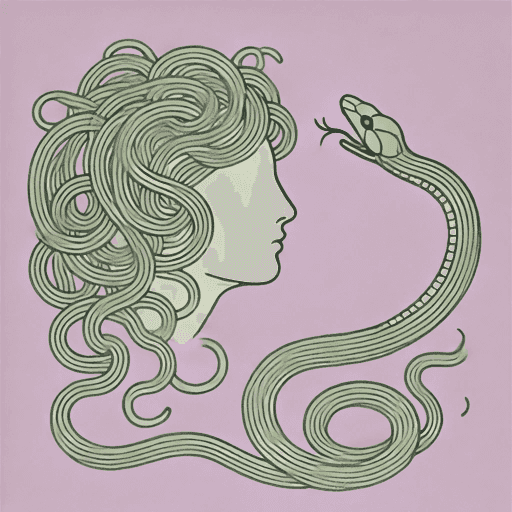
The Gorgonian head refers to an apotropaic symbol—a symbol to ward off evil—common in Greek culture, where the decapitated head of Medusa often featured on common objects. In such depictions, the Gorgonian head appears as a woman with snakes springing from her scalp, her mouth sometimes open in a scream, her tongue lolling out. While there are many interpretations of the Gorgonian head, it is often seen as symbol of both female rage and the male desire to curtail or demonize female power. By depicting the head as terrifying, female rage or power is immediately slotted as unnatural. The hair turned into serpents reflects the fear of women’s wild tresses, common across cultures. A woman’s uncovered or flowing tresses are often associated with unbridled sexuality and untamed power, while neat and bound hair suggest decorum.
In the novel, Meddy’s pride in her hair symbolizes her pride in her identity and selfhood. She and her sisters braid their locs in intricate hairdos, lovingly tending to each other’s hair. The fact that the priestesses ask Meddy to remove the golden cuffs from her locs symbolizes the dominant culture’s attempts to tame Meddy. Later, Kallisto exoticizes Meddy’s locs, making uncomfortable remarks about them. Meddy’s assertion of her boundaries to Kallisto signifies her resistance. In this context, the transformation of Meddy’s beautiful, prized locs into serpents represents Athena attempting to rob her of her identity as a free-spirited, brown-skinned woman. Meddy’s refusal to let the curse define her and tame the serpents which are now her hair indicates her continuing resistance against cruel institutions.
Owls
The text features strong animal symbolism, with owls representing both wisdom as well as intrusion. Meddy recalls that her wide-set, large eyes have been described as “owlish,” thus foreshadowing her connection with Athena and the bird which is her emblem. Later, Meddy warms up to Glaukopis, the regal, golden-eyed owl who belongs to Athena. Glaukopis readily perches on Medusa’s arm, signifying Medusa’s identification with Athena’s wisdom and shrewdness.
However, when Poseidon is assaulting Medusa, she notices owlish eyes watching her. The eyes remind her of her vow of chastity and jolt her awake, like the light of wisdom. At the same eyes, the watchful presence of the owl is intrusive, almost as if Athena keeps an eye on Medusa. This is later reinforced when Athena insinuates that she has seen Medusa and Appolonia make love. Thus, the owl emerges as a dualistic symbol, signifying both awareness and knowledge, as well as unwanted surveillance.
Maheer’s Lion
An important symbol, Maheer’s lion illustrates the theme of The Construction of Monstrosity to Silence Survivors. When Meddy first sees the lion, her response is fear at its large size and ferocious appearance. The fact that the lion has probably been fed on persons enslaved by Maheer adds to its monstrous aspect.
However, as Meddy’s own understanding of monsters evolves, she begins to view the lion differently. Meddy’s second encounter with the lion occurs on the shore of her island, before Hermes takes her to Athens. As the great animal approaches her, Meddy no longer feels afraid, but is “respectfully wary of the creature” (128). She is able to look beyond the lion’s “monster” façade. During her final meeting with the lion, Meddy realizes the active process that made the lion a monster. She now sees the lion as a survivor of the violence of men, fashioned as monstrous so its reality is silenced. Meddy identifies with the lion and moves closer to it. Significantly, the lion’s eyes are described as yellow, the same color as Meddy’s after her transformation. The fact that Meddy does not touch the lion’s nose shows her respecting its boundaries. She does not wish to treat the lion as a pet, the way Kallisto tried to treat her. Thus, the lion also symbolizes to Meddy her own self.
Transformation
Transformation is a popular trope in Greco-Roman myths and a key motif in the novel. Just as Medusa is transformed into a monster, the nymph Daphne changes into a tree to escape Apollo’s assault. After Tereus rapes his sister-in-law Philomela, he cuts her tongue to silence her, with Philomela ultimately transforming into a bird. As these examples show, transformation often serves a dual purpose, robbing the transformed of their human form, but conferring on them agency or respite in return. Medusa transformed can repel the lecherous male gaze with her own petrifying look, Daphne escapes Apollo’s oppression, and Philomela finds a voice of sorts. While these instances of transformation suggest that in an unequal, violent world women cannot be free in their own bodies, the women in these examples use transformation to assert themselves and exercise agency, speaking to Survival and Identity Forged Through Resistance.
Gods also use transformation on themselves differently, with the intent to deceive or manipulate. In the novel, Poseidon changes into a young man to win Meddy’s trust, while Athena disguises herself as a persecuted old woman to test her acolytes. Thus, transformation also symbolizes the treacherous power of the gods.

Unlock the meaning behind every key symbol & motif
See how recurring imagery, objects, and ideas shape the narrative.
- Explore how the author builds meaning through symbolism
- Understand what symbols & motifs represent in the text
- Connect recurring ideas to themes, characters, and events