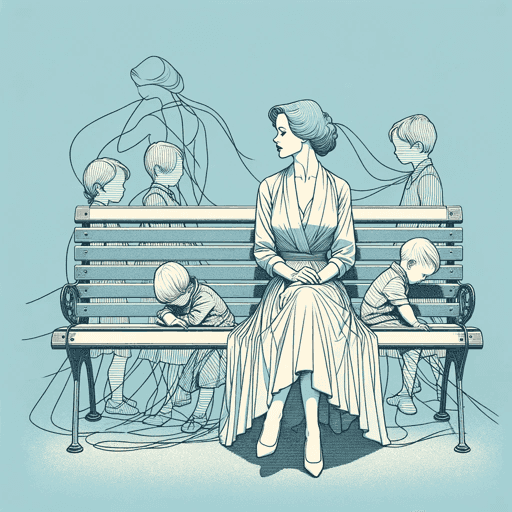
In The Park
In The Park
A modern alternative to SparkNotes and CliffsNotes, SuperSummary offers high-quality Study Guides with detailed chapter summaries and analysis of major themes, characters, and more.
Literary Devices
Form and Meter
“In the Park” is a sonnet with three stanzas. The rhyme scheme of the poem combines two types of sonnets: Shakespearean and Petrarchan. The first two stanzas follow the same pattern, while the third stanza changes. In the first two four-line stanzas, or quatrains, the rhyme scheme creates the pattern ABBA—the first and last lines rhyme, and the middle two lines rhyme. The third stanza has six lines that feature the rhyme scheme EFGEFG, rhyming lines nine and 12, ten and 13, and 11 and 14. All of the rhymes are precise.
Like all sonnets, Harwood’s poem has 14 lines and loosely features iambic pentameter, which is a pattern of unstressed/stressed syllables five times per line. Many of the lines throughout the poem end the thought and have periods. However, there are moments of enjambment, as the thoughts continue from one line to another. The most conspicuous example is from Line 4 to Line 5, moving from the first to the second stanza: “too late / to feign indifference” (Lines 4-5).
This consistency of form and meter establishes the theme of the poem: The woman is trapped in her maternal duties and cannot escape them. However, some formal inconsistency, such as the enjambment and loose meter, keeps readers guessing about the possible alternate futures for the woman—futures she briefly glimpses when she runs into an old love interest.
Imagery
Harwood’s poem incorporates imagery. Interestingly, the poem's visuals feature the woman and her immediate surroundings, not the actual details of the park, suggesting the poet’s and the woman’s narrow focus—nature, which poetry typically depicts at length, is here completely ignored. The only natural phenomena the woman registers are the wind, which she personifies and treats as a confidant, and the "flickering light" (Line 9)—a symbol of the fleeting moment of connection and the woman's fading chance to use the encounter with the man to build a bridge to her former self.
The poem's imagery primarily focuses on aspects of the woman that would be judged as lacking: Her clothing is “out of date” (Line 1) and her children’s misbehavior leaves her open to outside criticism. The other prominent use of imagery is aural: The children complain and fight—noise she later describes as "chatter" (Line 11), mixing it into the other sounds of conversation the poem describes. Tactile imagery appears with the children tugging at their mother’s skirt, as the woman not only hears and sees the disorder around her, but feels it as well.
Contrast
The poem juxtaposes the reality of her duty-bound and relentless motherhood and her past existence as an attractive woman with a sense of self. It also contrasts how the woman feels internally with what she says externally to the man.
The woman's "out of date" (Line 1) clothing, which is disordered by her children yanking on her skirt, contrasts with the man's "neat head" (Line 6)—he does not need to tend to small children, and so has the time to arrange his appearance.
In their stilted, cliché-ridden conversation of social pleasantries, the woman rhapsodizes about the joy with which her children fill her: She tells the man that she finds it “sweet / to hear their chatter” (Lines 10-11). The obvious lie of this phrase is that the children’s “chatter” has already previously been characterized as “whine and bicker” (Line 2). The contrast between the socially-acceptable things the woman is supposed to say as a mother and her actual experiences is what creates the poem's pathos.
The poem's ending offers the sharpest contrast of all. They begin with an image straight out of the canon of Western art: the woman quietly nursing her youngest child in a pose that evokes the standard depiction of the Mary and Jesus. However, the final line is straight out of a horror novel, as the woman admits to the wind that “They have eaten me alive” (Line 14)—describing her children figuratively and literally cannibalizing her.

Get in-depth, chapter-by-chapter summaries and analysis from our literary experts.
- Grasp challenging concepts with clear, comprehensive explanations
- Revisit key plot points and ideas without rereading the book
- Share impressive insights in classes and book clubs