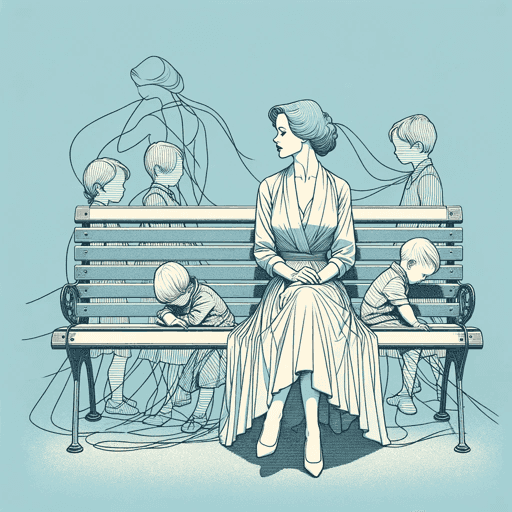
In The Park
In The Park
A modern alternative to SparkNotes and CliffsNotes, SuperSummary offers high-quality Study Guides with detailed chapter summaries and analysis of major themes, characters, and more.
Further Reading & Resources
Related Poems
“The Double Image” by Anne Sexton (1958)
In this early confessional poem, Sexton addresses motherhood from the perspective of being a daughter and of being a mother to her four-year-old daughter; her account includes mentions of her depression and suicide attempts. In the final stanza, Sexton explains that she named her daughter Joyce, so her nickname could be Joy; although the situation is imperfect, the last line of the poem carries the hope of connection: “I made you to find me” (Line 210). This idea of imperfection is also apparent in Harwood’s “In the Park”: The woman nurses her baby like the quintessential image of motherhood, the Madonna, but her feelings are not of love.
“Morning Song” by Sylvia Plath (1961)
In this autobiographical poem, Plath writes about the birth of her daughter Frieda. The mix of emotions, akin to those of “In the Park,” shows the complexity of becoming a mother and sustaining the life of a new person that was once inside of her. The poem shows the new mother in denial about her relationship to the newborn: “I’m no more your mother / Than the cloud that distills a mirror to reflect its own slow / Effacement at the wind’s hand” (Lines 7-9). The reference to the wind blowing away reality echoes Harwood's use of the same image in her poem.
“Suburban Sonnet” by Gwen Harwood (1961)
Like “In the Park,” this poem is also about a beleaguered mother dealing with personal desires. The desire is not the waning romance of “In the Park,” however, but the wish to be a creative or artistic person. The mother returns to the musical instrument she once played, but the act is pointless: “She practices a fugue, though it can matter / to no one now if she plays well or not” (Lines 1-2). In both poems, the woman is forced to suppress her interests in favor of those of her children; here, she must comfort them when they find a dead mouse. Harwood’s potential career as a musician likely influenced this portrayal.
“Barn Owl” by Gwen Harwood (1975)
This poem features the first-person perspective of a child, unlike the third-person motherly adult perspective of “In the Park,” although its theme is equally dark. The child sneaks off to the barn to shoot an owl, as his father encourages him to “End what you have begun” (Line 36). The innocence the child loses in the murderous act parallels the loss of a past self in “In the Park.”
“Nightfall” by Gwen Harwood (1975)
This poem describes the father and child of “Barn Owl” forty years in the future. There is tenderness between the adult child and his aging father, as they pick fruit and enjoy a walk. Despite the parent's advanced age and the child's maturity, the father still does things to make the child happy: “Eighty years old you take / this late walk for my sake” (Lines 11-12). The tone here is a stark contrast to the regret of motherhood the female characters feel in “In the Park” and “Suburban Sonnet,” perhaps suggesting the differences between fatherhood and motherhood.
Further Literary Resources
Gwen Harwood: The Real and Imagined World by Alison Hoddinott (1991)
Hoddinott, a friend of Harwood’s for 40 years, offers critical analysis from a biographical point of view. Her work links Harwood’s writing with significant events in Harwood's life, including her youth and her marriage. This resource includes letters between Hoddinott and Harwood, as well as an extensive bibliography.
A Steady Storm of Correspondence: Selected Letters of Gwen Harwood 1943-1995 edited by Gregory Kratzmann (2001)
This collection of letters shows Harwood’s epistolary talent. About half of the letters are to Harwood's long-time friend Tony Riddell, to whom she dedicated many of her poetry collections. Other letters are to friends, and to accomplished Australian artists, writers, and musicians.
My Tongue is My Own: A Life of Gwen Harwood by Ann-Marie Priest (2022)
Priest’s biography traces the childhood and adulthood of a very private poet known for her wit and rebellion against tradition, especially 1950s patriarchal Australia.
Bad Art Mother by Edwina Preston (2022)
This novel set in 1960s Australia features a poet who gives up her son to a well-to-do couple to gain time to write. The figure of a woman poet fighting to be taken seriously as an artist rather than just being seen as a mother has clear connections to Gwen Harwood. This novel also includes letter writing, something Harwood was known for, and a scandal akin to Harwood’s Bulletin prank (Preston references the real-life event in her epilogue).

Get in-depth, chapter-by-chapter summaries and analysis from our literary experts.
- Grasp challenging concepts with clear, comprehensive explanations
- Revisit key plot points and ideas without rereading the book
- Share impressive insights in classes and book clubs