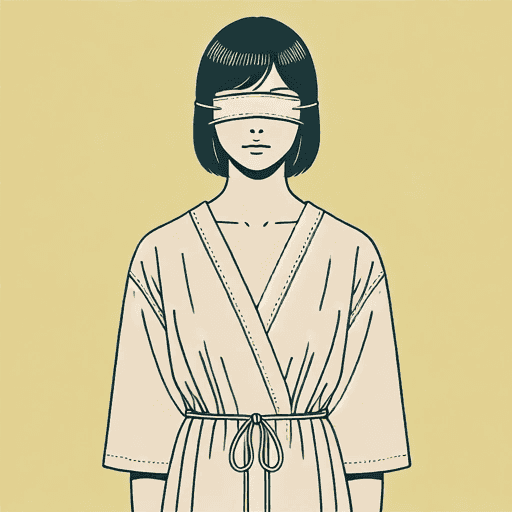
Intercepts
57 pages • 1-hour read
T. J. PayneIntercepts
A modern alternative to SparkNotes and CliffsNotes, SuperSummary offers high-quality Study Guides with detailed chapter summaries and analysis of major themes, characters, and more.
Themes
Content Warning: This section of the guide includes discussion of death, death by suicide, graphic violence, mental illness, and physical abuse.
The Destruction of Identity Through Sensory Deprivation
The Prologue of Intercepts opens with a consciousness drifting in sensory darkness, a mind cut off from its body and unsure it still exists. This scene establishes one of the book’s central ideas: Human identity comes from the physical world and the senses that link a person to it. When that contact breaks, memory and selfhood fall away. T. J. Payne shows this collapse through the construct of human experimentation with sensory deprivation, then pushes the idea further by depicting how a stripped mind—fragile and easy to reshape—can reorganize itself around one overpowering purpose, potentially becoming the monster such experimentation sought to thwart.
Payne grounds this idea in the Antenna in the Prologue, who orders her hand to inflict pain on herself in an attempt to confirm her own existence. Unable to process any sensory information, existing in darkness for long periods of time has caused her memories to fade. Thus, she becomes merely a body slumped on the floor with no stable identity left. This state is not simple disorientation. It wipes out the sense of being a particular person and leaves a hollow mind with nothing to attach to.
From that emptiness, Payne shows how a new identity can form with startling force. Bishop’s shift from a passive body to a focused agent of revenge begins the moment she learns Joe Gerhard’s name. That detail gives her mind something to grip in the absence of any other engaging stimuli. Her thoughts gather around the idea of retribution, creating enough conscious awareness attack Carson. This moment reveals how a mind can rebuild itself when handed a single aim. Bishop’s new identity grows out of that aim and turns her into an efficient destroyer. Hannah observes in her a “fury and viciousness that didn’t exist in nature” and concludes that the Facility has created something “outside the bounds of nature” (286): a monster.
Later, the book offers a different version of this rebuilding. Joe becomes an Antenna known as “Happy,” and his consciousness condenses around his love for his daughter, Riley. His mind settles into “pure bliss” as he watches over her (319), and that feeling becomes the core of who he is. Joe’s change shows how affection can shape a new self just as hatred shapes Bishop’s. In each case, Payne shows how sensory deprivation affects identity, replacing the complexity of a full human life with one dominant drive that defines what remains of the person.
The Tension Between Parental Instincts and Professional Obligations
Inside the Facility where Joe works, a propaganda poster shows a smiling mother and daughter with the words: “Do your job. Keep them safe” (25). That image captures the moral conflict running through Intercepts, as Joe uses his need to protect his daughter, Riley, to justify the brutal work he performs. Payne traces how this rationalization collapses, shattering Joe’s illusions about himself as a father and as a human.
Joe ties his loyalty to the Company directly to his role as a father. He believes the poster, which shows a girl who resembles Riley, was designed for him. He compares it to an Air Force tactic that uses a recording of a child pleading, “Daddy… please eject,” to override a pilot’s violent impulses with a protective one (26). The Company turns Joe’s affection for Riley into a tool that keeps him committed to procedures that harm the Antennas. His love becomes the reason he continues the work instead of a force that pulls him away from it.
Payne then shows how Joe’s work destroys the very family he tries to shield. Bishop tortures Kate, bringing about her death by suicide, because of the pain she’s endured at the hands of Joe and the Facility. Joe’s work, then, becomes the thing that endangers his family rather than what protects them. Riley inherits the trauma that follows. Joe’s attempt to protect his family exposes them to the horror he manages every day, which reveals the emptiness of the logic he relies on.
Joe’s character arc is motivated by feelings of guilt and shame for his failures as a father and his desire to atone. Yet his efforts to atone are mired in his own ego: “Bishop had been haunting him too, he supposed. He had been haunted with the stress that his daughter was having a mental breakdown. Like a good father, Joe had taken care of the problem" (230). In this example, like in many others, Joe fails to comprehend how the consequences of his unethical work affect his family. He thinks Bishop’s death solves the problem because he doesn’t truly recognize his role in her suffering. He tells Bishop: "I'm sorry for your pain. But I was just doing a job. If you had come to me, if you had communicated with me, I coulda helped" (216). The scene in which Bishop is tuned to Victor Aminov contradicts his statement: She does communicate her pain and begs for it to stop, but Joe ignores her and insists that she continue the intercept. Even his choice to free the other Antennas in exchange for their promise to leave Riley unharmed is made without due consideration of how his actions will affect others, consequently bringing about the deaths of several more colleagues and orphaning his daughter. Joe’s efforts to atone for his failures as a father and for his crimes against the Antennas do little to reverse the damage he’s caused, despite his good intentions.
The Blurred Lines Between Perception and Reality
In Intercepts, surveillance and data monitoring reach the mind itself, and the Antennas weaponize that intrusion by altering what people see, hear, and feel. The constantly shifting line between perception and reality becomes the site of the book’s violence. The Antennas’ hallucinations show how unstable an individual’s sense of reality can be when the senses report false information, and characters find themselves unmoored when they cannot rely on their senses to define reality.
The novel first anchors this idea in private, isolating visions. Riley dismisses her vision of the woman in the hospital gown as a response to stress after Kate’s death. Joe reinforces that belief when he looks to the same spot and sees an empty roadside; he tells Riley she is “seeing things,” introducing the idea that Riley can’t trust her own senses. Kate’s fate, which Joe and Riley don’t understand the full extent of until later in the novel, reveals the danger behind these episodes. Bishop’s projections turned Kate’s own mind against her and trapped her in a hallucination she could not escape, foreshadowing Riley’s fate. These moments separate each person the Antennas target from the people around them, making perception dependent on only their experience and senses, isolating them further and leaving them with no outside perspective from which to check their own.
The book then expands this individual danger into a collective collapse, in which characters share a common hallucination. When Tyler and his security team gather in the break room with other workers, they fall under the Antennas’ influence and view their colleagues as attacking Antennas. They respond with gunfire and turn the room into a massacre. The scene shows how a shared hallucination can upend the order of the Facility and twist protectors into killers. The power of the hallucinations is strengthened by the fact that they all share in it—there is no one to contradict their perception of reality, and because of that, it feels irrefutable.
The novel ends its exploration of this idea with an act of tactical manipulation. The Antennas plant an image of a stairwell in Tariq’s mind, and he believes he is running toward safety. Instead, he unlocks and enters Ferro’s cell, where Ferro kills him. The Antennas exploit his altered perception to achieve a specific outcome, taking their manipulations further than before, driving a person to their death by prompting physical action, a different tactic than those that Bishop enacted with Kate and Riley, in which she used psychological manipulation to introduce the idea of dying by suicide. By showing how easily the mind can be steered into betraying the body, Intercepts presents a world in which whoever controls perception controls the realities of the characters, shaping their actions and decisions on a fundamental level.

Unlock every key theme and why it matters
Get in-depth breakdowns of the book’s main ideas and how they connect and evolve.
- Explore how themes develop throughout the text
- Connect themes to characters, events, and symbols
- Support essays and discussions with thematic evidence