Junie B. Jones and the Stupid Smelly Bus
34 pages • 1-hour read
Barbara ParkJunie B. Jones and the Stupid Smelly Bus
A modern alternative to SparkNotes and CliffsNotes, SuperSummary offers high-quality Study Guides with detailed chapter summaries and analysis of major themes, characters, and more.
Chapters 1-3Chapter Summaries & Analyses
Chapter 1 Summary: “Meeting Mrs.”
Junie B. introduces herself, noting that the “B.” stands for Beatrice, her middle name, which she does not like. She is nearly six years old and just about to begin kindergarten. Though today is her first day of school, Junie B. reports that her mother took her to meet her teacher last week. She wore her “bestest hat” and shiny shoes, and she selected a lovely red chair to sit in. When Mrs. referred to her as “Junie,” Junie B. corrected her; she tells the reader that people always forget her “B.” Mrs. asked if Junie B. would be riding the bus, and Junie B. asked where the bus goes. However, her mother reported that she would be riding the bus without answering Junie B.’s question. As Mrs. and Mother continued talking, Junie B. asked three more times where the bus goes, finally losing her temper the fourth time she asked. Her mother told her to watch herself, and Mrs. went to speak with another student. Junie B. thought that she could beat that boy up. Finally, her mother explained that the bus is yellow, stops at the end of Junie B.’s street, and takes her to school. Then, Mrs. will meet her in the parking lot. When her mother asked if that sounded like fun, Junie B. said “yes” but thought “no.”
Chapter 2 Summary: “Feeling Squeezy”
Junie B. feels scared about the bus for the rest of the week. When she tells Mother, the night before the first day of school, that she doesn’t want to ride the bus, her mother insists that she does. Junie B. repeats that she does not, and her mother tells her not to worry. She continues to worry, and she cannot eat her breakfast the next morning. Her stomach feels “squeezy.” At the bus stop, she sees another little girl but doesn’t say hello because the girl lives on another street. When the bus pulls up, its brakes screech so loudly that Junie B. must cover her ears. Again, she tells her mother that she doesn’t want to ride the bus, but her mother gives her a little push and tells her to be a “big girl.” Mother tells her to sit next to the other girl, who is already seated, and she promises that it’ll be fun.
Chapter 3 Summary: “The Stupid Smelly Bus”
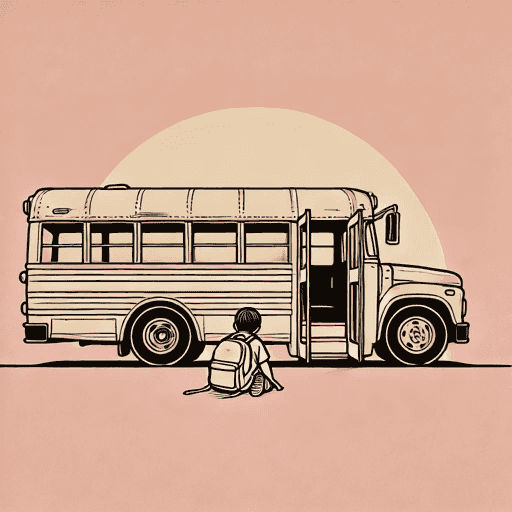
When Junie B. tries to sit next to this girl, the girl says that she’s saving the seat for her best friend. Junie B. sits across the aisle. The bus’s door folds in half and makes an odd noise when it closes; Junie B. thinks that it would cut her in half if it closed on her. Then, the bus roars loudly, and black smoke billows from its rear. Whenever it stops, the brakes screech, and Junie B. covers her ears. At one stop, a grouchy-looking boy called Jim gets on, and Jim’s father makes him sit down next to Junie B. She admires his backpack. When she touches it, Jim yells at her and moves away. Junie B. decides that she hates Jim. The bus gets noisier and hotter, and it begins to smell weird, too. Junie B. says aloud that she wants to get off and that she hates the bus, but no one hears her. She begins to sniffle and cry, though she denies it, stating that she’s not a “baby.” She feels like the bus ride lasts forever.
Finally, when it stops, she jumps up, but the other children push against her, so she pushes back; they push more, and she falls. Someone steps on her skirt, leaving a footprint on it. Mrs. greets her when she gets off the bus, and Junie B. points out the dirty footprint. Mrs. tells her not to worry, calling her “Junie” and forgetting her “B.” Junie B. frowns at her.
Chapters 1-3 Analysis
Junie B. has strong feelings about what she does and doesn’t want, and adults’ failure to listen to her makes her justifiably angry. Almost the first thing she tells the reader is that the “B.” in her name stands for Beatrice, a name she doesn’t like, though she likes the “B.” by itself. When Mrs. refers to her without the “B.,” Junie B. immediately corrects her, saying it “real loud. So she wouldn’t forget it” (4). However, Mrs. does forget Junie B.’s “B.” on the first day of school, despite how much it means to the girl. Because it is important to remember and pronounce someone’s name correctly, Junie B. is not demanding anything extraordinary by asking to be called by the name she prefers. However, when she corrects Mrs., her mother rolls her eyes, a gesture that Junie B. does not understand or interpret; thus, it does not guide her behavior. Further, Junie B. asks multiple times where the bus goes before she finally loses her temper and shouts. Her mother and Mrs. ignore her request for information three times and then get angry when she yells out the fourth time. Junie B.’s outburst demonstrates one of the novel’s key themes: The Consequences of Dismissing Children’s Feelings. While it is considered very rude for an adult to repeatedly ignore another adult’s question in this way, the adults repeatedly dismiss Junie B.’s inquiries. This treatment demonstrates a double standard that exists in terms of adults’ expectations of children’s behavior; they expect children to simply accept treatment that would be unacceptable to adults.
Further, when Junie B. experiences anxiety surrounding the new experience of riding the bus, her mother dismisses these concerns, too. She says, repeatedly, that she does not want to ride the bus to school, but her mother only responds by saying that she does want to ride it and not to worry. Her mother does not ask why Junie B. is apprehensive; instead, she invalidates Junie B.’s feelings, telling her that she wants to do something that she knows she doesn’t want to do. This doesn’t assuage her anxiety at beginning something new and being in a new environment. The process of riding the bus has been briefly explained to her, but her mother never allows her to voice her concerns, introducing the theme of The Anxiety Created by New Rules and Experiences.
The bus is large and loud, adding to Junie B.’s worries. She uses onomatopoeia to describe the bus’s sights and sounds vividly, saying that the door makes a “whishy sound,” though she fears it could “cut [her] in half,” which would create a “squishy sound” (14). Next, she describes its “big roar” and the “big puff of black smelly smoke” that she likens to “bus breath” (14). The word “roar” is another example of onomatopoeia, and the description of the smoke presents a visual image; further, by comparing the bus’s smoke to “breath,” she uses a metaphor that highlights the idea that she thinks of the bus as a gigantic, frightening monster. As more children board the bus, it begins to develop a smell “like an egg salad sandwich” (16), a simile that creates a rather gross olfactory image and conveys the smell of several bodies in the heat. Finally, she reports that the bus ride lasts “about an hour or three” (17), an example of a hyperbole that emphasizes just how interminable the ride seems. Park uses these literary devices to vividly describe Junie. B’s experience, specifically the anxiety she feels while on the bus.

Unlock all 34 pages of this Study Guide
Get in-depth, chapter-by-chapter summaries and analysis from our literary experts.
- Grasp challenging concepts with clear, comprehensive explanations
- Revisit key plot points and ideas without rereading the book
- Share impressive insights in classes and book clubs