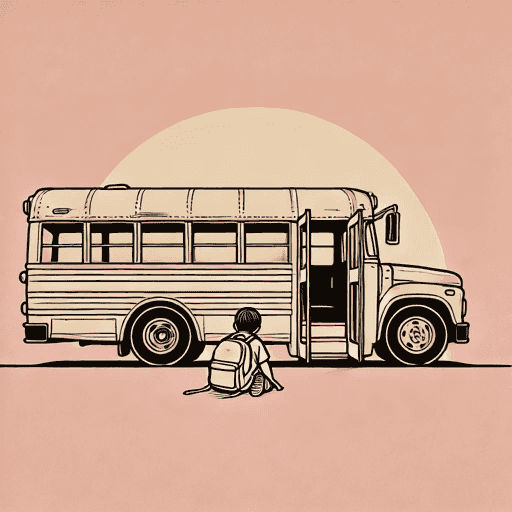
Junie B. Jones and the Stupid Smelly Bus
34 pages • 1-hour read
Barbara ParkJunie B. Jones and the Stupid Smelly Bus
A modern alternative to SparkNotes and CliffsNotes, SuperSummary offers high-quality Study Guides with detailed chapter summaries and analysis of major themes, characters, and more.
Important Quotes
“Almost six is when you get to go to kindergarten. Kindergarten is where you go to meet new friends and not watch TV.”
(Chapter 1, Page 1)
Junie B.’s statement about school indicates both her Human Desire for Independence and Control and The Anxiety Created by New Rules and Experiences. She likes to watch TV, as she mentions twice in the text that she won’t get to watch TV at school, and this highlights that her lack of choice in the matter slightly irritates her. Further, this statement demonstrates her understanding that there will be new rules to learn and that some of these rules might conflict with her preferences.
“Today was my first day of school. I’d been to my room before, though. Last week Mother took me there to meet my teacher. It was called Meet the Teacher Day.”
(Chapter 1, Pages 1-2)
This experience demonstrates how practicing new things can mitigate the anxiety created by new rules and experiences. The existence of Meet the Teacher Day acknowledges the fear and worry that going to school often causes for young children, especially if it’s their first year at a new school. This shows that Junie B. is not averse to new experiences, but she needs to be introduced in a way that is more comfortable and less overwhelming.
“‘This is my bestest hat […] See the devil horns sticking out the sides?’ Mrs. laughed. Except I don’t know why. Devil horns are supposed to be scary.”
(Chapter 1, Pages 3-4)
Junie B.’s choice to wear a “scary” hat to meet her teacher for the first time belies the anxiety that she feels. When she doesn’t feel in control, she sometimes resorts to growling or showing her fist to whoever is bothering her, as though making herself “scary” gives her more confidence.
“Mother rolled her eyes and looked at the ceiling. I looked up there, too. But I didn’t see anything.”
(Chapter 1, Page 4)
Mother may hope that Junie B. will regret her choice to correct Mrs. when she sees Mother roll her eyes, an expression of annoyance and disapproval. However, this gesture is not intelligible to Junie B. yet. When Mother only rolls her eyes, she misses an opportunity to teach her daughter a better way to address her teacher or to explain why the “B.” is so important to Junie B. In other words, Junie B. doesn’t learn anything from this interaction, one of The Consequences of Dismissing Children’s Feelings.
“That made me feel scary inside. ’Cause I never rided on a bus before.”
(Chapter 1, Page 5)
When Junie B. learns that she will be riding the bus to school, the unfamiliar prospect immediately frightens her. This demonstrates the anxiety created by new rules and experiences. New things can be scary, especially when several occur all at once, such as going to school, riding the bus, making new friends, and so on. This sentence also emphasizes Junie B.’s youthful grammar mistakes, as she does not know that the past tense of “ride” is irregular. Such mistakes make her authentic and relatable as a young character.
“Missy’s my name when I’m in trouble. I looked down at my shoes. They didn’t look as shiny as they did before.”
(Chapter 1, Page 7)
This line shows Junie B.’s lack of understanding about the circumstances surrounding the moments in which she gets in trouble. Missy isn’t the name she’s called when she gets in trouble, but it feels that way to her; she takes it literally, showing her limited understanding. Adults, like her mother, often refrain from explaining that her behavior seems disrespectful; thus, she doesn’t realize that this is how it’s interpreted. In addition, her clothes are symbolic of her emotional state. Her “shiny” shoes seem perfect at the start of the day, but as things begin to derail at school, her excitement dims; she perceives her shoes as being more muted now as well.
“The boy was hiding behind his mother and acting very babyish. I can beat that boy up, I think.”
(Chapter 1, Page 7)
Junie B.’s reaction demonstrates the consequences of dismissing children’s feelings. Junie B. feels dismissed by Mother and Mrs., who don’t answer her question about the bus until she loses her temper, and then they get upset about her outburst rather than realizing that she grew angry because they ignored her. When Junie B. is made to feel small, she wants to reassure herself that she is still bigger than some, like this other little boy. She consoles herself by deciding that another boy is acting more babyish than her and that she could beat him in a fight.
“And this morning I felt very droopy when I got up. And my stomach was squeezy.”
(Chapter 2, Page 10)
On the day of the dreaded bus ride, Junie B. describes her physical complaints. They are evidence of the anxiety created by new rules and experiences. Her “droopy” feeling indicates her trepidation, while her “squeezy” stomach emphasizes her nervousness.
“Then I put on my skirt that looks like velvet. And my new fuzzy pink sweater.”
(Chapter 2, Page 10)
Junie B. wears special, fancy clothes that represent her heightened emotional state on the first day of school. She wants to make a good impression and feel confident, so she wears items that feel good to her. They are especially tactile, and this makes them unique, like Junie B.
“Except I didn’t hop on. ’Cause my legs didn’t want to.”
(Chapter 2, Page 12)
Junie B. personifies her legs, demonstrating her feeling that she is not in control of them. Her discomfort with this situation—not wanting to get on the bus while being pressured to do so—highlights her human desire for independence and control.
“Then she put her little white purse on the place where I was going to sit.”
(Chapter 3, Page 13)
When Junie B. tries to sit with the other girl from the bus stop, the girl places her purse on the seat. The purse is a symbol of the girl’s rejection, as she’s saving the seat for her best friend. Later, when Junie B. plans to carry her little purse to save a seat for Grace, this indicates her heightened level of comfort with the bus ride and provides evidence of her growth.
“And when [the door] closed, it made a whishy sound […] If it closes on you by accident, it will cut you in half, and you will make a squishy sound. The bus made a big roar. Then a big puff of black smelly smoke came out the back end of it. It’s called bus breath, I think.”
(Chapter 3, Page 14)
Junie B. uses onomatopoeia, which illustrates how vividly she perceives the bus and its strange new sounds and experiences. Words like “whishy” and “squishy” sound like the noises they describe, as does “roar.” This description also metaphorically compares the bus to a monster, almost like a big, yellow dragon that puffs black smoke as it breathes.
“Then the bus began getting very noisy and hot inside. And the sun kept shining down on me and my fuzzy hot sweater.”
(Chapter 3, Page 16)
As the bus begins to heat up, Junie B.’s fuzzy sweater starts to irritate her. Its fuzziness makes her feel even warmer, which is unpleasant, and she no longer describes it as “new” but, rather, “hot.” Her changed feelings hint at her growing disappointment with how the day is going.
“The bus smelled like an egg salad sandwich.”
(Chapter 3, Page 16)
Junie B. uses a simile to compare the smell inside the bus to that of an egg salad sandwich. This demonstrates that the odor becomes quite pungent, even bordering on sulfurous, as bodies accumulate in the warming vehicle. The combination of hard-boiled eggs, mayonnaise, and spices can be off-putting to some, especially if one thinks about that concoction getting warmer and warmer.
“That’s when I fell down! And a big foot stepped on my skirt that looks like velvet.”
(Chapter 3, Page 19)
Junie B. loves her skirt that feels like velvet, and her clothes continue to be symbolic of her feelings. When someone steps on her skirt, leaving a big footprint behind, not only is the fabric “soiled,” as she tells Mrs., but her high hopes for the day also seem ruined.
“When Mrs. unlocked it, everyone squeezed in all at once.”
(Chapter 4, Page 61)
Junie B.’s repeated use of the word “squeezed” (or some variation of it) throughout the text indicates a lack of control that she doesn’t like. Her stomach might feel “squeezy,” indicating her anxiety, or her body might feel “squeezed” when she is pressed in on by other children. This repetition of the word emphasizes the human desire for independence and control, as it typically surfaces whenever Junie B. feels disempowered.
“YEAH, ONLY GUESS WHAT? RIGHT NOW I JUST LIKE THE KIND OF BOOKS WITH PICTURES. BUT MOTHER SAYS WHEN I GET BIG, I’M GOING TO LIKE THE KIND WITH JUST WORDS.”
(Chapter 4, Page 27)
Junie B.’s excitement upon seeing the Media Center library in her school emphasizes The Unbridled Joy of Children. She is so joyful that she is unable to contain herself and speak quietly, as multiple adults have told her to do. It isn’t that she’s trying to be disobedient, but rather, she is simply so overwhelmed by delight that she cannot contain it.
“That Jim turned around again. ‘P.U.…I smell your feet,’ he said to Lucille. This time Lucille stuck out her tongue at him. After that, we held hands again.”
(Chapter 4, Page 29)
When Jim says something unkind to Junie B., Lucille laughs; this causes Junie B. to drop Lucille’s hand, which she’d been holding. However, when Jim turns his meanness on Lucille, Junie B. does not laugh. When Lucille responds in a way that Junie B. feels is appropriate to Jim’s insult, Junie B. takes her hand again, demonstrating Children’s Highly Developed Sense of Fairness.
“‘Clear is the color of spit.’ ‘I hate Clear,’ said Lucille. ‘Me too,’ I told her. ‘And also I hate yellow—which is the color of the stupid smelly school bus.’”
(Chapter 5, Pages 33-34)
Not being able to select her nail polish color is deeply upsetting to Junie B. Lucille gets to wear a pinkish red that Junie B. finds very beautiful, while she can only wear “Clear,” which she greatly dislikes. Likewise, Junie B. is upset when she must sit in a yellow chair instead of the red one; because the bus is yellow and she dislikes the bus, she dislikes yellow now, too. Her desire to choose her own nail polish and chair color demonstrates the human desire for independence and control.
“After that, I bowed. ‘Thank you very much,’ I said. ‘Now you may all go out for recess…’ I smiled. ‘Except for not that Jim.’”
(Chapter 6, Page 42)
Junie B.’s role-playing, when she pretends to be the teacher, demonstrates both her human desire for independence and control and children’s highly developed sense of fairness. She likes the idea of being an authority who can tell others what to do rather than being instructed by someone else. Further, she enjoys the idea of getting to punish Jim for his bad behavior, something that never actually happens in the story.
“Then I ran to the water fountain and I drank for a long time. And nobody tapped on me and said, ‘Hurry up, girl.’”
(
After the school day, Junie B. is pleased that she can drink from the water fountain without having to worry about the other children behind her in line and how long she’s taking with her turn. She did not like it when another student tapped her before and the group insisted that she finish so that they could go. Again, this longing for freedom from others’ wishes emphasizes Junie B.’s human desire for independence and control.
“Hello, Mrs.? Please send that Jim to my office. I have to give him a shot.”
(Chapter 8, Page 52)
Similar to when Junie B. pretended to be a teacher, her role-play as the nurse also demonstrates the human desire for independence and control and children’s highly developed sense of fairness. She enjoys the idea of being confident and commanding, in charge of herself and beholden to no one else. She also likes the idea of controlling others, especially Jim, who she feels deserves some punishment for his earlier meanness.
“Except then a terrible thing happened! The chair was on wheels. And it rolled away from my feet! And I got stuck on the crutches way high in the air! And I was very dangly up there!”
(Chapter 8, Page 54)
When Junie B. plays with the crutches and loses control of her body as the nurse’s chair rolls away, her fantasy of being confident and commanding crumbles. Her antipathy to getting “stuck” and feeling “dangly” atop the crutches indicates her human desire for independence and control. After this, she pretends to make another call in which she “quit[s]” this job because the fantasy no longer affords her the illusion of independence and control that made it alluring in the first place.
“After that, I started to jiggle up and down very fast. ‘OH, NO! NOW I’M GONNA HAVE AN ACCIDENT ON MY SKIRT THAT LOOKS LIKE VELVET.’”
(Chapter 9, Page 58)
Again, Junie B.’s clothing serves as a symbol of her emotional state. She is in a panic because she doesn’t want to have a bathroom accident on her skirt, which looks velvet; it is still a special skirt to her, and she certainly doesn’t want to soil it with an accident. The day is not turning out as she’d hoped, further showing the human desire for independence and control.
“And guess what else? Tomorrow I think I might like yellow a little bit, too.”
(Chapter 10, Page 69)
Once Junie B. learns that no one will pour chocolate milk on her head on the bus ride home, she feels much better. Then, once she is matched up with Grace, who will be riding the bus for the first time in the morning, she feels even better. Finally, knowing that she can take her purse to save Grace’s seat—a practice that she didn’t seem to be aware of before she was denied a seat herself—makes her almost excited about the next bus ride. She begins to change and grows up a little bit as new rules and experiences become more familiar to her.

Unlock every key quote and its meaning
Get 25 quotes with page numbers and clear analysis to help you reference, write, and discuss with confidence.
- Cite quotes accurately with exact page numbers
- Understand what each quote really means
- Strengthen your analysis in essays or discussions