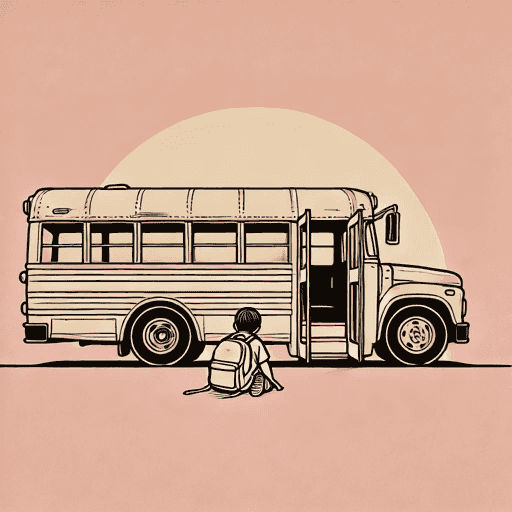
Junie B. Jones and the Stupid Smelly Bus
34 pages • 1-hour read
Barbara ParkJunie B. Jones and the Stupid Smelly Bus
A modern alternative to SparkNotes and CliffsNotes, SuperSummary offers high-quality Study Guides with detailed chapter summaries and analysis of major themes, characters, and more.
Symbols & Motifs
“The Little Hiding Girl”
When Junie B. hides in the supply closet to avoid riding the bus, she tells herself a story called “The Little Hiding Girl” inside her head. This story gives her some emotional distance from the challenging situation in which she’s placed herself—she knows that she cannot “come out for a very, very long time” if she wants to be a successful hider and avoid the bus, but she’s “all bended up” and uncomfortable (38). This story is a motif that supports The Anxiety Created by New Rules and Experiences.
The story addresses her physical discomfort, as the hiding girl’s “head [i]s very tight. And her brain [i]s squishing out” (39). Junie B.’s anxiety about the bus is so significant that she would rather endure this discomfort than face its scariness. Her story also addresses her fear of the bus, which she characterizes as “a smelly yellow monster [that is out to] get her” that contains the “meanies with chocolate milk” whom Lucille mentioned (39). The monstrous bus and “meanies” contribute to Junie B.’s anxieties about new experiences, and her creation of a story is her attempt to process and mitigate those anxieties. She wants to feel in control of herself, and choosing to characterize herself as “The Little Hiding Girl” demonstrates this desire. Even her choice to narrate the story using the third-person point of view demonstrates a wish for control and a desire to distance herself from her anxieties. Her choice to hide results from both her wish for bodily autonomy and the adults’ refusal to honor her feelings.
The Media Center
The Media Center, or school library, presents a perfect hiding spot for Junie B. because it reminds her of a fort. Forts are secure spaces that allow the people inside to feel protected and safe from others’ intrusions or invasions, and this is how the Media Center makes Junie B. feel. Thus, it is a motif that demonstrates the Human Desire for Independence and Control, as it shows that Junie B. prefers this spot because it allows her to feel this way.
Of the library area, Junie B. says, “The shelves are like walls. And the books are sort of like bricks. And you can move some of them around and make peeky holes. Peeky holes are what you spy out of” (45). She uses multiple similes, comparing the shelves to castle walls and the individual books to the bricks in those walls. Junie B. likes the space so much because it provides her with a sense of security and control; no one can see her unless she lets them, and she can always see them first through her “peeky” holes. Many forts have arrow slits or other small openings that the people inside can use to keep an eye on anyone outside the fort. Knowing that she is hidden, with the ability to surveil others—like the custodian who comes in to empty the garbage—from her secure and concealed location, gives her a sense of power.
The Gold Star Sticker
Junie B. finds gold star stickers in her teacher’s desk and immediately puts one on her forehead. Typically, gold stars are reserved for excellent work or effort, and sticking one to her head highlights that Junie B. longs to be seen as good, even great. When Junie B. gets upset about messing up on her nametag, Mrs. shushes her and gives her a new one; “‘Thank you,’ [Junie B.] said nicely. ‘Grandma Miller says I print beautifully’” (25). She hopes to be recognized for her superior penmanship and obedience. Likewise, when her mother insists that she ride the bus, rhetorically asking if it sounds like fun, Junie B. “nod[s] the word yes. But inside [her] head [she] sa[ys] the word no” (8). She doesn’t want to contradict her mother, though she does long to be true to herself. She may make some unfortunate decisions due to her fear of new experiences, but it’s clear that she longs to please the adults in her orbit.
When Junie B. finally gets into the bathroom, she is very proud of herself for not having an accident and does not have any inkling of the trouble she has caused for the adults. She “look[s] in the mirror. And the gold star [i]s still on [her] forehead! It look[s] very beautiful up there!” (63). Junie B. thinks of herself as a good girl, and it doesn’t occur to her that she might be in trouble for hiding or that it could affect adults’ opinions of her. She believes that she deserves the gold star for not having an accident. The gold star sticker that she awards herself, and later admires, demonstrates that her rule-breaking choice is the result of The Anxiety Created by New Rules and Experiences rather than a desire to be “bad” or to rebel against authority.

Unlock the meaning behind every key symbol & motif
See how recurring imagery, objects, and ideas shape the narrative.
- Explore how the author builds meaning through symbolism
- Understand what symbols & motifs represent in the text
- Connect recurring ideas to themes, characters, and events