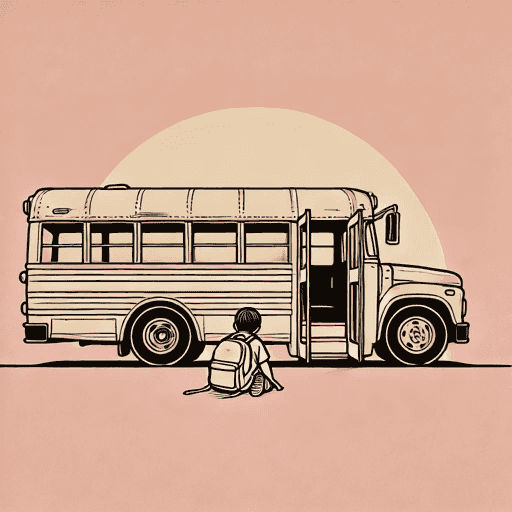
Junie B. Jones and the Stupid Smelly Bus
34 pages • 1-hour read
Barbara ParkJunie B. Jones and the Stupid Smelly Bus
A modern alternative to SparkNotes and CliffsNotes, SuperSummary offers high-quality Study Guides with detailed chapter summaries and analysis of major themes, characters, and more.
Themes
Human Desire for Independence and Control
Junie B. may be a young child, but her experiences and feelings demonstrate a very human desire: to feel in control of her body and her choices. She repeatedly differentiates herself from babies, whom she perceives as being less autonomous than herself. Moreover, when she is denied opportunities to be self-governing, perhaps making a choice or decision that adults would prefer she wouldn’t, she gets upset. These responses emphasize a very human wish for independence and personal freedom of choice.
Often, when Junie B. gets emotional, she explicitly denies any similarity between herself and babies, who are helpless and, thus, disempowered. On the bus, which she quickly grows to dislike, she says, “[M]y eyes got a little bit wet. I wasn’t crying, though. ’Cause I’m not a baby, that’s why” (17). She doesn’t want to admit that she’s crying because this makes her feel less in control of herself and her feelings. She longs to feel confident and authoritative, especially because she’s so uncertain and confused in this moment. Likewise, when she falls asleep while hiding in the closet, she says that she’s just resting, which is “not the same thing as a nap, though. ’Cause naps are for babies, that’s why” (40). Unlike a baby, who has no power to control himself or make decisions, Junie B. wants to feel empowered and in charge of herself.
Junie B.’s role-playing provides further evidence of her human desire for independence and control. First, she makes up a story that she calls “The Little Hiding Girl” (39), a literal effort to control her narrative. She doesn’t want to feel scared or weak, so she thinks about her story and herself in the third person, creating emotional distance between herself and her current circumstances. Then, she pretends to be the teacher and punishes “that Jim” by keeping him inside during recess. Later, she acts like the nurse, putting on the woman’s sweater and pretending to call the hospital. Acting like adults gives her a feeling of capability and power, as though she’s trying on their authority to see how it “fits.” She even reaps the satisfaction of getting to discipline Jim, something that no adult in the narrative does. When she gets stuck atop the crutches and bumps her head—a clear sign that she is not in control during that moment—she picks the phone back up and “quit[s] this stupid job” (54). She longs to be in control, and when her fantasy spirals out of her control, it no longer serves her.
This desire isn’t just the purview of children, however, as Park highlights how the adults around Junie B. respond to her decision to hide. When she’s found, “everyone start[s] talking at once. And nobody [i]s using their quiet voices. And nobody [i]s smiling, either” (64). The adults were scared for her, and this made them “grumpy.” Even Mother says, “Didn’t you see all the commotion you caused? You had a lot of people very scared” (67). When a human being does not feel in control, they often feel scared, no matter whether they are a child or an adult. Thus, Junie B.’s decisions demonstrate an innate desire for independence and control.
The Unbridled Joy of Children
Children often feel disempowered by the adults around them, but they also possess an unparalleled capacity for joy and enthusiasm, especially concerning objects that many adults think of as rather mundane or commonplace. Junie B.’s list of multiple “favorite things” provides evidence of the unbridled joy of children.
When her class goes on a tour, they stop at the Media Center, or library, and Junie B. is unable to control her excitement. She says, “Books are my favorite things in the whole world!” (27). This explains why she immediately exclaims aloud, “HEY! THERE’S A JILLION OF THEM IN HERE! […] I THINK I LOVE THIS PLACE!” (27). Even after the librarian cautions Junie B. to use her “quiet voice” in the library, Junie B. keeps shouting about her love of books. Her excitement is simply too overwhelming for her to keep quiet about it.
After the school day ends and Junie B. gets to decide how to spend her time, her joy accumulates even more quickly. She is thrilled to find clay in the supply closet because “clay is [her] very favorite thing in the whole world” (40). Then, when she returns to the library, she is equally enamored with the electric pencil sharpener there, declaring it to be her “most favorite thing in the whole world!” (46). Likewise, the nurse’s office is full of wonders, and Junie B.’s raptures are palpable. She is elated to find Band-Aids, explaining, “I love those guys!” (50). However, this pales in comparison to her joy upon spotting her “most favorite thing in the whole world! They [a]re near the door. And their name is crutches!” (52). While most adults would not get this excited to find clay, sharpen pencils, use bandages, or play with crutches, these activities are so marvelous to Junie B. that she declares them all to be her favorite. Through Junie B.’s excitement for her multiple “favorite things,” Park shows children’s capacity for joy and enthusiasm—including about mundane or commonplace objects—which counteracts the disempowerment they may feel due to adults’ wishes.
The Consequences of Dismissing Children’s Feelings
Junie B.’s choices prove that the consequences of dismissing children’s experiences as unimportant or insignificant can range from the very small to the gargantuan. Adults repeatedly dismiss the main character’s anger and frustration as silly or inconsequential, neglecting opportunities to teach her something important. Both her mother and the principal roll their eyes at Junie B., but she does not understand the gesture and thinks they are looking at the ceiling. After Mother does it, Junie B. says, “I looked up there, too. But I didn’t see anything” (4). Likewise, after the principal finds and lectures her, she says, “Principal looked up at the ceiling. And I looked up, too. But I didn’t see anything again” (65). In both instances, adults miss an opportunity to instruct Junie B.—either in the appropriate way to speak to her teacher or to understand why hiding was such an unfortunate and worrisome choice. When individuals dismiss her feelings with this gesture, she does not understand that she has annoyed or irritated them, and she therefore learns nothing from the experience.
This missed opportunity to learn, however, is a relatively small consequence when compared to the potential dangers she could encounter while unsupervised in the school. Mother’s dismissal of her feelings about riding the bus precedes this choice. Before her first ride, Junie B. says, “‘I don’t think I want to ride that school bus to kindergarten tomorrow.’ Then my mother rumpled my hair. ‘Oh, sure you do,’ she said. ‘Oh, sure I don’t,’ I said back” (9). Mother literally tells her that she is wrong about her feelings. Then, when she is on the bus, she repeats, “‘I want to get off of here’ […] But nobody heard me” (16-17). Believing that no one is going to care about her reasons for not wanting to ride the bus—especially when Lucille tells her that someone will most certainly pour chocolate milk onto her head—she takes matters into her own hands and injures herself. The head bump that she sustains when playing with the crutches in the nurse’s office isn’t a severe injury, but it could have been. She could have wandered into a science room and started a fire or even fallen down the stairs. Several dangerous consequences could have resulted from her choice, a choice made because adults dismissed her feelings. Thus, through Junie B.’s decisions, Park underscores the consequences—big and small—of dismissing children’s experiences and emotions.
The Anxiety Created by New Rules and Experiences
Junie B.’s experiences with riding the bus and beginning her first year of school demonstrate the way that dealing with new rules and experiences can create anxiety for children, just like it can for adults. These anxieties are increased by Junie B.’s inability to guess at the rules, which most adults can intuit based on their deeper wealth of life experience.
When Lucille tells Junie B. that children who ride the bus home get doused with chocolate milk, Junie B. has no way of knowing whether this is true, and her uncertainty creates a lot of anxiety for her. After listening to Lucille—who has an older brother who has, ostensibly, ridden the bus home and knows more about it—Junie B. says, “[A]ll of a sudden my stomach felt very squeezy again. ’Cause I had to ride the bus home, that’s why” (34), and she wishes that Lucille hadn’t told her this information. Later, when she tells her mother that this is the outcome she was attempting to avoid, her mother “growl[s]” and says, “That’s not going to happen” (68). However, Junie B. would have no way of knowing this. Already, unimaginable things have happened to her on the bus: getting rejected when she tried to sit down, getting yelled at by Jim, getting pushed to the ground, and having her skirt soiled with a footprint. Her limited experience has taught Junie B. that the bus is a rather lawless place, so she has no way of knowing what else might happen there. Thus, the environment makes her nervous.
At school, Junie B. also learns that there are unwritten rules she is expected to follow, and these make her apprehensive as well. On her class’s tour of the school, the children are permitted to get a drink from the water fountain. Junie B. says, “I didn’t get a long one, though. ’Cause kids kept tapping on me. ‘Hurry up, girl,’ they said” (31). She informs them that “girl” isn’t her name. Their response, however, is enough to show her that long turns at the water fountain break the unwritten rules of school. Likewise, when the students are shown the bathrooms, Junie B. notes that there’s one for girls and one for boys. She says, “I can’t go in the boys’ kind, though. ’Cause no girls allowed, that’s why. I tried to peek my head in there. But Mrs. snapped her fingers at me” (31). The idea of single-sex bathrooms is new to her, and getting “snapped” at by her teacher alerts her to the new-to-her rule that boys can go in the boys’ room and girls must stay out.
New experiences mean new rules, and often, one must learn those new rules during the experience itself. This can cause anxiety for even the most well-adjusted adult, but adults are typically more capable of guessing at the rules ahead of time. Children, however, must learn how to act like adults, and this can cause angst and discomfort for them. Junie B.’s experiences throughout the novel demonstrate the anxiety caused by being in new environments with many unspoken rules, something that adults like Mother ultimately help her understand and work through.
Children’s Highly Developed Sense of Fairness
Often, adults accept that life simply isn’t fair and that sometimes people don’t get the things they want, even if they believe they deserve them. Junie B.’s experiences, however, highlight the belief common among children that life should be fair, and this sense of what is just or right often conflicts with the new rules she’s learning as her life experience broadens.
This awareness most often surfaces whenever Junie B. is responding to other children who are behaving in ways that she feels are unjust. When Lucille sits in the red chair that Junie B. chose before school began, she says,
‘Yeah, only I already picked that chair out […] Ask my mother if you don’t believe me.’ But the girl just shook her head no. And then Mrs. clapped her loud hands again and said, ‘Please find a seat!’ And so then I had to quick sit down in a stupid yellow chair (23).
To Junie B., the claim that she made on this chair—though Mrs. never promised that it could be hers and Lucille was not present at the time—should outrank any more recent claim, such as Lucille’s. Thus, she even appeals to her mother’s authority, suggesting her belief that her mother would support her claim and obliging Lucille to move. Junie B. is incensed when this logic does not garner the results she wants, and she is especially affronted by having to accept a yellow chair because it is the same color as the bus, which she now hates. Her response does not strike her as an overreaction because she feels that the red chair should be hers and that she should not have to sit in a chair that is a color she hates.
Similarly, when Lucille laughs at Junie B.’s expense, the sting of this injustice upsets Junie B. When she exclaims over the delicious smell of spaghetti in the cafeteria, Jim responds by saying, “P.U.…I smell you,” and “Lucille laugh[s] very hard” at this remark (28). Jim’s statement doesn’t shock Junie B., but Lucille’s apparent betrayal bothers her. Consequently, Junie B. “stop[s] holding her hand” (28). Lucille’s reaction feels unfair to Junie B., especially because Lucille took her red chair, and Junie B.’s reaction demonstrates her disapproval of Lucille’s behavior. Junie B.’s desire to show Lucille her displeasure is evidence of her deeply held belief that the world should be fair, as Junie B. has done nothing to earn the girl’s derision. Thus, part of Junie B.’s character arc is learning that her sense of fairness often conflicts with the new rules she encounters while at school.

Unlock every key theme and why it matters
Get in-depth breakdowns of the book’s main ideas and how they connect and evolve.
- Explore how themes develop throughout the text
- Connect themes to characters, events, and symbols
- Support essays and discussions with thematic evidence