Katabasis
64 pages • 2-hour read
R. F. KuangKatabasis
A modern alternative to SparkNotes and CliffsNotes, SuperSummary offers high-quality Study Guides with detailed chapter summaries and analysis of major themes, characters, and more.
Chapters 12-18Chapter Summaries & Analyses
Content Warning: This section includes discussion of death by suicide, suicidal ideation, and sexual violence and harassment.
Chapter 12 Summary
Alice’s pentagram scar severely altered her dreams, which layer dreams and reality in horrible new hallucinations. She dreams she’s abducted by Grimes with a horse head, which she stabs with scissors and licks the blood. Peter wakes her. Archimedes has returned. As they eat breakfast, Alice tries to divine Peter’s intentions. While flaky, she never knew him to be malicious, but she convinces herself of his plan. She resolves to pretend everything is fine.
Treacherous steps lead from Desire to Greed. She remembers back to her first year, when Grimes called her to his office for tea. He told her Peter was her competition and she’d have to work twice as hard as him for a portion of his success. Over the next few years, he constantly compared her to Peter. Alice became hyperaware of Peter. One day, Peter came into the lab with a friend and didn’t notice her napping. She overheard them talking about her, and Peter made a joke about Alice being intimate with Grimes. Alice wonders if the rumor spread and stopped her from getting opportunities.
They descend the steps, and Peter tries to guess at the occupations of the Shades passing into Greed. They pass over a bridge made of petrified Shades. Peter recognizes a Shade from a legendary academic dispute, which he explains before expressing displeasure at sabotaging a colleague. Alice implies he’s hypocritical, and he asks why she is mad at him. She avoids his questions.
A woman materializes in front of them. Alice recognizes the Chinese mythological figure Weaver Girl, a deity who followed her mortal lover to the afterlife, only to be left there when he went into the Lethe. She mistakes them for lovers and offers them a test: Pass, and she’ll weave them a bridge to wherever they want to go. Aside, Peter tells Alice to go along with it.
Weaver Girl separates them and presents the test: A red apple represents going forward together, while the green represents going on alone. If they both choose red, they both proceed. If they both choose green, they both get thrown into the Lethe. If one chooses red and the other chooses green, the one who chooses green moves forward while the other gets collected by Weaver Girl. Alice resolves to pick red but has a series of memories and hallucinations that convince her she hates Peter. She comes back to herself with an apple in her hand.
Chapter 13 Summary
During the winter of Alice and Peter’s first year, Grimes’s fourth-year student suddenly left for Canada after an ultimatum from his girlfriend. Alice and Peter were recruited to work uncredited hours to make up for the loss. She and Peter bonded amid the difficulty, and Alice thought she may have been in love. She loved her work because she felt like she could make discoveries no one had made before; she felt the same way about Peter, and she noticed him making observations and discoveries about her. They shared details about their specialties and knowledge and developed a shorthand language.
After Grimes’s project ended, Peter pulled away. He merely nodded in greeting and refused to engage with their old inside jokes. Alice went to Italy with Grimes the next summer, and her life changed. Shortly after that, a philosophical article came out that proposed that the things people think define personhood do not ground fact, and so it is impossible to truly know someone else’s essence. Alice used this to comfort herself about not truly knowing Peter.
Chapter 14 Summary
Alice thinks she’s still reasoning through which apple to grab, but she looks down to see she’s holding the green apple. Weaver Girl tells Alice to go on alone and begins to wrap Peter in a silk web. Alice tries and fails to cut through with her hunting knife.
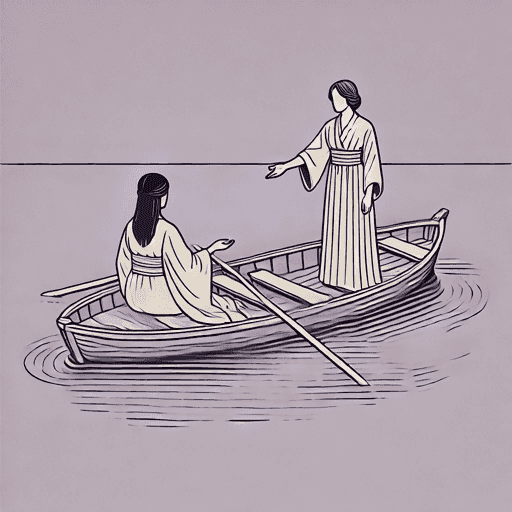
When Peter is almost fully encased, bone-things set upon them. They pick Alice up and begin to carry her, but a horn scatters them. A boatman arrives and begins fighting the bone-things. She brings Alice and Peter onto the boat before Weaver Girl can reclaim them.
Chapter 15 Summary
The boatman introduces herself as Elspeth, a name Alice recognizes. She was a Grimes advisee who died by suicide 10 years before Alice arrived at Cambridge. Though Cambridge had tried to scrub evidence of her from existence, rumors still circulated. In Hell, she’s solid-looking, beautiful, and chatty. She says the bone-things are controlled by magicians called the Kripkes. Alice recognizes them as American academics who used “wild and unconventional magick” (228) that could fill stadiums. Their tenure was denied, and they disappeared from public for five years before announcing a “TO HELL AND BACK” event (229). On stage, they consensually slit the other’s carotid artery and bled to death. Academics decided the pair got lost within their own “complex webs of fantasy” (230).
Elspeth says the Kripkes have taken on the “attributes of deities” (231) in Hell. She thinks the bone-things contain fragments of their minds. She says they also have a large bone construct imbued with their son; before they died, they laced his drink with arsenic. They’ve travelled all over the Courts trying to find a way back. Elspeth also tells Alice and Peter that if they die in Hell, they can’t be reincarnated.
Elspeth leaves to get food. Alone, Alice apologizes to Peter for condemning him. She tries to explain how her pentagram scar makes her lose her sense of self and agency. She admits she was afraid he’d condemn her because she saw his notebook. He’s offended she’d think he’d exchange her and expresses disbelief that he ever thought Alice wasn’t like Grimes.
Elspeth roasts rats for their dinner. Peter asks her how she and the Kripkes use magick. She cuts herself and dips the chalk in her blood before writing a pentagram that will fix Peter’s scratches. She says bigger spells demand bigger sacrifices. Peter tries a more complex spell with Alice’s blood. Elspeth says living blood works better than that of Shades, so the Kripkes have hunted any magician who has made the descent since their arrival. They’re on “the Great Quest” to leave Hell again: Elspeth discovered she didn’t want to stay in Hell, so she is also on the Great Quest. They can succeed by finding a “True Contradiction” (244) or a Dialetheia.
Chapter 16 Summary
Elspeth invites Peter and Alice into her home and shows them her library, filled with books she fished out of Lethe. When Peter goes to the bathroom, Elspeth says something that implies Alice and Peter are romantic partners. Alice denies this and changes the subject. Alice asks how Elspeth stays more solid than other Shades; Elspeth says it depends on proprioception and being able to hold an image of what you looked like in your mind while using your will to assemble your essence. Alice asks her why she died by suicide. When Elspeth asks why, Alice confesses she has considered it.
Elspeth begins by asking who Alice’s advisor is; Alice lies and says Helen Murray. Elspeth says her advisor was Grimes, and she was extremely successful until the “absolut[e] farce of it all” (250) became apparent to her. She sees Grimes as symptomatic of that structure. Alice thinks she is better than Elspeth because she could “read [Grimes’s] moods” (251) in a way that kept her from the worst of his anger. Elspeth also says Grimes is not a great magician anymore and is riding on his wartime success. Alice defends Grimes, and Elspeth drops it.
Instead, Elspeth explains a philosophical paradox called the self-torturer problem, where an individual chooses to imperceptibly increase their pain for a reward, which is figured as rational because the pain is imperceptible. Eventually, they experience intense pain but continue to make the choice and receive the reward, as the change is still imperceptible. She compares this to academia and says Alice looks like she understands. Alice knows Elspeth wants to help her and feels resentful.
Chapter 17 Summary
Alice wakes Peter in the night to convince him to find the Dialetheia before Elspeth does, so they can use it to bargain for Grimes’s life. Peter is shocked by Alice’s desire to betray their ally. Archimedes is listening, and Alice warns him not to tell Elspeth.
Alice reflects back on an ex-boyfriend who guessed she was infatuated with academia because she liked to accumulate gold stars. Alice thinks she’s enamored with “the high of discovery” (260). She thinks this separates her from being “just an animal” (261). She also loves how, among her peers, she is free to follow whatever trains of conversation they please without judgment. She sees the institution as the thing that gets in the way of that and decides she just needs to survive it.
Chapter 18 Summary
When Alice wakes the next morning, she joins Elspeth and Peter on deck. Inside the water of the Lethe, memories swirl in eddies and currents. Elspeth has to beat back a tumultuous nightmare. Alice almost gets sucked in by the memories, but Elspeth draws her back to herself. She explains that a draft made from the Lethe is used to cleanse Shades’ memories for reincarnation, but drinking water from the river directly can destroy Shades. She has seen the Kripkes drinking from the river, slowly erasing their humanity. Alice finds the idea of stripping away parts of herself alluring.
They sail past Greed, the Third Court, which takes the form of the empty areas at the edge of campus where the university has bought land but not done anything with it. Elspeth says she sees many academics in Greed, and they have trouble getting out.
They pull over at Wrath, where the structured institutions that mimic campus begin to disintegrate. Elspeth disembarks to gather hot coals left by Phlegyas. Peter goes below deck to draw the pentagram that will trap Elspeth. When she returns, Alice asks Elspeth for some tea. She goes to the kitchen, where Peter has hidden a pentagram under the mat.
As Elspeth makes tea, Alice starts asking Elspeth questions she hopes will be affected by Peter’s pentagram. They’re interrupted by Archimedes, who attacks the mat and reveals the pentagram. Elspeth calls Peter up to join them. In her fury, Elspeth transforms, butterflies erupting from her eyes. She alters the pentagram to make Peter and Alice tell the truth. They admit they’re there to rescue Grimes. Butterflies swarm them, carrying them off the ship and onto the shore of Wrath.
Chapters 12-18 Analysis
These chapters examine the interpersonal consequences of Grimes’s manipulation of Alice and Peter, with the toxic power dynamics invoking Academia as an Infernal Structure. Alice’s past traumas with Grimes keep her from opening up to Peter, while Peter has trouble opening up to Alice because of what he perceives as her closeness with Grimes. Alice’s account of Peter’s “joke” about her implied romantic encounter with Grimes is the first explicit indication that Grimes’s abuse of Alice may also have been sexual. Peter and his friend didn’t see Alice in the lab when Peter told his friend that Alice is: “‘Hopping where the seed is. Eating right out of his hand.’ ‘Burrowing in for warmth,’ said his guest. ‘Warmth,’ Peter drawled, the nastiest sound Alice had ever heard Peter make. There was the sound of fists against palms, some unquestionably vulgar gesture” (187). At this point, Peter’s comments are presented as a lewd joke at Alice’s expense, which they are, in part. However, they also foreshadow the revelations to come.
Grimes primed both Alice and Peter to see each other as competition, using their insecurities and ambitions to prevent them from becoming steady allies. Grimes told Alice, “[t]he only thought in your head these next five years should be whether you are keeping pace with him” (184), and unbeknownst to Alice, he told Peter the same thing about her. During this exchange with his friend, though his comments are mean-spirited, half-informed, and ultimately make light of Grimes’s abuse, Peter assumes that Alice is using sexuality to get ahead of him. Likewise, Alice thinks that Peter is using a “fragment of hearsay” (187) to get ahead of her. Grimes keeps them so busy with their competition that they cannot unite in solidarity with one another against him.
What Peter and Alice both think are facts about the other are incorrect, reflecting The Mutability of Facts, Reason, and Logic. Alice tells herself that people are “living paradoxes, keeping up an illusion just long enough to survive contact with others” (214). While Alice readily believes this about Peter, she does not extend the same logic to either herself or Grimes. Alice says the “first rule every graduate student learned was that at the base of every paradox there existed the truth” (229-30), and they should “never fully believe [their] own lie” (230), positioning this principle as elementary. The Kripkes, who seem at this point to be antagonists but are in reality very morally complex, show the consequence of losing one’s “grip on reality” (230) in this way. Elspeth says that the Kripkes “are not human anymore” (233). This new sense of repercussions for one’s relationship with fact provides narrative tension, as it remains unclear to what extent Alice believes her own unreliable narration about herself, Peter, and Grimes.
The tensions around whether Alice’s character will grow and accept certain grim realities, or get lost in a fiction, grow as she meets Elspeth and has a visceral negative reaction to the parts of herself she sees reflected in Elspeth. As Elspeth talks about dying by suicide, Alice thinks that it “scared her to hear her own thoughts reflected back to her” (249). For a moment, it seems as if Alice will have a breakthrough, though she sinks back into denial when she decides that “[s]uicidal depression was just an extreme form of failure” and “the same thing couldn’t possibly happen to her” (250). Learning about Alice’s suicidal ideation is a small glimpse into the reality of her experience, which she continually obscures through her unreliable narration and insistence that the institution is working as it should.
The novel often uses paradoxes as allegories for the narrative. Elspeth uses the self-torturer paradox to describe her relationship to academia, contributing to the theme of Ambition as Self-Damnation. This paradox explores how someone can make single decisions that seem logical and beneficial in each individual instance, but when seen as an accumulated whole, they lead to great pain and suffering. Though Elspeth uses this paradox to describe herself, the example also explains how and why Alice continues to make decisions that do not seem to be in her best interest, like betraying Elspeth or believing in Grimes. Only as Alice continues her katabasis will she realize she is trapped in her own self-torturer paradox.

Unlock all 64 pages of this Study Guide
Get in-depth, chapter-by-chapter summaries and analysis from our literary experts.
- Grasp challenging concepts with clear, comprehensive explanations
- Revisit key plot points and ideas without rereading the book
- Share impressive insights in classes and book clubs