Keep Your Friends Close
50 pages • 1-hour read
Lucinda BerryKeep Your Friends Close
A modern alternative to SparkNotes and CliffsNotes, SuperSummary offers high-quality Study Guides with detailed chapter summaries and analysis of major themes, characters, and more.
Symbols & Motifs
Content Warning: This section of the guide includes discussion of graphic violence, substance use, addiction, mental illness, illness, child abuse, emotional abuse, and sexual content.
Secrets and Lies
The motif of secrets and lies drives the plot and illuminates the theme of The Corrosive Power of Secrets in Friendships. The book suggests that relationships built on deception are destined for collapse, as they foster an environment of paranoia, betrayal, and violence rather than genuine connection.
Each character is entangled in a web of deceit that isolates them while creating a facade of intimacy. Whitney’s decision to hide her husband’s gambling relapse is the first significant lie the novel portrays, and it creates a fissure in her friendship with Kiersten. However, this deception pales in comparison to Jade’s fabrication of her daughter’s cancer, a lie she uses to manipulate her friends and steal from Whitney. As the novel progresses, the lies grow in magnitude. Kiersten’s secret about infertility and the fact that her daughter, Rinley, is not biologically hers isolates her and fuels her jealousy, while Jade’s secret affair is the precipitating factor for murder. When Kiersten discovers the affair, Jade kills her to prevent the truth from emerging, later explaining her panic: “I just wanted her to stop, but she wouldn’t” (251). Her desperate act of violence is the final, tragic outcome of a world where secrets are valued more than friendship, demonstrating that such bonds are not merely unstable but lethal.
The Swimming Pool
The swimming pool is a central symbol, representing the beautiful, placid surface of the characters’ privileged lives that conceals deadly truths. As an emblem of wealth and leisure in Beverly Hills, the pool is the perfect setting for Kiersten’s lavish “moms’ night out” (6), an event celebrating the characters’ curated images of success and happiness. However, its glittering water becomes a crime scene, a metaphor for how a perfect facade can hide terrifying dangers. Kiersten, an expert swimmer, appears to drown in her own pool, a starkly ironic event that immediately signals that nothing in this world is as safe as it seems. The discovery of her body transforms the symbol of status into a site of horror, underscoring that the very symbols of the women’s success are intertwined with their capacity for destruction.
Brooke’s initial, detached perception of the scene introduces the theme of The Unreliability of Perception in a World of Deceit. As her friends panic, she observes Kiersten’s body, thinking only of “how buoyant she looked. The way she just bobbed in the water like she was doing the dead man’s float” (3). This disconnect highlights the gap between appearance and the horrific reality of the situation, securing the pool as a reflection of the characters themselves: clear and inviting on the surface, but obscuring the moral decay and violence lurking just beneath.
The resolution of the mystery cements the pool’s association with deception. Early in the investigation, it emerges that Kiersten was killed by a blow to the head, and Jade ultimately reveals that after striking Kiersten in a panic, she placed her body in the pool in an effort to conceal her cause of death. The pool itself thus serves the characters’ lies, albeit in a way that ultimately unravels.
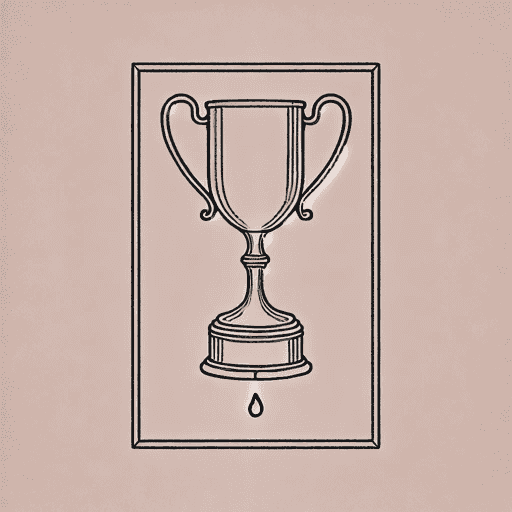
The “Mothering Award” Trophy
The “mothering award” trophy distills the novel’s critique of The Performance of Motherhood and Social Status into a single, ironic object. The awards ceremony is Kiersten’s idea, designed as a fun way to recognize “mothering tasks” like being the “fastest diaper changer” (8). This concept immediately establishes that for the West Hollywood Moms’ Club, motherhood is a public competition judged on external performance. The trophies are tangible emblems of this contest, celebrating a version of motherhood that is more about image and social status than genuine emotional connection. The awards are meant to be a lighthearted part of the party, yet they represent the toxic rivalry and jealousy that define the women’s relationships.
This symbolism reaches its apex when Jade uses one of the trophies as a murder weapon. This violent act transforms the object into an instrument of death, encapsulating how the group’s obsession with image turns lethal. The fact that the object used to kill Kiersten is an award for being a good mother is the ultimate indictment of their social circle, as the competitive drive to maintain a perfect facade has created an environment in which violence is used to protect a secret.

Unlock the meaning behind every key symbol & motif
See how recurring imagery, objects, and ideas shape the narrative.
- Explore how the author builds meaning through symbolism
- Understand what symbols & motifs represent in the text
- Connect recurring ideas to themes, characters, and events