Killing the Witches: The Horror of Salem, Massachusetts
51 pages • 1-hour read
Bill O'Reilly, Martin DugardKilling the Witches: The Horror of Salem, Massachusetts
A modern alternative to SparkNotes and CliffsNotes, SuperSummary offers high-quality Study Guides with detailed chapter summaries and analysis of major themes, characters, and more.
Chapters 8-15Chapter Summaries & Analyses
Chapter 8 Summary
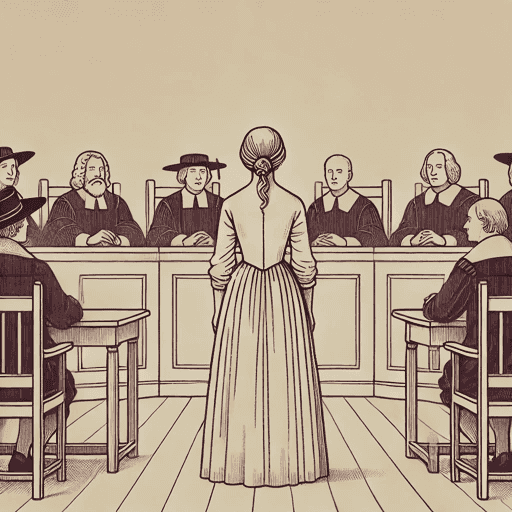
The next victim of the witch hunt was 71-year-old Rebecca Nurse, a respected member of the community whose husband clashed with Reverend Parris. Her accuser was from the Putnam family, with whom the Nurses had a longstanding property dispute. Her trial gained particular significance, as “a conviction will prove everyone is in jeopardy, even the most faithful. But an acquittal will cast doubt on those who deliver ‘spectral’ testimony” (74). Stoughton declared that if the image of a person appeared, it was because the person was communing with the devil. The odds were against Rebecca, but even the father of her accuser, Nathaniel Putnam, testified on behalf of her good reputation. The jury returned and, to the shock of the assembly, delivered a not-guilty verdict. However, Stoughton asked the jury to consider that “Nurse had referred to a confessed witch as ‘one of us.’ Is that not a confession [?]” (78). Nurse had only meant that they were in jail together, but it was too late. On July 19, Nurse and four others were hanged, one by one. Later that day, more accusations were made.
Chapter 9 Summary
John Proctor became a public opponent of the witch trials, denouncing them as a farce. His wife, Elizabeth, was a talented healer and related by marriage to Rebecca Nurse. When Proctor’s servant, Mary Warren, testified against Nurse, Proctor objected fiercely, but he was then arrested, and Warren named both John and Elizabeth as agents of the Devil. Many in the community spoke on Proctor’s behalf to no avail. Proctor was executed on August 19 along with four others, including another man, the minister George Burroughs. The event proved disturbing for Cotton Mather, as Burroughs recited the Lord’s Prayer from the gallows: “[T]he spectators are stunned. Witches cannot do that. The Devil doesn’t allow it” (89). The crowd wondered who would be next.
Chapter 10 Summary
Cotton and Increase Mather amassed considerable power in New England. They were not just preachers but community leaders in all aspects of life. Increase believed in witches, viewing them as the result of “a decline in religion” (93) but his son was far more eager to prosecute them. Cotton was a tremendous intellect, using his writings to support a large family, but his zeal for hunting witches knew no limit. He clashed with his own father on the question of spectral evidence, and the church decided not to rely on it solely while continuing with the trials and executions: “Back in Salem, the evil continues. There is no end to the pattern of accusation and execution. And, incredibly, things are about to get even worse” (98).
Chapter 11 Summary
Sixteen-year-old Margaret Jacobs watched four men approach her home. They arrested her, her grandfather, and then proceeded to arrest her mother, who had mental illness, and confiscate the property of her father, who vanished to avoid the accusations of witchcraft. Margaret’s grandfather, George Sr., was known as an irritable loner. Desperate to save her family, she decided to admit she was a witch. She testified against her grandfather, but when he was condemned to death, she denied being a witch, but it was too late. The 83-year-old man was hanged. Margaret’s trial was delayed, and she ultimately went free.
The jailers of Salem devised brutal methods for extracting confessions: Prisoners were tied to chairs or made to stand with their arms outstretched for long periods of time, locked in tiny cells, and their feet were tied to their necks as they were hung upside down. The next target of the hysteria was 81-year-old Giles Corey, whose large land holdings were eyed greedily by the town sheriff. His wife, Martha, was accused first, and after he supported the charges, he was arrested, and the sheriff promptly confiscated his property. When charged, Corey refused to make a plea of any kind, which prevented the trial from proceeding. To induce a plea, officials took Corey to a field and gradually put stones on his body. He refused to plea and died—since he was not formally convicted, his property remained within his family. Three days later, his wife was hanged with seven others. News of the killings reached London, and the king expressed his displeasure to the governor, William Phips, putting the governor on a collision course with Cotton Mather.
Chapter 12 Summary
John Alden Jr. was suddenly freed from his cell and taken away on horseback. Months earlier, Alden had just returned to Salem when accusations fell upon him. He denied the accusations, assuming that his good reputation would protect him, but his good relations with the Indigenous peoples informed accusations of engaging in pagan practices. He paid associates to spring him from jail and lived in exile for several months in New York City until returning to Massachusetts after the trials ended and was granted a pardon. After 19 executions (not counting Corey’s death), accusations continued to fly, many with personal motives. A group of young girls accused Elizabeth Cary of witchcraft, even though they could not identify her, and she was jailed. Her husband Nathaniel, a powerful shipbuilder, tried to have her released, but he instead broke her out, and they fled to New York City.
Southwest of Boston, Tom Danforth used his large estate to hide those accused of witchcraft—so many took refuge there that it gained the nickname “Salem’s End” (118). He did not directly supervise the accused, but many were saved due to his efforts.
Chapter 13 Summary
By September 1692, Salem was gripped in paranoia: “Families have been ripped apart. Parents are wary around their own children. Friendships have ended” (119-20). Tom Putnam was at the center of it, since it was his daughter, servant, neighbor, and daughter’s friend who were the main accusers. Going into constant fits and making accusations took an enormous toll on his young daughter, Ann, who even accused a four-year-old, who survived, of witchcraft. Other girls learned to mimic Ann’s symptoms and followed whatever she said. Cotton Mather regarded himself as coming to the aid of children under attack. Soon, children turned on their own parents, including 14-year-old Abigail Hobbs, who sought safety in accusing her father and stepmother. Their actual fate remains unknown, but it seems they avoided execution due to the sheer number of cases postponing their trial.
Chapter 14 Summary
The wife of Governor Wiliam Phips was next to be accused and jailed, joining upwards of 200 prisoners in Boston and Salem. He deferred considerable authority to the Mather family, and he had many other concerns as governor, including raids by native tribes and an ongoing drought. He was convinced that “the numerous arrests and gruesome hangings of their friends and neighbors [had] caused some to question whether justice [was] done” (130). When Lieutenant Governor Stoughton insisted on continuing the trials, Phips appealed to London, warning the Crown that “innocent people may have been executed because of the accusations” (131). After securing his wife’s release, Phips suspended all arrests and released many of the accused from jail. He also suppressed publications about the witch hunt, except for Cotton Mather’s defense of their necessity and effectiveness. Phips disbanded the court in late October, and while the Mather family insisted on the creation of another court to take its place, it did not carry out further executions.
Chapter 15 Summary
With the court abolished, accusations of witchcraft persisted but lost much of their power, and those accused could go about their lives. But even though there was no formal inquiry against the accusers, some still faced consequences. Samuel Parris, whose daughter became one of the main accusers, lost his ministry and went into obscurity. His daughter, Betty, lived and mostly escaped the infamy of her youth. Thomas Putnam and his wife, Ann, struggled financially and succumbed to illness in 1699. Their daughter (also Ann) admitted that she lied in her testimonies and died unmarried at 37. Sarah Churchill, the accuser of the Jacobs family, confessed to being a witch and narrowly escaped execution, and Elizabeth Hubbard, another frequent accuser, fled Salem after the trials ended. Abigail Williams allegedly died at 16, but this is uncertain. Sheriff Corwin, the killer of Giles Corey, died of a heart attack at 30. John Alden Jr. managed to have his innocence legally affirmed, and he lived to the age of 75. Governor Phips returned to England, where he faced charges of abusing seamen, but he pardoned all in Massachusetts Bay accused of witchcraft. Phips set sail on a Sunday, in violation of strict Puritan doctrine: “Just to make sure the colony noticed, Phips ordered the ship’s guns fired as the vessel cleared Boston Harbor” (139). He was arrested upon his return to London and died soon thereafter. His wife married a former judge on the court of Oyer and Terminer, and Cotton Mather was one beneficiary of her estate.
Increase Mather traveled to London to help write a new charter for Massachusetts and resumed his position as president of Harvard College, at one point allegedly holding a book burning for a text critical of his role in the witch trials. He died at the age of 84 and was buried in the North End of Boston. Cotton Mather failed to succeed his father as president of Harvard but helped to co-found Yale University in New Haven, Connecticut. His work in science placed him “at the forefront of advances in biology, genetics, and the prevention of scurvy” (142). He died at the age of 65. For the town of Salem itself, “a series of bad harvests in the years after the trials lead many to believe that God is punishing Salem” (143). Witch trials would never again occur in New England, and the families of the victims received compensation in 1711.
The trials were over, but the system of Puritan theocracy would lay the groundwork for a conflict that “affects every American to this day” (143).
Chapters 8-15 Analysis
With the Salem Witch Trials fully underway, the authors examine how hysteria escalates when fear overrides reason, reinforcing the theme of Mass Hysteria and the Perils of Fear-Driven Justice. The accusation of Rebecca Nurse exemplifies circular reasoning—where the more implausible an accusation, the more proof it becomes of an insidious conspiracy. The common-sense reasons for the accusation are plain: “Francis Nurse is a member of the five-man committee trying to get rid of Reverend Parris. Francis is also involved in a property dispute with the Putnam family. Clearly, things have become political” (73). Yet, for figures like Parris and Putnam, who benefit from hysteria, rational explanations are ignored in favor of paranoia. The trials become a tool of social and political control, eliminating rivals while consolidating power. Nurse’s standing in the community served as proof that “if a good person like Rebecca Nurse can fall prey to the Devil, then no one is safe” (73). Her family’s disputes likewise furnished the accusation that they were plotting against Parris and Putnam precisely because they were demonic agents trying to bring down honest and godly men. This form of reasoning ensures that no one, no matter how respected, is beyond suspicion—effectively dismantling any resistance to the trials.
What ultimately makes Parris and Putnam’s scheme possible, however, is the actions of the young girls. Throughout history, children often play key roles in episodes of mass hysteria, their perceived innocence making their accusations more credible. But the girls needed only throw themselves into fits, and whatever they said, no matter how ludicrous, was accepted. This emotional contagion describes how collective fear spreads rapidly through a group, reinforcing and escalating extreme behavior. Arthur Miller’s play The Crucible, which, as the authors note, is heavily influenced by the McCarthyite “witch hunt” against suspected communists in the US government, but otherwise deals with the same set of characters as this book. Miller convincingly portrays how the girls as a group are repeatedly capable of pushing each other’s mimicking and then expanding upon the performance to the point where they may even believe that their professions are true, as their group identity depends upon its unquestioning acceptance. This self-reinforcing dynamic transforms a handful of accusations into a full-blown societal crisis. What they present is, at least emotionally, very real, offering powerful evidence to those predisposed to knowing the conclusion. By the time rational doubt creeps in, the machinery of persecution is too strong to stop.
Several instances shook the aura of certainty: When the Rev. Burroughs cited the Lord’s Prayer at the gallows, “the spectators are stunned…there is a murmur in the crowd -folks beginning to question if somehow a mistake has been made.” This moment marks a turning point, revealing cracks in the hysteria. Here, the interests of powerful people like Cotton Mather—who has decided to stake his public reputation on being even harsher to witches than his famous father—intervene to ensure that doubt is swiftly quashed. Mather is there to assure them that “Satan is a cunning enemy” (89) and that the prayer is actually further proof of his guilt. This demonstrates how belief systems can be manipulated to sustain a narrative even when contradictions arise—any deviation from expectation is reframed as further proof of the initial premise.
There is thus a cycle of affirmation between the young girls and their protectors in Salem, and men like Mather based in Boston. The former group originally expressed the terror of the community, opening the way for a formal legal process to affirm the narrative of the Puritan ministry that tightened their iron grip on power, which had been foundering due to internal dissent and external crises. In this sense, the trials acted as a unifying force for a divided and uncertain Puritan society, allowing its leaders to reclaim control by presenting an external enemy. This consolidation of religious and political power reinforces the theme of When Faith Becomes Law: The Dangers of Theocratic Rule. Approval from the governing bodies gave the girls a sacred status, albeit one that surely inflicted a heavy psychological toll on them and may have contributed to some of them dying at a very young age. This unintended consequence—where the accusers themselves suffer because of the hysteria they helped create—reveals the destructive nature of unchecked fear.
Yet, hysteria itself is a self-sustaining force. The authors include the stories of brave people who stood up to the mass hysteria and did their part to alleviate the suffering of the victims, but, ultimately, the madness ended when someone equipped with both power and good sense stepped in and demanded that it stop.
Once Governor Phips shut down the courts, “the end has come. Few pay attention to the girls any longer” (133). This abrupt reversal highlights how quickly mass hysteria can dissolve once it is no longer reinforced by authority figures. The lesson here appears to be that mass hysteria thrives on cowardice—when no one, or only a handful of people like John Proctor, stands up, then they too can be cut down. Those who level accusations are cowards who, when the tables turn, will be “desperately trying to save their own reputations” (132). This aligns with historical patterns in other purges and moral panics, where accusers shift blame or attempt to escape scrutiny once public sentiment turns against them. Brave people with power who could stand up to bullies and social manipulators were needed. Governor Phips’s decision to intervene, despite previously allowing the trials to continue, demonstrates that those in power ultimately have the final say over whether hysteria is allowed to persist. If power is captured by the cowardly, then all may be lost.

Unlock all 51 pages of this Study Guide
Get in-depth, chapter-by-chapter summaries and analysis from our literary experts.
- Grasp challenging concepts with clear, comprehensive explanations
- Revisit key plot points and ideas without rereading the book
- Share impressive insights in classes and book clubs