Part 4Chapter Summaries & Analyses
Content Warning: This section of the guide features discussion of death, sexual content, animal cruelty, and death by suicide.
Part 4: “Book Four: The Trap”
Part 4, Chapter 1 Summary
In 2006, Colin charters a private flight to London, accompanied by his female pilot, Ronnie. Colin knows that Ronnie is attracted to him because he has hacked her phone. They part ways at Heathrow.
Colin meets Arthur, who cautions him about the journey they are about to undertake. Colin reminds Arthur that he wouldn’t have located the troll without Colin’s help.
Part 4, Chapter 2 Summary
Colin and Arthur argue over Arthur’s disdain for technology and Colin’s disdain for England. Colin critiques Arthur for choosing to leave Gwen for Oxford. Arthur counters that this was the only thing he could do after disappointing her.
Part 4, Chapter 3 Summary
Arthur and Colin drive to a town called Basingstoke shortly after Easter, when King Sorrow is weakest. Colin tells Arthur about the latest sacrifice: several Al-Qaeda soldiers in Iraq. Colin wants to use King Sorrow to prevent the next major terrorist attack. He believes that preemptive strikes in Iraq will ensure the survival of US soldiers there. Arthur is conflicted: In 2003, Colin gave him misleading information to make him choose Saddam Hussein as that year’s sacrifice. The resulting destruction in Baghdad, Iraq, caused Arthur to exile himself.
Part 4, Chapter 4 Summary
At an inn, Arthur explains how they will use the Surrealist’s Glass to locate Svangur if he chooses to hide from them.
Colin located Svangur using an algorithm, using reported sightings to track him to a place called Slaughterbridge. The location is also believed to be the site of King Arthur’s final battle against his son, Mordred.
Arthur has a contingency plan in case Svangur deceives them. He then welcomes Robin Fellows, who is joining their party as backup.
Part 4, Chapter 5 Summary
Robin believes that Arthur and Colin are searching for an unhoused man named Stuart Finger, who will help them to tour the area’s cave systems in search of a crypt. Robin is supposed to call emergency services if something goes wrong.
Part 4, Chapter 6 Summary
While touring a local waterfall, Colin muses that he is better off than Arthur because he uses technology to preserve the world.
Part 4, Chapter 7 Summary
That evening, Arthur, Colin, and Robin proceed to Slaughterbridge. Robin senses that her companions haven’t told her the full truth about their plans. Arthur reassures her by stressing that everything he has told her thus far has been true and that they are willing to face the risks of their quest. Robin asks if their visit has to do with the creature that attacked BA 238. Arthur refuses to answer, hoping to protect her.
Part 4, Chapter 8 Summary
Arthur and Colin find Svangur watching television under the bridge. Arthur bargains with him, offering 40 pounds to lead them to the crypt. Svangur accepts.
Part 4, Chapter 9 Summary
Svangur takes Arthur and Colin down a circuitous route, warning them against ghosts, voices, shadows, and briars. Arthur and Colin meticulously follow his movements, touching the same stone that he does. During their third circuit, the path reforms, revealing an old gate. The Surrealist’s Glass reveals a much larger structure and Svangur’s troll form.
Svangur leads them through a briar tunnel and under a dragon’s egg. He then ambushes Colin, prompting Arthur to activate the highest setting on his flashlight. The sun-like beam overwhelms Svangur and threatens to petrify him. This forces Svangur to comply.
Part 4, Chapter 10 Summary
Arthur identifies the cave they are in as a sanctuary that was turned into a mass grave during the Black Death. Colin posits that God is an egregore, or hive mind, like Elwood Hondo. Arthur suggests it is the other way around: Humanity is God’s egregore, testing his belief in them. They debate the implications of God’s existence for human suffering and agency, citing Black Cricket and the Black Death as conflicting examples. Arthur argues that suffering is the cost of living, and death is the end of suffering.
Spiders emerge from wall murals and attack Arthur and Colin. Arthur uses his willpower to manifest candles, using them to ward off the spiders. When they climb to safety, Colin urges Arthur to petrify Svangur, knowing that he sent the spiders. Arthur reminds him that Svangur is the only one who knows the way out of the cave.
Part 4, Chapter 11 Summary
The party reaches a natural formation called Arthur’s Stairs. Svangur’s gleeful comments about King Arthur’s grief cause Arthur to remark that the troll and Colin think the same way about God. Their attitude proves that noble acts like sacrifice and love are rare and therefore valuable.
The next chamber contains an endless chasm, triggering Arthur’s vertigo. Svangur mocks the men and sings a calypso song that compels Colin and Arthur to sing and dance, putting them at risk on the edge of the abyss. Colin prevents Arthur from falling into the chasm several times. They eventually reach the end of the chamber, much to Svangur’s amusement. Arthur threatens Svangur with his flashlight once again, impressing Colin.
Part 4, Chapter 12 Summary
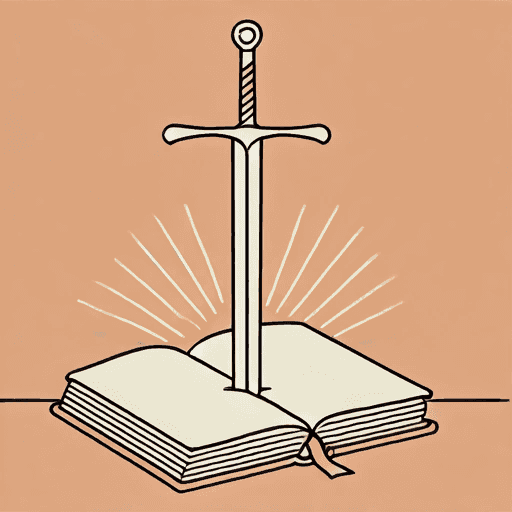
The group descends to the chamber containing Svangur’s hoard. Colin and Arthur uncover a tomb and find the Sword of Strange Hangings inside, along with a vial of saint’s blood and a martyr’s robe. Arthur explains that the sword evaluates intentions; it can only be drawn by good people. To his surprise, the sword comes easily to him. Colin asks to inspect the sword. While Arthur explains his plan to kill King Sorrow, Colin fatally stabs him. Colin does not want to let go of King Sorrow, believing he can continue to improve the world.
Part 4, Chapter 13 Summary
Colin sheathes the sword and confirms that he cannot draw it back out. It is revealed that Svangur and Colin conspired to trap Arthur. Colin retrieves the saint’s blood, which has restorative powers, and the martyr’s robe, which offers magical protection. When Svangur rejects the Surrealist’s Glass, Colin gifts him a new laptop as compensation for his services.
Part 4, Chapter 14 Summary
Colin and Svangur inter Arthur in the tomb with the sword.
Part 4, Chapter 15 Summary
As Svangur leads Colin back to the surface, he reveals that Colin could have harvested Arthur’s blood, which is also saint’s blood. He claims that in his dying moments, Arthur wept for Colin, rather than for himself or Gwen. Svangur thanks Colin for his contributions to the tech industry, indicating that many trolls will thrive on technology.
Part 4, Chapter 16 Summary
Colin fakes tears to convince Robin that he grieves Arthur’s death.
Part 4, Chapter 17 Summary
The novel flashes back to the summoning ceremony.
During the rite, Colin sees several visions in the broken mirror: the deaths of Van and Arthur; the defeat of Donna, Allie, and Gwen at the hands of King Sorrow; and Colin’s rise to power, ending with his winning the Nobel Peace Prize. Using the conch shell, Colin speaks to Elwood Hondo, who encourages Colin to use King Sorrow to protect both himself and those in need of protection. This motivation will turn his friends’ deaths into noble sacrifices. Hondo promises that Colin will have power over King Sorrow.
Part 4, Chapter 18 Summary
Gwen arrives to await the results of the search for Arthur’s body. She finds consolation from Colin. The search fails.
Part 4, Chapter 19 Summary
Before returning to the United States, Colin looks at himself using the Surrealist’s Glass and sees a void. He then uses some of the saint’s blood to heal his injuries and restore his youth in anticipation of sex with Ronnie.
Part 4, Chapter 20 Summary: “Fourth Interlude: Gwen, Under Attack”
In 2015, Robin sees a viral social media video of a man swallowing a live goat. The man reminds her of Stuart Finger. Robin returns to Slaughterbridge and finds an old man calling himself Glen Schrödinger. He initially denies knowing anything about Arthur or Colin, but eventually expresses awareness of Colin’s betrayal. Schrödinger then transforms into Svangur and attacks Robin, who uses Arthur’s old flashlight to petrify him.
Robin informs Gwen that Colin betrayed Arthur. Colin monitors their conversation using spyware he installed on Gwen’s phone. Gwen reflects on Colin’s selfish attachment to King Sorrow, as well as her friends’ deference to his selections, which she contrasts with her use of the sacrifice to help people in hospice die by assisted suicide. Gwen discovers that Colin manipulates the list every year to prioritize targets whose deaths advance his business interests. Shortly before their next selection meeting, Gwen cautiously deflects when her friends ask if she has spoken to Robin. When Colin mentions Arthur, however, Gwen articulates her resentment about Colin’s ulterior motives. Later, King Sorrow visits Gwen to tell her that Colin has named her as the sacrifice.
Daphne Nighswander is released from incarceration. She tells the release officer that she is planning to visit her late daughter’s friends. She also jokes that she plans to buy a car and a gun.
Part 4 Analysis
The death of Arthur reconnects the novel to its roots in Arthurian legend. Both characters’ arcs end tragically in unexpected betrayal by a would-be ally: King Arthur is killed by his son, whose jealousy and rage over not being named Arthur’s heir turn him against his father; in the novel, Arthur is lured to his death by Colin, who is similarly motivated by greed and a lust for power. Both Arthurs are also fatefully associated with swords that render judgment about their worthiness: The mythical Arthur proves his fitness to rule Britain by pulling a magical sword from a stone, while the novel’s Arthur is characterized as an upstanding man by the sword in the crypt. Most importantly, both deaths signal the end of a potentially positive future. King Arthur’s demise marks the conclusion of a golden age and the dissolution of the Round Table’s chivalric order. Likewise, killing Arthur empowers Colin to continue his cynical self-dealing all the more; as Gwen comes to learn, he uses King Sorrow to further business interests rather than truly evaluating the worst of humanity. Consequently, the stakes heighten for the novel’s remaining protagonist, Gwen, as she must not only contend with the threat of King Sorrow but also that of Colin.
Just as the novel has one foot in the world of myth, it is also firmly situated within the real world. Hill uses many historical events to parallel elements of his plot so that the characters feel grounded even as they face increasingly supernatural forces and interact with magical artifacts and beings. The references also compare the group’s faulty decision-making about whom to sacrifice to King Sorrow to errors in judgment made by officials in our own world. In 2001, the group regrets not naming Osama Bin Laden, the mastermind of the biggest terrorist attack on US soil, despite being aware of him for several years. This is a direct parallel to US officials’ failure to act on collected intelligence about Al Qaeda and its plans before the September 11 attacks. In 2003, Colin convinces the group to name Saddam Hussein, the tyrannical dictator of Iraq, who Colin claims poses a dire threat to the world. This is an allusion to the famously false justification made by the US for the Iraq War in the real world: that Hussein had weapons of mass destruction. These references contrast the seeming certainty of the premonitions received during the initial summoning ritual with the chaotic reality of trying to predict the future, deepening Hill’s examination of The Ethics of Killing.
Despite these many errors in judgment, Colin never questions his choices. Like Donna, his moral rot is evidenced in his self-assuredness and lack of doubt. His penchant for surveillance and invasion of other people’s privacy suggests that he views information as the prime currency of power. In part, this is the result of his experience during the summoning ceremony, where the malevolent ghost of Hondo promises a prosperous future. For Colin, the deaths of his oldest friends are an acceptable cost for his own success: “It was noble (Nobel?) to imagine his friends dying so thousands of others might live […] so that no one could ever say no to Colin Wren” (661).
Although the novel borrows many elements from Arthurian legend, the most glaring omission is the absence of Merlin, the sage wizard and mentor figure who shepherds King Arthur. The role of the guide in the novel is instead split into two. Moral instruction is provided by Arthur’s mother, Erin, whose example is meant to show the next generation how complicated The Challenge of Absolving Guilt is and also to promote Faith in Human Goodness. The magical aspects of Merlin’s assistance, in contrast, are transferred to an antagonist: Svangur, a literal troll who shows Colin and Arthur the way to the sword. Svangur’s motivations are, well, trollish: He mocks the two friends, causes them to almost dance themselves off a cliff, and helps Colin betray Arthur for the cost of a laptop that will enable him to connect to other trolls for further mischief (the implication is that Svangur will become an internet troll). Thus, when Svangur rejects the Surrealist’s Glass, he is symbolically rejecting the knowledge of true forms in favor of a technology that enables him to deceive and exploit others.
Colin’s transformation into one of the novel’s antagonists underscores the importance of the debate he has with Arthur during their descent into the cave. After Colin compares God to the murderous Elwood Hondo, Arthur points out that Colin and Svangur think alike, deriding those who suffer the cruelty of King Sorrow in the absence of an objective moral order. Arthur’s appeal to the value of compassion and love matches Erin’s philosophy, which sees the chaos of the world as a given in which one can perform noble deeds. Arthur has tried to embody this ideal by working to end their arrangement with King Sorrow, but because his excessive goodwill has led to his downfall, the novel now charges Gwen, Donna, and Allie to embody the same nobility while facing the dual threats of Colin and King Sorrow.

Unlock all 72 pages of this Study Guide
Get in-depth, chapter-by-chapter summaries and analysis from our literary experts.
- Grasp challenging concepts with clear, comprehensive explanations
- Revisit key plot points and ideas without rereading the book
- Share impressive insights in classes and book clubs