Kingdom of the Blind
64 pages • 2-hour read
Louise PennyKingdom of the Blind
A modern alternative to SparkNotes and CliffsNotes, SuperSummary offers high-quality Study Guides with detailed chapter summaries and analysis of major themes, characters, and more.
Symbols & Motifs
Content Warning: This section of the guide includes discussion of death, addiction, and substance use.
The Crooked Farmhouse
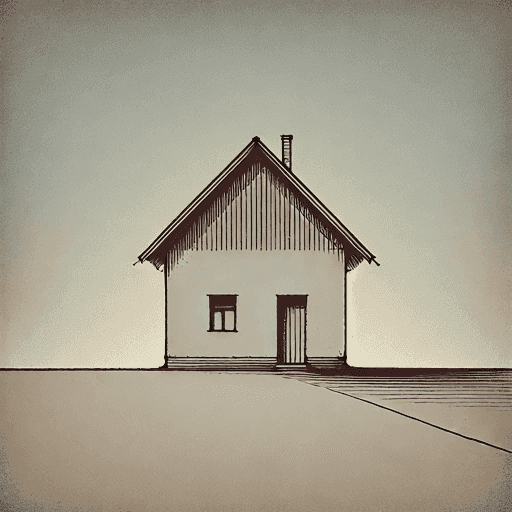
The crooked farmhouse is a symbol of the decaying and fundamentally unsound legacy of the Baumgartner family. Its physical dilapidation directly mirrors the moral and psychological crookedness of an inheritance built on fantasy and resentment, connecting to the theme of Choosing Forgiveness Over Conflict. From his first sight of it, Gamache frames it through the lens of a nursery rhyme: “He bought a crooked cat, which caught a crooked mouse, / And they all lived together in a little crooked house” (3). This association immediately casts the farmhouse as more than a building or even a home; it is the repository of a dysfunctional history, a place where generations have been shaped by a warped foundation. Its structural instability represents the instability of the family’s identity, which has been propped up for decades by the fantasy of a lost fortune and title.
The house’s final collapse under the weight of snow is a metaphor for the family’s legacy crumbling under the pressure of truth. The event is both a physical, structural failure and a narrative climax, as the wreckage reveals the murdered body of Anthony Baumgartner. The violent collapse of the home exposes the violent, buried truth of the family’s history. However, the house also represents the complexity of generational inheritance; growth charts on a doorjamb remind the liquidators that it was once a happy home, filled with children. This duality suggests that legacies, however corrupted, contain both cherished memories and the seeds of their own destruction, making their eventual ruin all the more tragic.
Carfentanil (Opioids)
The missing shipment of carfentanil is a symbol of the tangible and catastrophic consequences of a decision made for the “greater good.” It embodies the theme of The Burden of Accountability, serving as a ticking clock that quantifies the immense human cost and urgency of Gamache’s morally ambiguous actions. The carfentanil is not an abstract threat; it is a physical poison that Gamache knowingly allowed into the country, and its presence haunts him throughout his suspension. Although he is no longer in a position of power, he still holds himself accountable for that decision. This feeling of responsibility forces him into a secret, unsanctioned operation that pushes him beyond the legal and ethical boundaries he has sworn to uphold.
The sheer deadliness of the opioid, and the magnitude of Gamache’s decision, is reinforced by Beauvoir, who, when asked to imagine the worst possible outcome, states, “That would be the very best that could happen” (46). This chilling assessment frames the carfentanil as an almost apocalyptic force, elevating Gamache’s personal crisis to one of societal scale. The carfentanil symbolizes the uncontrollable chaos that can be unleashed by even well-intentioned choices. Its recovery becomes Gamache’s sole focus, a desperate attempt to contain the destructive potential of his morally ambiguous decision and reaffirm his commitment to justice, even at the cost of his career and reputation.
Snow
Snow functions as a motif in Kingdom of the Blind, representing both the obscuring of truth and the difficulty of clear perception, connecting to the theme of Recognizing the Limits of One’s Perspective. Throughout the novel, heavy snowfall traps characters physically while also mirroring the way inherited grievances and personal secrets cloud judgment. When Gamache visits the Baumgartner farmhouse, he warns that it is “too dangerous. Especially with the weight of this snow” (106). On a literal level, the structure cannot withstand the accumulation. Symbolically, the house bears the weight of decades of resentment, fantasy, and deception. The snow becomes an external sign of the invisible pressures pressing down on the family: stories about stolen wealth, concealed crimes, and unexamined anger. The true danger in the novel is in the layers that obscure the truth.
Earlier, Gamache imagines the farmhouse as it once was, and “once Armand stripped away the snow and straightened the crooked house, he could just about see it” (65). The phrasing suggests that clarity requires deliberate effort. Truth is not absent; it is covered. Snow conceals outlines and distorts shapes, much like the characters’ assumptions distort their understanding of Bertha’s will and Anthony’s death. When the farmhouse finally collapses and “disappear[s] into a cloud of snow” (133), the image captures a paradox. The very element that hid the truth also accompanies its revelation. The fall of the house exposes Anthony’s body and the violence within, even as snow momentarily blots out vision. The motif underscores the novel’s insistence that the limits of one’s perspective persist only as long as individuals refuse to clear away what has settled over the past.

Unlock the meaning behind every key symbol & motif
See how recurring imagery, objects, and ideas shape the narrative.
- Explore how the author builds meaning through symbolism
- Understand what symbols & motifs represent in the text
- Connect recurring ideas to themes, characters, and events