Symbols & Motifs
The White Room
Content Warning: This section of the guide includes discussion of sexual content, graphic violence, cursing, child abuse, and death.
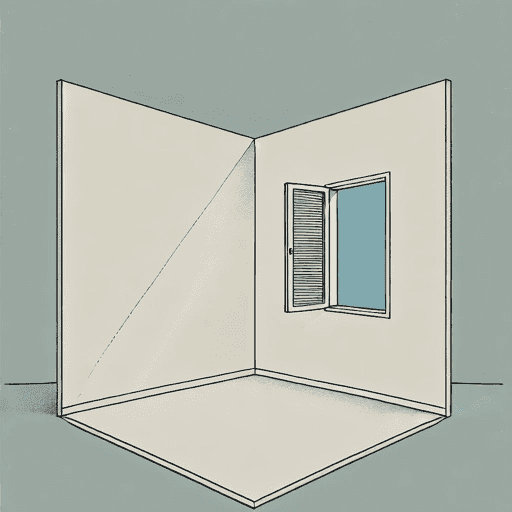
Gareth’s white room is a recurring symbol within the narrative that contributes to the theme of The Relief of Establishing Power Dynamics. For Gareth, the white room is a metaphysical space and a state of mind where he is allowed to find peace from his impulses. As a symbol, therefore, the white room operates as a marker of calm but also of stability, wherein Gareth feels balanced and does not fear the actions of his own person.
Its barren, white walls are also significant as they come to represent simplicity. The room is without color or noise, providing a sensation of sensory deprivation, wherein Gareth is no longer under the onslaught of his impulses or what he calls his “demons.” Kent makes this especially clear when Gareth is being tortured, and his white room reflects his response to the violence, “dripping in crimson no matter how much [he wipes] the walls” (276). This disruption of his calm, safe space is echoed in the real world as he loses control and inflicts harm upon himself, unable to resolve his conflicting feelings about Kayden. Kent implies that Gareth finds it very difficult to achieve this state of mind, as the only notable instance where he accessed it outside of his relationship with Kayden is when he avenged Harper and killed her father. Murder and violence, therefore, are what he associates most with this space before he encounters Kayden. Within the context of the dominant-submissive relationship, however, not only can Gareth attain this state more often but, by the end of the narrative, he can do so seemingly at Kayden’s command: “The white room is closed now, locked. Not even bloodied like it used to be. I don’t have access to it anymore, because Kayden has the keys” (352). His relinquishment of control over the white room parallels the relief he feels when he gives control of their relationship over to Kayden.
Tattoos
Tattoos are a recurring symbol within the narrative and support the theme of The Lasting Effects of Past Trauma. Kayden’s snake tattoo symbolizes his tumultuous past and the great effort he’s made to overcome his father, Vencor, his brother Grant, and the death of his wife, Cassandra. As an image, the snake serves two functions. The first is, as he describes to Gareth, “power through transformation. It’s about being fluid, adapting, and never getting too comfortable” (218). Here, Kent invokes Kayden’s cruel childhood under his father, as he learned to remain vigilant and constantly flexible to survive his father’s ruthless tutelage and expectations. In its second function, the snake imagery denotes the inherent danger within Kayden, specifically when juxtaposed against his small lily tattoo, which represents Cassandra’s innocent life and the love he bore her.
The meaning of Kayden’s tattoos changes over the course of the novel: As it is later mutilated by Gareth, the remnants of the lily tattoo come to represent Gareth’s possessive jealousy of Kayden and the consequent eradication of Kayden’s rage for Cassandra’s murder. Kayden’s third and final tattoo, the compass with Gareth’s crossed arrows tattooed over Kayden’s heart, symbolizes how Kayden’s life will now be directed by his love for Gareth. Gareth’s tattoos are comparatively straightforward and steadfast. As a symbol, his crossed arrows also serve a dual purpose: They denote his killing impulses and dangerous personality while also being “a paradox, a memento that [he’ll] never [be] as in charge as [he wants] to be” (218). His snake tattoo, which he gets later in the novel, serves a similar purpose to Kayden’s compass with crossed arrows; it is his response to Kayden’s tattoo and a declaration of his answering love and commitment.
Penetrative Sex
Penetrative sex is a motif within the narrative that supports the overarching theme of the relief of establishing power dynamics. Within the first half of the narrative, penetrative sex is used as a symbolic idea to intimidate Gareth as, for him, it entails a complete submission and abdication of control, as well as a new understanding of his sexuality and identity. As he states, “But me? Gay? No way in hell. It’s not actually about being gay. I’m open to that idea, but I’ll never be fucked” (111). Through this narration, Kent establishes that Gareth’s initial refusal to partake in penetrative sex stems from his fear of being made vulnerable rather than a reticence to engage in sexual activities with another man.
As Kayden pressures Gareth to allow penetration, however, the symbol evolves and becomes the basis of their non-negotiated and barely consented dominant-submissive relationship. It is through Gareth’s first experience with penetrative sex that they establish how Kayden will dominate Gareth and, within their sexual activities, remove his will. Penetrative sex thus becomes a gateway for Gareth to be vulnerable and no longer hide behind the social mask of his golden boy persona, since Kayden gives him no other option and demands his honesty. As Gareth becomes more accustomed to this dynamic, he comes to terms with his sexuality as he freely explores his hitherto nonexistent libido.

Unlock the meaning behind every key symbol & motif
See how recurring imagery, objects, and ideas shape the narrative.
- Explore how the author builds meaning through symbolism
- Understand what symbols & motifs represent in the text
- Connect recurring ideas to themes, characters, and events