Languages
Languages
A modern alternative to SparkNotes and CliffsNotes, SuperSummary offers high-quality Study Guides with detailed chapter summaries and analysis of major themes, characters, and more.
Poem Analysis
Analysis: “Languages”
“Languages” opens with both a declaration and a warning: “There are no handles upon a language” (Line 1). In opening the poem with this bold statement, the speaker immediately draws the reader’s attention to both language’s greatest strength and its greatest weakness, both of which will feature throughout the poem. The greatest strength of language is its dynamism—the very fact that it eludes “handles” allows it to develop and change over time as a living force in human society. However, this same lack of “handles” also means that language ultimately evades preservation, and therefore, forfeits its only means of survival: Since men cannot “take hold of it” (Line 2), it is therefore impossible to “mark it with signs for its remembrance” (Line 3). The duality of this situation creates the tension that lies at the very heart of language and human communication more generally.
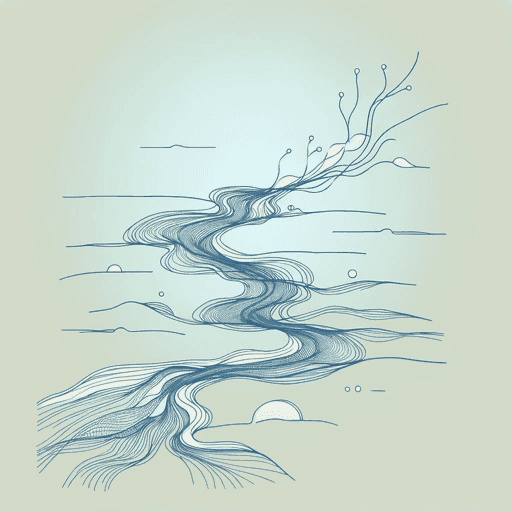
The speaker then compares language to “a river” (Line 4), which will become the dominant symbol in the poem. In choosing the symbolism of the river, the speaker emphasizes the key qualities that a language always possesses while in active use: fluidity and dynamism, the ability to change direction or form when necessary, and the ability to link different places and people through its presence, just as a river can connect diverse areas of terrain. In describing a language as “Breaking a new course / [and] Changing its way to the ocean” (Lines 6-7), the speaker credits language with transformative power and a high degree of strength, as a force that can and does change the face of the earth. In praising the way language can move “from nation to nation / Crossing borders and mixing” (Lines 10-11), the speaker acknowledges the essential role language plays in linking different human societies.
While clearly important for the functioning of human societies at large, the speaker also emphasizes the importance of language on a more individual level. The speaker depicts language as the means by which a person can share something of their emotions or intellect with someone else: words are “wrapped round your tongue today / And broken to the shape of thought / Between your teeth and lips speaking” (13-15). Similarly, human song is also referenced as a means of expression in the lines, “Sing—and singing—remember / Your song dies and changes” (Lines 19-20), suggesting the emotional release that language can provide in both individual and communal settings. Furthermore, the poem itself is an act of human expression through language: Using words as his medium, the speaker is able to share his vision of the nature of language with the reader, with the poem itself serving as a testament to the creative and communicative power of human language.
However, alongside this celebratory vein in the poem is a perpetual reminder that languages—like rivers—inevitably give way to a natural life cycle that ends in extinction and irrelevance. The poem’s opening warning about a language’s lack of “handles” (Line 1) and man’s inability to “mark it with signs for its remembrance” (Line 3) becomes more marked throughout the course of the poem. The speaker warns the reader that the living words they are “speaking / Now and today” (Lines 15-16) will be reduced to “faded hieroglyphics / Ten thousand years from now” (Lines 17-18), with the use of the term hieroglyphics serving as an allusion to the past civilization of Ancient Egypt. Just as Ancient Egyptian hieroglyphics became remnants of a dead language, so too will the words that the speaker (and reader) uses today become irrelevant or even forgotten with time.
The poem ends on a bittersweet note, with the speaker urging the reader to “Sing—and singing—remember / Your song dies and changes” (Lines 19-20, italics added), with the imperative use of “remember” reminding the reader of the importance of being fully aware of the dual nature of language. As the speaker points out in the poem’s closing lines, while human song and expression may bring joy to the reader today, such language will nevertheless “not [be] here to-morrow / Any more than the wind / Blowing ten thousand years ago” (Lines 21-23). Languages, like the natural phenomenon of rivers and wind alluded to throughout the poem’s imagery, will eventually die away, to be replaced with new languages that may completely eliminate even the memory of the languages that came before.

Get in-depth, chapter-by-chapter summaries and analysis from our literary experts.
- Grasp challenging concepts with clear, comprehensive explanations
- Revisit key plot points and ideas without rereading the book
- Share impressive insights in classes and book clubs