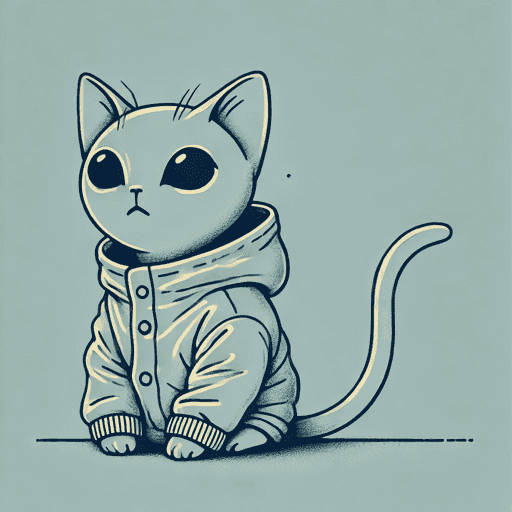
Leonard (My Life as a Cat)
47 pages • 1-hour read
Carlie SorosiakLeonard (My Life as a Cat)
A modern alternative to SparkNotes and CliffsNotes, SuperSummary offers high-quality Study Guides with detailed chapter summaries and analysis of major themes, characters, and more.
Themes
Identity and the Struggle to Fit In
In Leonard (My Life as a Cat), Sorosiak explores the challenges of fitting in through the parallel character arcs of Leonard and Olive. Both characters struggle with feeling like outsiders, grappling with the pressure to conform to social expectations and fearing being judged by others. However, through their friendship, they learn to embrace their differences and discover that true belonging comes not from fitting in, but from finding others who accept you for who you are.
Leonard’s struggle is a hyperbolized, science fiction-infused version of the outsider experience. As an alien, he arrives on Earth with only a limited understanding of human behavior, making even the smallest social interactions a challenge. He originally meant to come to Earth as a Yellowstone park ranger and spent years studying how to guide humans through nature. Instead, he is mistakenly transformed into a cat, a creature whose instincts and behaviors he does not understand. Leonard conceptualizes this new adjustment challenge as a journey “venturing… into unknown territory” (22). This language emphasizes the physical nature of belonging and the way movement poses a particular challenge for an outsider.
Leonard also faces barriers that come not from his outsider status among humans, but from his own species’ rules. His species believes that he should “never trust a human” (49), emphasizing their reputation as invaders and colonizers. Even though Leonard believes in the “goodness of people” (49), he feels an internal pressure to conform to the social rules of his own species. This secrecy isolates him, preventing him from forming meaningful connections at first. It is only when he breaks this rule and confides in Olive that he begins to experience true belonging as himself.
Olive’s journey parallels Leonard’s, though on a more human scale. Like Leonard, she struggles to fit in, particularly among her peers. She feels like “there are all these rules” that are “not written down anywhere” (127), emphasizing how hard it is to parse social conventions if one is in any way different. For instance, when other children mock her for taking her cat to the beach, she is genuinely confused about why this is laughable behavior. She also loves talking about animals, but people like her mother’s boyfriend, Frank, make her feel as though this passion is embarrassing. Just as Leonard struggles with the unspoken rules of being a cat, Olive feels stifled by the unspoken social rules governing her peers.
Both characters also struggle with internalizing the judgments of others. Frank’s comment about Olive being weird causes her to withdraw and doubt herself, making it difficult for her to open up to new people. Leonard similarly internalizes his status as an outsider, often worrying that he is a burden to those who care for him. This self-doubt becomes a barrier to connection, reinforcing their feelings of isolation.
However, their friendship provides an antidote to these fears. Leonard validates Olive’s love of animals and sees her for who she truly is, while Olive offers Leonard unconditional acceptance, patiently helping him adjust to life on Earth and never treating him as a burden. With one another’s help, they both learn to embrace their unique identity and cultivate a sense of genuine belonging.
What It Means to Be Human
Leonard (My Life as a Cat) uses its science fiction premise to explore the fundamental question of what it means to be human. Leonard’s identity as an alien offers him a unique outsider’s perspective, allowing him to reflect on the essence of human experience with sharp insight. His journey reveals that humanity is not defined by objects, rituals, or even common experiences, but by emotional connection and the relationships that infuse even small, quotidian moments with meaning.
Leonard arrives on Earth with preconceived notions about humanity, shaped by exported media like I Love Lucy and the galaxy’s broader conception of humans as violent and destructive. Leonard oscillates between these two pictures of humanity, and his understanding of human nature is both fragmented and romanticized. Since his species is so data-driven, he initially approaches human life with a checklist of experiences he believes are essential. He wants to “try a cheese sandwich” and “go to the movies” and “walk with someone by the river” (17-18), choosing ordinary, isolated moments that represent his romanticized view of humanity. Leonard does not initially understand what would give these experiences the emotional significance that causes humans to consider them meaningful.
The major turning point in Leonard’s journey is when he begins to understand connection as the core piece of what it means to be human. As he inhabits a mortal body, he experiences “real, actual pain” (55) and the fear and sense of impending mortality that come with it. After going to the movies with Olive and Norma, he is surprised to discover one of the essential functions of art: It helps people cope with uncertainty, mortality, and the unpredictability of life. Music, books, and television are not just entertainment but a means of processing emotion, building empathy, and finding joy despite life’s challenges.
Leonard’s relationship with Olive ultimately gives his expectations of humanity new meaning. A cheese sandwich is no longer just a food item—it becomes a special experience because he shares it with Olive. Leonard recontextualizes his study and preparation, recognizing that after “all that time” and “all that study,” the most meaningful part of this Earthly experience is the fact that he now has “someone to share it with” (168). Walking in the rain is not just about feeling water droplets on his fur but about the companionship and warmth of being with someone who cares about him.
Through Olive, Leonard realizes that connection is the key element of being human. The very things that make human life fragile—mortality, risk, and imperfection—also make it beautiful and meaningful. By the end of the novel, Leonard has fully embraced this understanding, choosing to remain on Earth as a mortal rather than returning to his immortal, emotionless existence in space.
The Power of Unconditional Friendship
Through the central relationship between Olive and Leonard, Leonard (My Life as a Cat) explores the transformative power of unconditional friendship. Their bond demonstrates how true friendship provides courage, strengthens self-esteem, and ultimately becomes a form of chosen family.
From the very beginning, Olive’s friendship with Leonard is defined by her selfless willingness to help him. When she first meets him, she braves “dark water” (14) and “thunderous rain” (15), defying her grandmother’s orders because she can’t bear to leave a vulnerable cat outside in the storm. This act of kindness demonstrates the pure and instinctive nature of her friendship—she helps because she cares, not because she expects anything in return. Her courage and generosity inspire Leonard in turn.
Although Leonard struggles to adjust to life as a cat, Olive’s unwavering support gives Leonard “a kernel of faith” (22), giving him the strength to navigate all of the obstacles he faces on Earth and the seemingly impossible journey to Yellowstone. When Olive later learns that he is an alien, her acceptance never wavers. She is willing to go to great lengths to protect him, even embarking on a road trip to Yellowstone to help him return home. Her bravery and dedication inspire Leonard to make his own sacrifices, ultimately choosing to stay on Earth with her permanently, even though it means giving up his old life.
Beyond inspiring courage, their friendship also serves as a key source of emotional support. Unconditional friendship means accepting someone completely, without judgment or expectation, and Olive and Leonard provide this for each other. Olive, who has spent much of her life feeling like an outsider, feels safe enough with Leonard to express her deepest fears: Her frustration with Frank, her sadness about not fitting in, and her worry that she is unlovable. Leonard’s presence reassures her that she is valued and understood. Similarly, Leonard, who worries about the “burden” he places on Olive and “how little [he] was giving in return” (103), learns that he is valued for who he is and that he is not a burden at all. Olive’s unwavering support counteracts his feeling of insecurity, enabling Leonard to accept help.
By the end of the novel, Leonard and Olive reframe their relationship in terms of family. Their friendship transcends companionship; it becomes a lifelong commitment based on trust, acceptance, and unconditional love. Through their journey together, the novel emphasizes that family is not solely defined by biology but by the people who stand by you no matter what.

Unlock every key theme and why it matters
Get in-depth breakdowns of the book’s main ideas and how they connect and evolve.
- Explore how themes develop throughout the text
- Connect themes to characters, events, and symbols
- Support essays and discussions with thematic evidence