Leonardo Da Vinci
53 pages • 1-hour read
Walter IsaacsonLeonardo Da Vinci
A modern alternative to SparkNotes and CliffsNotes, SuperSummary offers high-quality Study Guides with detailed chapter summaries and analysis of major themes, characters, and more.
Chapters 14-20Chapter Summaries & Analyses
Chapter 14 Summary: “The Nature of Man”
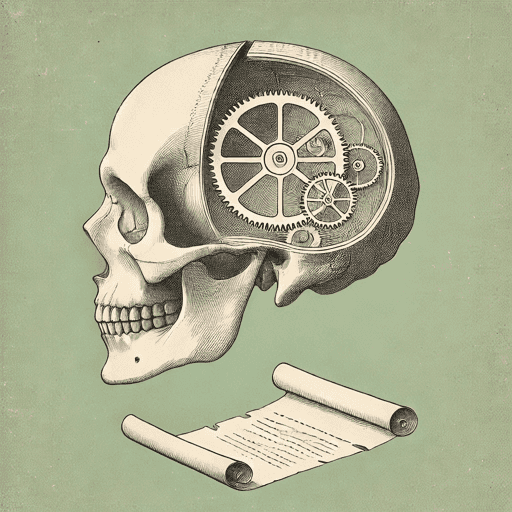
Leonardo’s anatomical studies began as a tool to enhance his painting, but they evolved into a deep scientific inquiry driven by curiosity. Influenced by Alberti’s belief that understanding anatomy was essential to art, Leonardo immersed himself in dissection, sketching bones, muscles, and internal organs with extraordinary detail. His 1489 studies of the human skull pioneered cross-sectional drawing techniques. He explored how the senses worked, especially vision, and theorized about the “senso comune,” where all perception converged in the brain. He also conducted early nervous system experiments, including pithing a frog to locate the center of motion. By the 1490s, Leonardo extended his anatomical research to human proportion, producing thousands of measurements and sketches. This obsessive documentation was part of a larger vision: to discover the universal measure of man and unify artistic representation with scientific truth.
Chapter 15 Summary: “Virgin of the Rocks”
Leonardo’s Virgin of the Rocks exists in two major versions, one in the Louvre and one in London’s National Gallery. Originally commissioned in the 1480s by a Milanese confraternity, the painting was intended to celebrate the Immaculate Conception, though Leonardo ignored specific instructions and depicted a more mystical scene with Mary, Jesus, John the Baptist, and an angel. The first version, rich in geological and botanical accuracy, was likely sold after a payment dispute. The second version was produced with help from Leonardo’s studio and differs subtly in composition, lighting, and symbolic detail. Both versions showcase Leonardo’s use of sfumato, chiaroscuro, and narrative gesture. The chapter also explores Leonardo’s collaborative studio practices and the androgynous depiction of the angel, likely based on his silverpoint drawing Head of a Young Woman, considered one of the most beautiful and technically masterful studies of the Renaissance.
Chapter 16 Summary: “The Milan Portraits”
This chapter examines several portraits Leonardo painted during his Milan years, including Portrait of a Musician, Lady with an Ermine, La Belle Ferronnière, and the controversial La Bella Principessa. Portrait of a Musician—unfinished and rigid—may depict Leonardo’s companion Atalante Migliorotti. Lady with an Ermine, a portrait of Ludovico Sforza’s mistress Cecilia Gallerani, is lauded for its emotional depth, dynamic pose, and luminous light effects. La Belle Ferronnière, possibly of Lucrezia Crivelli, explores reflected light and viewer interaction but is less universally admired. The chapter concludes with the dramatic story of La Bella Principessa, a drawing whose attribution to Leonardo sparked debate involving fingerprint analysis, vellum dating, digital forensics, and scholarly disagreement. The authentication journey, marked by twists, skepticism, and eventual support from Leonardo experts, highlights the complexity of connoisseurship and the scientific and humanistic fascination surrounding Leonardo’s legacy.
Chapter 17 Summary: “The Science of Art”
This chapter explores Leonardo’s defense of painting as the highest of the liberal arts, articulated in a public paragone (comparison) debate in 1498 and developed in his notebooks and treatise drafts. He argued that painting combines science and imagination, requiring knowledge of optics, perspective, light, shadow, and human motion. He emphasized sight’s supremacy over other senses and described painting as both an intellectual and creative act. Leonardo also challenged the dominance of lines in art, instead favoring gradations of shadow to model form. His pioneering insights into light, vision, and sfumato were supported by experiments, anatomical dissections, and optical studies. Though he never published his treatise, his assistant Melzi later compiled it from Leonardo’s notes. Leonardo’s approach blurred the line between observation and invention, art and science, reinforcing the central tenet of his genius: that creativity thrives at the intersection of disciplines.
Chapter 18 Summary: “The Last Supper”
This chapter details Leonardo’s creation of The Last Supper, his iconic mural for the refectory of Santa Maria delle Grazie in Milan. Commissioned by Ludovico Sforza, the painting captured a dramatic biblical moment—Jesus announcing his betrayal—with psychological depth, expressive gestures, and innovative use of perspective. Leonardo’s working style was irregular, oscillating between intense focus and long pauses, prompting both awe and concern. He layered tempera and oil on dry plaster to allow detailed, subtle effects, but the technique proved unstable and led to early deterioration. Leonardo applied theatrical stagecraft to the composition, choreographing gestures to convey emotion and narrative progression. He also manipulated visual perspective to accommodate multiple viewing angles within the dining hall. After centuries of decay and flawed restorations, a major 20th-century conservation effort aimed to recover Leonardo’s vision, highlighting both the genius and fragility of his experimental approach.
Chapter 19 Summary: “Personal Turmoil”
In 1493, Leonardo’s mother Caterina came to live with him in Milan, and he carefully recorded her arrival and funeral expenses after her death in 1494. While emotionally reserved in his writings, his records suggest a respectfully arranged burial. Around this time, Leonardo’s professional life also grew unstable. After completing The Last Supper, his grand equestrian statue was canceled due to the French threat, and he was relegated to lesser projects like decorating the Sala delle Asse, which became mired in disputes and technical difficulties. Financial frustrations mounted, and Leonardo even drafted job applications. In 1499, French forces invaded Milan, destroying his horse model but sparing The Last Supper. Surprisingly, the French appreciated his work; Leonardo stayed briefly before arranging a return to Florence. As political turmoil ended his tenure in Milan, Leonardo transitioned into a new phase of his career and life.
Chapter 20 Summary: “Florence Again”
After fleeing Milan in 1500, Leonardo traveled through Mantua and Venice before returning to Florence. In Mantua, he sketched Isabella d’Este; in Venice, he proposed imaginative military inventions, including diving suits and flood defenses. Back in Florence, he entered a highly productive period, beginning The Mona Lisa, Virgin and Child with Saint Anne, and Madonna of the Yarnwinder. He continued engineering work and anatomical studies while living at the church of Santissima Annunziata. Now approaching 50, Leonardo embraced his flamboyant persona, dressing in colorful satin and velvet alongside his companion Salai. Despite repeated entreaties, he never painted Isabella d’Este’s portrait. Her lobbying campaign spanned six years and revealed Leonardo’s aversion to commissions that didn’t inspire him. Meanwhile, Madonna of the Yarnwinder, created collaboratively in his workshop, became highly influential, demonstrating Leonardo’s mastery of emotional narrative and collaborative studio practice.
Chapters 14-20 Analysis
These chapters reveal a shift in Leonardo’s work and outlook, as Isaacson foregrounds not just what Leonardo produced, but the intellectual and emotional frameworks behind his creations. The artist’s techniques—especially his studies of anatomy, light, and expression—are now deeply entwined with questions about inner life and perception. While earlier chapters emphasized invention and performance, this section showcases Leonardo’s growing desire to capture not just what the human body looks like, but what it feels like to live inside one.
A central concern throughout these chapters is how Leonardo uses scientific inquiry to deepen his portrayal of emotional truth. Isaacson emphasizes that Leonardo did not pursue anatomy for its own sake; he dissected bodies so he could better render the psychological experiences of his subjects. His belief that “the actions of the figures are, in all cases, expressive of the purpose of their minds” (303) exemplifies this convergence of artistic vision and empirical observation. Isaacson highlights how Leonardo’s attention to tendons, muscles, and posture was always in service of making gesture a form of interior expression. Even in portraits like Lady with an Ermine, emotion emerges not from dramatic display but from the subtle tilt of a wrist or the charged ambiguity of a smile. Through Isaacson’s framing, the reader sees that Leonardo was not merely documenting anatomy—he was attempting to depict consciousness itself. This interplay of observation and interpretation reinforces The Integration of Art and Science as a Path to Truth, as Leonardo channels empirical study into emotional realism.
Equally prominent is Isaacson’s ongoing defense of Leonardo’s nonlinear, process-focused approach to work. These chapters return to the idea that Leonardo’s frequent incompletions stemmed not from laziness or evasion, but from an intellectual stance that valued reflection, gestation, and revision. Isaacson cites Leonardo’s assertion that “men of lofty genius sometimes accomplish the most when they work least” (376), a quote that reframes procrastination as part of the creative cycle. Isaacson supports this claim by examining how works like Saint Anne or The Adoration of the Magi show deliberate layering and experimentation rather than indecision. He also notes Leonardo’s frustration with outside obligations, quoting a letter where Leonardo writes, “It vexes me greatly that having to earn my living has forced me to interrupt the work” (396). This tension between outer demands and inner vision illustrates The Tension Between Vision and Completion, a theme Isaacson handles with nuance. Rather than idealizing productivity, he elevates Leonardo’s commitment to process, reinforcing the idea that depth often requires delay.
At the same time, Leonardo’s evolving interests suggest a redirection of his curiosity—from theatrical spectacle and mechanical designs to questions about identity, perception, and the body. As Isaacson shows, Leonardo begins to turn away from commissioned portraits and lavish murals, immersing himself instead in anatomical sketches, optical studies, and philosophical speculation. One observer notes that Leonardo “cannot bear the sight of a paintbrush” (408), an evocative line that marks his growing distance from traditional artistic duties. Isaacson doesn’t frame this as a failure of discipline, but rather as the deepening of a personal quest. This inward turn reflects Curiosity as a Discipline and a Way of Life, not as a scattered impulse but as a sustained commitment to understanding the human condition—through sensation, gesture, and form.
Throughout this section, Isaacson’s language becomes more reverent and contemplative, especially when describing unfinished works or subtle effects. In contrast to earlier chapters where technical prowess or theatricality was foregrounded, here he focuses on ambiguity, nuance, and expression. This tonal shift mirrors the evolution in Leonardo’s work. The contours blur, both literally and figuratively, as Leonardo’s sfumato technique echoes his belief that outlines do not exist in nature—and perhaps, by extension, that firm boundaries between disciplines or inner and outer life are equally artificial.

Unlock all 53 pages of this Study Guide
Get in-depth, chapter-by-chapter summaries and analysis from our literary experts.
- Grasp challenging concepts with clear, comprehensive explanations
- Revisit key plot points and ideas without rereading the book
- Share impressive insights in classes and book clubs