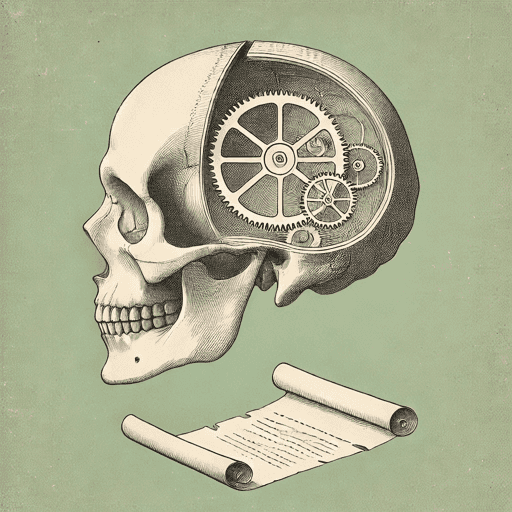
Leonardo Da Vinci
53 pages • 1-hour read
Walter IsaacsonLeonardo Da Vinci
A modern alternative to SparkNotes and CliffsNotes, SuperSummary offers high-quality Study Guides with detailed chapter summaries and analysis of major themes, characters, and more.
Chapters 7-13Chapter Summaries & Analyses
Chapter 7 Summary: “Personal Life”
In Milan, Leonardo gained a reputation not only for his talents but also for his beauty, charm, and generosity. He maintained a colorful personal style, adopted a vegetarian lifestyle grounded in compassion and scientific reasoning, and was beloved by intellectuals and artists alike. Central to his personal life was his long and complex relationship with Gian Giacomo Caprotti—nicknamed Salai—who joined his household at age 10 and remained a lifelong companion, model, assistant, and likely lover. Despite Salai’s thievery and antics, Leonardo showed enduring affection, often recording his misdeeds with amused exasperation. Leonardo’s notebooks and drawings frequently juxtapose youthful, androgynous beauty with craggy old age—possibly reflecting both artistic motifs and personal introspection. In allegorical and erotic sketches, Leonardo explored the emotional tensions between beauty and decay, pleasure and pain, and youthful desire and aging, revealing a more intimate and psychologically layered view of the artist.
Chapter 8 Summary: “Vitruvian Man”
In 1487, Leonardo participated in a competition to design a tiburio (lantern tower) for Milan’s cathedral, collaborating with architects Donato Bramante and Francesco di Giorgio. Though his proposal was ultimately rejected, their shared work on church design, proportion, and geometry led to deeper studies, including exploration of Vitruvius’s De Architectura, a Roman treatise linking human and architectural symmetry. Leonardo and his colleagues produced various drawings of the “Vitruvian Man,” but Leonardo’s version, created around 1490, was uniquely precise, blending anatomical observation with philosophical symbolism. His drawing depicts a nude man inside both a circle and square, visually linking the microcosm of man to the macrocosm of the universe. Vitruvian Man became a defining symbol of Renaissance humanism, reflecting Leonardo’s fusion of art, science, and geometry. The chapter also emphasizes the collaborative environment of the Milanese court, where such interdisciplinary breakthroughs were made possible.
Chapter 9 Summary: “The Horse Monument”
In 1489, Leonardo da Vinci was officially commissioned to design a monumental equestrian statue honoring Ludovico Sforza’s father, Duke Francesco. Leonardo received a court residence, studio space, and a stipend, launching one of his most ambitious projects. The planned bronze statue—three times life-size—led Leonardo to pursue exhaustive anatomical studies of horses, culminating in a detailed clay model completed in 1493. Simultaneously, he developed complex and innovative casting techniques to execute the statue in a single pour, defying traditional multi-part methods. His detailed engineering sketches included systems of furnaces, molds, and materials. Despite his ingenuity, the project was never completed. War with France redirected the bronze to cannon-making, and invading troops destroyed Leonardo’s clay model in 1499. Though never realized, the horse monument demonstrated Leonardo’s fusion of art, anatomy, and engineering—and his tendency to dream big, even when fate intervened.
Chapter 10 Summary: “Scientist”
In the early 1490s, Leonardo da Vinci began to broaden his intellectual pursuits, teaching himself Latin and amassing a library that spanned science, poetry, anatomy, engineering, and philosophy. While he initially prized firsthand experience over classical scholarship, he came to embrace the complementary power of theory and experiment. He meticulously studied phenomena by observing, recording, and testing his ideas, often devising original tools and techniques to do so. He made profound analogies across disciplines—comparing trees to arteries, rivers to veins, and sound to light—to understand the natural world. His insatiable curiosity and observational prowess, especially regarding motion, helped him forge early versions of the scientific method. Leonardo’s legacy as a scientist stems not from formal education but from his relentless questioning, acute observation, and synthesis of art and inquiry, laying groundwork for a more empirical and interdisciplinary vision of knowledge.
Chapter 11 Summary: “Birds and Flight”
Beginning in the 1490s, Leonardo da Vinci spent over two decades studying bird flight and developing designs for human-powered flying machines. His work merged artistic observation with mechanical innovation, producing more than 500 detailed sketches and 35,000 words on the subject. Initially inspired by theatrical stagecraft, Leonardo transitioned to serious engineering, studying anatomy, air pressure, fluid dynamics, and the principles of motion. He observed birds with intense precision and drafted early theories that anticipated Newton’s third law and Bernoulli’s principle. His Codex on the Flight of Birds explored gravity, aerodynamics, and the curved structure of wings. Though he never created a functional flying machine, he produced elegant gliders and flapping contraptions, testing them in private and over water. In his final years, he returned to creating mechanical birds for court amusement, echoing where his fascination with flight had begun.
Chapter 12 Summary: “The Mechanical Arts”
Leonardo’s fascination with motion led him to study machines with the same detail he applied to anatomy. Unlike most contemporaries, he used exploded diagrams and layered drawings to understand how motion was transferred through parts like gears, levers, pulleys, and springs. He tackled engineering challenges such as regulating the speed of unwinding springs and maximizing human muscle output. He designed tools powered by water, gravity, or people—including needle grinders and waterwheels—and investigated the feasibility of perpetual motion. Through visual thought experiments, he concluded such machines were impossible, largely due to friction. He became one of the first to study friction methodically, devising instruments to measure it and even inventing ball bearings and friction-reducing alloys. His work helped establish a mechanistic worldview that foreshadowed Newtonian physics, rooted in the belief that the same physical laws govern machines, living bodies, and nature itself.
Chapter 13 Summary: “Math”
Leonardo developed a deep appreciation for mathematics, especially geometry, as a tool for understanding the natural world. Although he struggled with arithmetic and algebra, he excelled in visualizing shapes and using geometric analogies to explore scientific and artistic principles. With the help of mathematician Luca Pacioli, Leonardo learned Euclidean geometry and illustrated Pacioli’s On Divine Proportion, producing the only drawings he published during his lifetime. Fascinated by transformation of shapes, he explored the conservation of volume and pioneered ideas later formalized in topology. His relentless efforts to “square the circle” and solve other ancient mathematical puzzles became a lifelong obsession. Though he lacked the symbolic tools of later mathematicians, Leonardo’s visual experiments and thought processes foreshadowed key concepts in calculus and physics. To Leonardo, geometry wasn’t just a discipline—it was a path to discovering the harmonious patterns underlying nature and art.
Chapters 7-13 Analysis
In this section of the biography, Isaacson presents Leonardo at the peak of his intellectual expansion, not by cataloging finished works, but by emphasizing the fusion of disciplines that characterized his thinking. These chapters do not pivot around a single artistic masterpiece or scientific breakthrough, but instead showcase the dynamic interplay between Leonardo’s passions—anatomy, flight, hydraulics, optics, engineering, and mathematics. Isaacson’s authorial strategy is to foreground the connective tissue between these interests, allowing the reader to observe Leonardo not as a compartmentalized expert but as a thinker whose identity was defined by synthesis. The structure of these chapters mirrors that approach, alternating between narrative momentum and focused explorations of Leonardo’s ideas, which cumulatively reveal a portrait of genius grounded in method and association.
Leonardo’s notebooks remain central to this depiction, serving not only as a trove of raw material but as a window into his cognitive architecture. Isaacson repeatedly returns to the idea that Leonardo’s brilliance lay not in execution, but in observation—particularly his ability to return, revise, and expand his ideas over decades. The notebooks’ lack of polish becomes a rhetorical device, proof of a mind more invested in inquiry than finality. Their pages teem with layers—sketches written over older notes, diagrams modified years later—emphasizing what Isaacson sees as Leonardo’s nonlinear, recursive genius. This structural motif reflects The Tension Between Vision and Completion, as Leonardo frequently moved on from commissions and treatises without feeling compelled to produce conclusive outcomes. His vision, Isaacson argues, was too expansive to be bound by deadlines or conventional standards of productivity.
Leonardo’s anatomical studies in these chapters illustrate how his artistic practice was never isolated from scientific inquiry. His dissections of muscle, bone, and sinew were driven as much by the desire to depict motion and emotion on canvas as by empirical curiosity. Isaacson points to passages where Leonardo explains how a painter must understand the interior workings of the body to faithfully express outward gestures: “In painting, the actions of the figures are, in all cases, expressive of the purpose of their minds” (303). This comment collapses the distinction between external form and inner life, positioning painting as both artistic expression and anatomical science. Leonardo’s insistence on sfumato and chiaroscuro—his hallmarks of blending and shading—further illustrates this union of method and meaning. These techniques required an understanding of how light diffuses in the atmosphere and scatters across uneven surfaces. In depicting human form, Leonardo applied what he had learned from the curvature of wings, the structure of riverbanks, and the branching of trees—examples of The Integration of Art and Science as a Path to Truth that appear again and again in his work.
Leonardo’s engagement with machines, motion, and geometry also plays a major role in these chapters, further deepening Isaacson’s portrayal of him as an empirical thinker. His designs for flying machines, water-powered tools, and automata appear both fanciful and rigorous, reflecting the way he used speculative invention as a method of reasoning. The line, “The large bird will take its first flight from the back of the great Swan” (264), typifies his lyrical yet technically grounded style. While poetic in tone, the quote caps his Codex on the Flight of Birds, a study rooted in careful anatomical observation and primitive aerodynamics. Even as he abandoned dreams of perpetual motion—calling them “impossible delusions”—he continued designing systems that responded to the limits of friction and gravity. His transition from fantasy to falsifiability demonstrates how Leonardo’s imagination did not outpace his rationality. Instead, the two developed in tandem, revealing how failure could act as a clarifying force. These pursuits emerge not as distractions from art but as extensions of it: To Leonardo, the motion of gears, wings, or pulleys mirrored the movement of limbs or clouds.
Mathematics, especially geometry, completes the trifecta of disciplines Leonardo sought to unify. Isaacson presents his relationship with Luca Pacioli as both intellectually formative and ideologically aligned. For Leonardo, math was not an abstract field but a visual and spiritual tool—one that could explain the proportional harmony of the Vitruvian Man as easily as the arrangement of leaves or the curve of a smile. His declaration that “there is no certainty in sciences where mathematics cannot be applied” (279) signals his growing conviction that nature is structured by measurable, often beautiful, rules. Even when he could not solve a given problem—such as squaring the circle—Leonardo used these challenges as a way of exploring form, transformation, and limits. These obsessions reflect Curiosity as a Discipline and a Way of Life, as Leonardo never abandoned a question simply because it was difficult or unsolvable.
Across these chapters, Isaacson subtly refines the book’s central claim: that Leonardo’s genius was not a product of divine inspiration, but of deliberate, relentless effort to link disparate forms of knowledge. The section does not focus on completed masterpieces or grand achievements, but on habits of mind—the rhythms of observation, revision, and inquiry that sustained his work across decades. The effect is to reveal a figure less defined by output than by outlook. Leonardo’s greatness lies not just in what he made, but in how he thought.

Unlock all 53 pages of this Study Guide
Get in-depth, chapter-by-chapter summaries and analysis from our literary experts.
- Grasp challenging concepts with clear, comprehensive explanations
- Revisit key plot points and ideas without rereading the book
- Share impressive insights in classes and book clubs