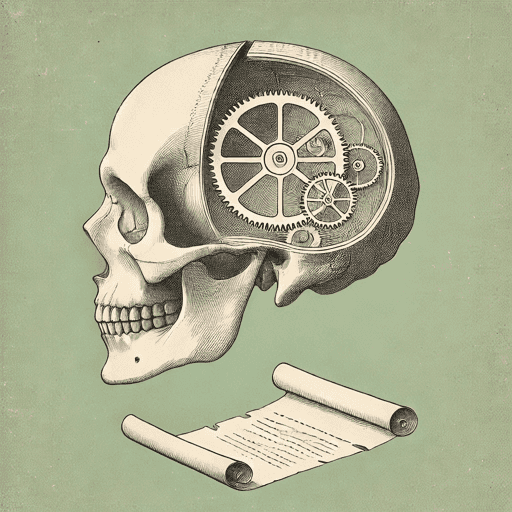
Leonardo Da Vinci
53 pages • 1-hour read
Walter IsaacsonLeonardo Da Vinci
A modern alternative to SparkNotes and CliffsNotes, SuperSummary offers high-quality Study Guides with detailed chapter summaries and analysis of major themes, characters, and more.
Introduction-Chapter 6Chapter Summaries & Analyses
Introduction Summary: “I Can Also Paint”
Content Warning: This section of the guide includes discussion of antigay bias.
In the Introduction, Isaacson presents Leonardo da Vinci as a vivid embodiment of the Renaissance ideal: a polymath whose insatiable curiosity spanned art, science, anatomy, optics, engineering, and natural observation. Leonardo’s notebooks—over 7,200 pages of sketches, observations, inventions, and whimsical questions—serve as the foundation for the biography and as a window into his uniquely imaginative mind. Isaacson argues that Leonardo’s genius was not divine or otherworldly, but human—based in observational skills, curiosity, and an ability to connect seemingly unrelated disciplines. The chapter explores Leonardo’s “to-do” lists, eccentric habits, and unfinished works, portraying a man driven less by deadlines than by a joyous desire to understand the world. Isaacson situates Leonardo within a historical context while acknowledging the myths, gaps, and embellishments in early biographical accounts. Ultimately, the chapter celebrates Leonardo’s human imperfections and urges readers to emulate his curiosity, wonder, and willingness to blend disciplines. Isaacson sets out to tell Leonardo’s story through the lens of his notebooks, inviting readers to appreciate how curiosity fuels creativity.
Chapter 1 Summary: “Childhood”
Chapter 1 recounts Leonardo’s early life, beginning with his illegitimate birth in 1452 in Vinci, Italy. His father, Piero da Vinci, was a rising notary, while his mother, Caterina, was a poor, orphaned teenager. Their brief relationship did not lead to marriage, and Caterina soon wed another man. Though illegitimate, Leonardo was baptized publicly with 10 godparents and grew up partly in his paternal grandfather’s home. His status barred him from his father’s notary guild but freed him to pursue his creative interests. Denied formal Latin schooling, Leonardo became largely self-taught, prizing direct experience over received knowledge. Childhood memories—including a dreamlike encounter with a bird and a formative hike to a dark cave—reveal his early curiosity, imagination, and fascination with nature. These dual drives—empirical observation and imaginative exploration—shaped his lifelong pursuits in art and science and foreshadowed his visionary yet grounded approach to understanding the world.
Chapter 2 Summary: “Apprentice”
Leonardo’s childhood in Vinci was disrupted around age 12 by the death of his stepmother and grandfather, prompting his move to Florence with his father, Ser Piero. Though he had no formal Latin or university education, Leonardo’s attendance at an abacus school helped him develop practical math skills and a pattern-based approach to problem-solving. His father did not legitimize him, likely due to social norms and guild restrictions, but did help arrange his apprenticeship with the accomplished artist Andrea del Verrocchio.
Florence in the 1460s and 1470s was a thriving center of commerce, art, and humanist learning, with the Medici family shaping its culture. The city’s dynamic blend of artisanship, science, and spectacle provided fertile ground for Leonardo’s development. Verrocchio’s workshop was a collaborative, commercially driven environment where apprentices learned anatomy, mechanics, and artistic techniques, often contributing anonymously to commissions.
Leonardo likely modeled for Verrocchio’s statue of David and contributed elements—like animals and angelic figures—to works such as Tobias and the Angel and Baptism of Christ. His skill with light, motion, and natural observation became apparent in these early works. He also began experimenting with chiaroscuro and sfumato, techniques that would define his mature style.
Leonardo’s fascination with engineering, geometry, optics, and theatrical effects also flourished in this period. He sketched elaborate machines and scenery, contributing to Medici pageants and blending artistic vision with technical precision. He produced his earliest dated drawing, a landscape of the Arno Valley, in 1473.
By his early twenties, Leonardo was producing independent paintings, including religious works and the portrait Ginevra de’ Benci, which hinted at his later psychological and technical mastery. His training under Verrocchio instilled in him the importance of observation, interdisciplinary curiosity, and capturing both narrative and movement in art.
Chapter 3 Summary: “On His Own”
In his mid-twenties, Leonardo da Vinci faced two accusations of sodomy involving a young male prostitute named Jacopo Saltarelli. Though the charges were dismissed due to lack of evidence and influential connections, the ordeal likely left an enduring impact on Leonardo, who never married and seemed romantically inclined toward men. His notebooks and artworks reflect a consistent attraction to male beauty, as well as a recurring theme of being an outsider—illegitimate, unconventional, and self-contained. Over the years, he lived and worked alongside a series of beautiful young men, including Salai and Atalante Migliorotti. Despite societal and legal risks, Leonardo neither denied nor suppressed his sexuality. His humor, curiosity, and nonchalance about bodily functions contrast sharply with the era’s moral strictures, especially those of the Church. Leonardo’s sense of alienation—heightened by his sexuality and family status—may have fueled his genius and artistic empathy.
Chapter 4 Summary: “Milan”
In 1482, Leonardo left Florence and moved to Milan, where he would spend the next 17 years. He arrived as part of a diplomatic delegation, presenting Ludovico Sforza with a silver lyre shaped like a horse’s skull. Hoping for court patronage, Leonardo submitted a striking job application letter that emphasized his abilities as a military engineer—though many of his designs were aspirational or fantastical. He later developed concepts for tanks, steam cannons, a massive crossbow, and a utopian city with multi-level infrastructure, sewage systems, and wide streets designed to prevent plague. Though most projects were never built, they reflected Leonardo’s polymathic imagination and obsession with blending beauty, science, and utility. Milan, with its ruling court and intellectual environment, offered fertile ground for Leonardo’s ideas, even if many remained unrealized during his lifetime.
Chapter 5 Summary: “Leonardo’s Notebooks”
After arriving in Milan in the early 1480s, Leonardo da Vinci began the lifelong habit of keeping notebooks, filling them with sketches, scientific observations, engineering designs, and to-do lists. These notebooks—some small and portable, others large—captured everything from studies of human anatomy and botany to jokes, costume designs, and treatises on flight and water. Though often disordered and undated, the surviving 7,200+ pages reflect his extraordinary range and intellect. Leonardo used every inch of the page, frequently returning to older sheets to add new ideas. His notes exemplify the Renaissance tradition of the zibaldone, or commonplace book, but on a level never seen before or since. Though he often intended to organize them into formal works, many remained unfinished, like his paintings. Still, his pages preserve an unparalleled view of a polymathic mind exploring the unity and patterns of nature.
Chapter 6 Summary: “Court Entertainer”
During his years at the Sforza court in Milan, Leonardo da Vinci became renowned not for his paintings or engineering, but for his elaborate court entertainments. He produced pageants, plays, and spectacles that combined music, costumes, allegory, and intricate mechanical devices. His work included the Masque of the Planets and the comedy La Danae, where rotating stages, celestial props, and fantastical creatures wowed audiences. Leonardo also designed musical instruments, drew grotesques and allegorical sketches, and created rebuses, fables, and satirical prophecies for performance. These literary and theatrical endeavors advanced his courtly status and provided a creative outlet with firm deadlines—unlike his paintings, which often remained unfinished. Some inventions, like mechanical birds and stage effects, foreshadowed more serious scientific studies. Even his dark fantasy novellas, likely written for court amusement, hint at deeper psychological fascinations with destruction, deluge, and the boundaries between imagination and reality.
Introduction-Chapter 6 Analysis
Isaacson opens Leonardo da Vinci with a clear intent to demystify genius. Rather than depicting Leonardo as a figure set apart by supernatural talent, Isaacson grounds his brilliance in daily habits, human flaws, and a relentless desire to understand the world. The opening chapters construct a portrait of Leonardo not as a miraculous exception, but as someone who made himself extraordinary through attention, observation, and the lifelong accumulation of knowledge. Rather than positioning Leonardo as a passive recipient of brilliance, Isaacson presents him as a maker—of art, of machines, of notebooks, and ultimately, of his own intellect.
This reframing begins with Isaacson’s use of the notebooks, not only as sources but as a narrative device. These messy, nonlinear collections of observations, doodles, and half-formed treatises become a kind of character in their own right—an extension of Leonardo’s mind on the page. In one of the most emblematic moments, Isaacson highlights the note: “Describe the tongue of the woodpecker” (23). The line is not framed as a punchline, but as a revelation: The specificity of the question reveals how Leonardo’s mind operated, looking closely at the overlooked, driven by wonder rather than utility. Rather than cherry-picking only grand designs or finished thoughts, Isaacson draws attention to the provisional and peculiar. By centering the act of noticing, the biography subtly suggests that mastery stems from accumulation, not arrival.
Structurally, the first six chapters echo the associative quality of Leonardo’s notebooks. While most of the book proceeds chronologically, this early stretch blends biographical scenes with more meditative chapters—on notebooks, court entertainments, and early commissions—that interrupt and expand the linear arc. This approach reflects Isaacson’s argument that Leonardo’s life cannot be told merely as a timeline of accomplishments. Instead, it must be explored as a set of habits, tendencies, and evolving fascinations. In this way, the form of the biography mirrors its subject: Like Leonardo’s pages, it is layered, recursive, and occasionally nonlinear, inviting readers to inhabit a worldview shaped by accumulation rather than plot.
Curiosity emerges as both method and philosophy. Isaacson underscores that Leonardo, who lacked formal Latin or university education, taught himself through sustained and joyful observation. In a telling recollection from Leonardo’s youth, he writes of standing before a dark cave, pulled forward by “two contrary emotions, fear and desire” (40). This moment becomes emblematic of his approach to knowledge. It is not the absence of fear that defines him, but the willingness to move forward anyway. Isaacson doesn’t overstate the metaphor, but by placing it near the book’s opening, he establishes a recurring image: knowledge as a darkness to be entered with wonder.
Leonardo’s curiosity takes form not just in content but in process. In a chapter devoted to his notebooks, Isaacson writes that “the beauty of a notebook is that it indulges provisional thoughts, half-finished ideas” (155). The value here is not finality, but motion. Leonardo’s refusal to divide art from engineering, or science from storytelling, reflects an underlying belief that knowledge is connected and that discovery is iterative. This integrated approach is what makes Leonardo emblematic of the Renaissance—not just his range, but his refusal to recognize boundaries between disciplines. Isaacson’s inclusion of musical instruments, pageant designs, and anatomical sketches in the same breath as his paintings reinforces this synthesis.
While Leonardo’s tendency toward incompletion will become more prominent later in the biography, its roots appear here. Isaacson juxtaposes the open-ended nature of the notebooks with Leonardo’s role as a court entertainer—one of the few roles that required deadlines. “Unlike paintings,” Isaacson writes, “performances had real deadlines. They had to be ready when the curtains parted” (164). This contrast hints at a central tension that will shape Leonardo’s career: His creative process thrives on open-ended exploration, yet some of his most impactful work arises under constraint. The result is not a portrait of contradiction, but of balance—a mind drawn equally to fantasy and structure, invention and performance.
Taken together, these chapters suggest that Leonardo’s greatness lies not in divine inspiration, but in his sustained habits of attention. Isaacson’s achievement is not simply in narrating a life, but in modeling how that life was made—through curiosity, iteration, and the deliberate erosion of boundaries between disciplines. Rather than offering a tidy thesis, Isaacson invites readers to inhabit Leonardo’s mindset: to wonder without agenda, to sketch without needing to finish, and to treat the world itself as a canvas for inquiry.

Unlock all 53 pages of this Study Guide
Get in-depth, chapter-by-chapter summaries and analysis from our literary experts.
- Grasp challenging concepts with clear, comprehensive explanations
- Revisit key plot points and ideas without rereading the book
- Share impressive insights in classes and book clubs