Leonardo Da Vinci
Leonardo Da Vinci
A modern alternative to SparkNotes and CliffsNotes, SuperSummary offers high-quality Study Guides with detailed chapter summaries and analysis of major themes, characters, and more.
Summaries & Analyses
Quizzes
NEWReading Tools
Themes
The Integration of Art and Science as a Path to Truth
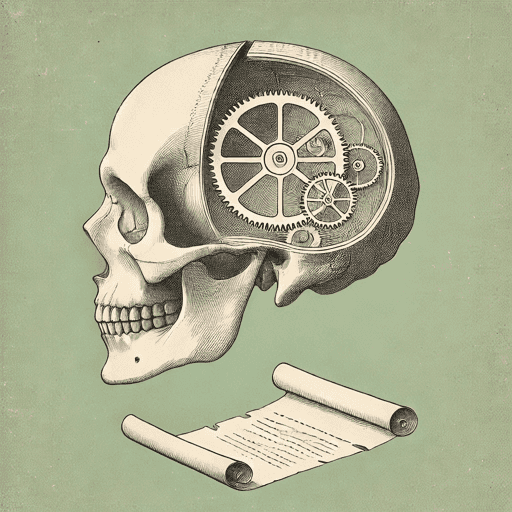
One of the most powerful and consistent themes throughout Leonardo da Vinci is the synthesis of art and science—what Isaacson calls the “interplay between observation and imagination” (359). Leonardo did not see art and science as opposing forces; instead, he believed that each enhanced the other, offering tools to understand and render the world more fully. Isaacson’s biography makes this integration the central axis of Leonardo’s genius, portraying him as a figure who blurred disciplinary boundaries to pursue beauty, knowledge, and truth.
Leonardo’s notebooks overflow with anatomical sketches beside painting studies, mathematical puzzles alongside botanical drawings, and flight designs sketched with the same attention to shadow and motion as a human hand. In Chapter 14, for example, Isaacson shows how Leonardo’s anatomical dissections were not only for science, but also for art: “In painting, the actions of the figures are, in all cases, expressive of the purpose of their minds” (303). This line illustrates how deeply Leonardo’s artistic goals were entwined with his anatomical studies. He wasn’t satisfied with surface-level accuracy—he wanted to convey inner life through gesture and posture, linking physical realism with emotional truth.
This theme reaches its peak in the Mona Lisa, where artistic mastery fuses with scientific understanding. Isaacson describes how Leonardo’s knowledge of facial muscles and optical phenomena allowed him to paint a smile that appears to change based on the viewer’s gaze. Likewise, the sfumato technique—achieved through countless transparent layers—demonstrates a painter’s sensitivity and a scientist’s precision. Leonardo’s notebooks show him experimenting with how light scatters in the atmosphere, a theory he applies not only to landscapes but also to skin tone and shadow.
His integration of disciplines extended to his view of the world itself. In one of his later writings, he muses that “[t]he body of the earth, like the bodies of animals, is interwoven with ramifications of veins” (563)—an image that fuses anatomical and geological thinking. This metaphor, seeing rivers as veins and the earth as a living body, shows how Leonardo’s art-science fusion shaped not just how he painted but how he perceived reality. The Vitruvian Man embodies this unity—the human body mapped onto cosmic geometry—and his view of nature as a network of interconnected systems reflects a profound belief in structural harmony.
Isaacson ultimately argues that Leonardo’s genius stemmed not from narrow expertise, but from his ability to make connections across fields. In a world increasingly defined by specialization, Leonardo reminds us that innovation often comes from integration. His life models a timeless ideal: that creativity flourishes at the intersection of art and science.
Curiosity as a Discipline and a Way of Life
Leonardo’s greatness, as Isaacson repeatedly emphasizes, was not the result of innate genius alone—it was the product of disciplined curiosity. Throughout the biography, curiosity is framed not simply as a trait, but as a deliberate way of seeing, recording, and questioning the world. Leonardo’s endless to-do lists—full of seemingly trivial questions like, “Describe the tongue of the woodpecker” (23)—are presented as evidence of a mind in constant motion. These notes reflect not just eccentricity but an intentional practice of observing what others ignore and asking questions few would think to ask.
Rather than following a rigid academic curriculum, Leonardo built his knowledge through relentless observation and experimentation. Isaacson shows how this curiosity extended into every domain: the curl of water, the mechanics of a bird’s wing, the flicker of emotion in a human smile. In a particularly vivid passage from The Flight of Birds, Leonardo writes: “The large bird will take its first flight from the back of the great Swan, filling the universe with amazement” (264). This moment—poetic yet rooted in scientific investigation—reveals how his imagination and inquiry merged. It wasn’t enough for Leonardo to dream of flight; he studied it, measured it, and tried to replicate it.
This theme emerges powerfully in Leonardo’s notebooks, where unfinished ideas live beside breakthrough insights. Isaacson writes, “The beauty of a notebook is that it indulges provisional thoughts, half-finished ideas, unpolished sketches” (155). Leonardo’s embrace of the incomplete reflects a process-driven mindset that prizes exploration over perfection. His curiosity even reshaped his definition of success. Many of his most “unfinished” works—like The Adoration of the Magi—are lauded today not despite their incompletion, but because they reveal a thinking process frozen in motion.
Crucially, curiosity also becomes a moral and philosophical principle. Leonardo’s pacifism, vegetarianism, and love of nature stem from an empathetic form of curiosity—a desire to understand and respect other beings. His scientific dissections were not detached or clinical; they were reverent. Even his darker fascinations—deluge drawings, grotesques, apocalyptic imagery—reflect an impulse to probe human fear, mortality, and imagination.
Isaacson ends the book with Leonardo’s curiosity unquenched. His final known notebook entry breaks off mid-thought with a practical note: “Perché la minestra si fredda” (Because the soup is getting cold) (676). The moment captures the balance between cosmic inquiry and earthly routine. In the final coda, Isaacson returns to the woodpecker’s tongue, reminding readers that “odd questions” are often the most illuminating. Leonardo’s life offers a call to action: to stay curious, not passively, but actively—to question with joy, to observe with intention, and to learn not just for mastery, but for wonder.
The Tension Between Vision and Completion
Throughout Leonardo da Vinci, Isaacson returns to one of the most poignant contradictions in Leonardo’s life: his dazzling imagination and chronic inability—or refusal—to finish many of his works. This tension between vision and execution becomes a recurring theme, not as a personal failing, but as a reflection of Leonardo’s perfectionism, boundless interests, and philosophical approach to creation.
Leonardo was notorious for abandoning commissions, delaying delivery, or endlessly refining even completed paintings. His Mona Lisa, never handed over to its commissioner, remained with him until his death. The Adoration of the Magi and Saint Jerome in the Wilderness were left unfinished, and even his scientific treatises—on anatomy, optics, water, and painting—remained in scattered notes rather than published volumes. Yet as Isaacson points out, this wasn’t simple procrastination. Leonardo defended his nonlinear process by writing, “Men of lofty genius sometimes accomplish the most when they work least, for their minds are occupied with ideas” (376). In Leonardo’s view, creative gestation was as valuable as execution—perhaps more so.
That tension becomes especially clear in how others perceived him. Pope Leo X, for instance, reportedly quipped, “Alas, this man will never get anything done, for he is thinking about the end before he begins” (606). While exasperated, the line also acknowledges the sheer scale of Leonardo’s imagination. His struggle wasn’t starting or dreaming—it was bringing those dreams to closure in a world ruled by patrons, deadlines, and political realities.
Isaacson shows that Leonardo did meet deadlines when external pressures required it. In his work designing court entertainments—fleeting theatrical spectacles—he had no choice but to finish on time. As Isaacson writes, “He could not cling to them and seek to perfect them indefinitely” (164). These performances revealed that Leonardo could complete work when the constraints were absolute. Yet the ephemerality of the medium perhaps made it easier for him to let go. In painting and science, his desire for perfection was more intense—and often paralyzing.
Ultimately, the biography portrays Leonardo not as a failure for leaving works unfinished, but as someone for whom the process was more important than the product. His vision was too expansive to be confined by deadlines or patron demands. The very incompleteness of his work becomes part of its genius, allowing us to witness a mind always in pursuit, never fully satisfied. Isaacson concludes that Leonardo’s greatness lies not in how many works he completed, but in how radically he redefined what it means to create. The tension between vision and completion, far from a flaw, becomes a testament to the richness of his intellectual ambition.

Unlock every key theme and why it matters
Get in-depth breakdowns of the book’s main ideas and how they connect and evolve.
- Explore how themes develop throughout the text
- Connect themes to characters, events, and symbols
- Support essays and discussions with thematic evidence