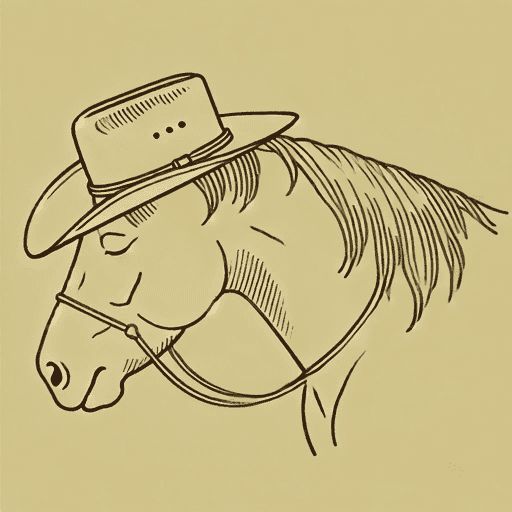
Leroy Ninker Saddles Up
33 pages • 1-hour read
Kate DiCamilloLeroy Ninker Saddles Up
A modern alternative to SparkNotes and CliffsNotes, SuperSummary offers high-quality Study Guides with detailed chapter summaries and analysis of major themes, characters, and more.
Chapters 1-3Chapter Summaries & Analyses
Chapter 1 Summary
As Leroy Ninker, the protagonist, works the concession stand of the Bijou Drive-In Theater, he dreams of being a real cowboy. When the theater shows Westerns, Leroy admires their hats, boots, lassos, and courage. Whispering his trademark, “Yippie-i-oh,” he declares that he is destined to be a cowboy (2). Beatrice Leapaleoni, the ticket seller who periodically helps at the concession stand, asks him what he needs to become a cowboy. Leroy responds that cowboys need hats, boots, and lassos. However, Beatrice emphasizes that a cowboy must also have a horse. Instantly, Leroy knows she’s right and wonders how he could ever be a real cowboy without a horse. Holding a newspaper advertisement, Beatrice suggests a solution—an old horse is for sale—and urges him to take control of his fate. Determined, Leroy puts the advertisement in his pocket, and Beatrice instructs him to check the teeth and hooves on the horse before purchasing it. Later that night, Leroy dreams of horses.
Chapter 2 Summary
The next day, confident that he is about to “procure” a horse, Leroy begins walking, imagining he’s in the saddle. A boy in a passing car calls him a “tiny cowboy” and someone else throws a can at Leroy’s head (12). Reminding himself of his goal, Leroy stands taller, rubs his head, and tells himself not to get upset. Focusing on the horse, he hopes that it is strong and fast and named Tornado.
At the stables, Leroy meets Patty LeMarque and tells her that he is interested in her horse. Patty leads him to a field where Maybelline (not Tornado) grazes. Hearing her name, the horse trots over and whinnies. After Patty introduces them, Leroy sees that the animal only has four teeth, but because he has no idea how many she’s supposed to have, he thinks it is fine. He admires her hooves and stays still as Maybelline rubs her nose against his face. Patty declares that Maybelline likes him, and Leroy feels joyful that now he will be a real cowboy.
Chapter 3 Summary
All Patty wants is for Maybelline to go to a good, loving home. When Leroy gives a “Yippie-i-oh,” Patty tells him to be straightforward and say what he means. Then she outlines three important rules for taking care of Maybelline. The first is that she needs to be complimented a lot. Second, Maybelline has a large appetite. Finally, the horse can get lonely, so she mustn't be left alone for too long. If she is, the consequences could be dire, and Leroy will regret leaving her. After Leroy repeats these rules, Patty helps him into the saddle.
Atop Maybelline, Leroy sees the world in a whole new light. It’s as if everything—the sun, the colors of the sky, birdsong—is more vibrant in the saddle. When Leroy says, “‘Giddy-up,’” however, Maybelline does not budge (24). Patty scolds him, reminding him to compliment Maybelline. As soon as Leroy tells the animal that she is beautiful and sweet, she perks her ears up and starts moving. With each new compliment, Maybelline gains speed. As they ride off, Patty shouts a reminder to Leroy about the rules, and she urges him to be a good listener.
Chapters 1-3 Analysis
DiCamillo’s protagonist, Leroy Ninker starts his arc as a whimsical dreamer, content with merely wishing to be a cowboy, and evolves over the course of the story to embody a cowboy’s loyal and courageous ethos. One of Van Dusen’s first illustrations depicts him wistfully watching a Western with his hand on his cheek (3). However, the nudge from his co-worker, Beatrice Leapaleoni, to “take fate in [his] hands and wrestle it to the ground” serves as the novel’s inciting incident, prompting Leroy to take action and introducing the novel’s thematic exploration of The Importance of Following One’s Dreams (8). DiCamillo describes the moment Beatrice’s advice sparks something in Leroy, saying: “The cowboy started to run. He was heading to meet the horse of his dreams! There was no time to waste!” (14). By taking active steps toward his dream, Leroy begins to view his dream as attainable. By transforming his wishful thinking into action, Leroy begins a dynamic character arc, progressively building confidence over the course of the narrative.
Leroy’s single-minded focus on his way to buy the horse emphasizes the novel’s thematic interest in Overcoming Obstacles with Determination and Positivity. When a boy from a passing car calls him “tiny,” instead of feeling dejected, he “[stands] up straighter” and reminds himself of his goal (12). When he’s hit by a can thrown from another car, Leroy thinks, “‘Don’t get agitated […] Just keep thinking about your horse’” (13). In both moments, Leroy refocuses on his goal and remains positive, encouraging himself not to give up. Leroy’s encounter highlights one kind of challenge in life: naysayers who attempt to make a person feel small. However, instead of deflating and giving up, Leroy’s words and actions underscore how being positive and resilient can empower a person to overcome such negativity.
In Leroy’s first meeting with Maybelline. DiCamillo introduces The Need for Friendship and Community as a central theme in the novel. When Patty outlines the rules for taking care of the horse, she notes that Maybelline is motivated by compliments. When Leroy tells her that she is beautiful, Maybelline “prick[s] up her ears. She twitche[s] the left ear to the right and the right ear to the left. Both ears [quiver] hopefully” (27). The horse’s attention is peaked because she “hopes” for more kind words—a desire visually represented by Van Dusen in the drawing where Leroy sits in the saddle with Maybelline glancing back at him with her mouth expectantly open (28). Patty’s admonition that “Maybelline is the kind of horse who gets lonesome quick” and “is not the kind of horse who cares to be left behind” emphasizes the animal’s need for companionship. Being with others is essential to her well-being (23).

Unlock all 33 pages of this Study Guide
Get in-depth, chapter-by-chapter summaries and analysis from our literary experts.
- Grasp challenging concepts with clear, comprehensive explanations
- Revisit key plot points and ideas without rereading the book
- Share impressive insights in classes and book clubs