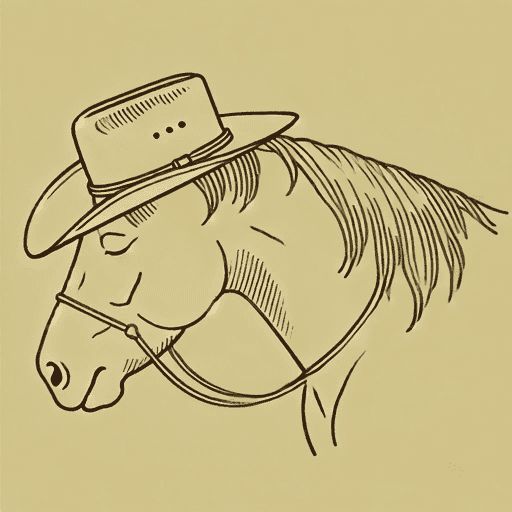
Leroy Ninker Saddles Up
33 pages • 1-hour read
Kate DiCamilloLeroy Ninker Saddles Up
A modern alternative to SparkNotes and CliffsNotes, SuperSummary offers high-quality Study Guides with detailed chapter summaries and analysis of major themes, characters, and more.
Important Quotes
“Leroy Ninker took off his hat and scratched his head.
Beatrice sighed again. ‘Horses, Leroy,’ she said. ‘Every cowboy needs a horse.’”
(Chapter 1, Page 6)
When Leroy scratches his head, DiCamillo signals the trajectory of his arc from a person with intangible dreams to one who takes action to make them a reality. When Beatrice first presents the advertisement, Leroy doesn’t immediately see it as relevant to his own life because he doesn’t yet see himself as a person who takes action. Beatrice’s explanation and encouragement provide him with the support her needs to take that active step, underscoring the book’s thematic interest in The Need for Friendship and Community.
“‘I am here about the horse,’ said Leroy.
‘You’re interested in Maybelline?’ said the woman.
‘Maybelline?’ said Leroy.
‘Follow me, Hank,’ said the woman.
‘Hank?’ said Leroy.”
(Chapter 2, Page 15)
Patty, the woman selling the horse, calls Leroy “Hank,” which sounds like a cowboy’s name, foreshadowing Leroy’s internal transformation. Leroy never corrects her, suggesting that he’s already embracing his growth into the best version of himself.
“How many teeth was a horse supposed to have? Beatrice Leapaleoni had not said.”
(Chapter 2, Page 18)
When Leroy sees that the horse only has four teeth, this question pops into his mind and shows how little he knows about horses, despite his dream to be a cowboy. At this early stage, he still relies on others for knowledge and help, emphasizing Beatrice’s role as a mentor to him.
“I ain’t looking for money is what I am saying. I am looking for love for Maybelline. And I am just going on my instinctuals here, but my instinctuals tell me that you are the right little fellow for this horse.”
(Chapter 3, Page 21)
DiCamillo uses specific diction and tone in Patty’s dialogue, characterizing her as straight-talking and kind, less worried about making money from the sale of Maybelline than she is about finding the horse a good home. Although this is a serious statement about love and compassion, DiCamillo invokes a humorous tone with the use of the word “instinctuals” instead of “instincts.” Despite Patty’s silliness, she sees good in Leroy, too, which is why she decides to sell Maybelline to him.
“‘Well, look at you Hank,’ said Patty LeMarque. ‘It seems you got a talent for poeticals.’”
(Chapter 3, Page 28)
When Leroy compliments Maybelline, Patty notes that he has a way with words. Her reaction, a little surprised, highlights the idea that people are not always what they seem. Although Leroy is small, he can still be a cowboy, just like how even though he does not know many things, he can string together kind and beautiful words for others.
“‘Oh,’ said Leroy. ‘I get it.’ He slid off Maybelline’s back. He took hold of the reins. ‘Come on, horse of my heart,’ he said. ‘I will show you the way home.’”
(Chapter 4, Page 33)
When Leroy realizes that Maybelline does not know the way home, he shows the depth of his love and his commitment to her. Although he enjoys riding fast, he dismounts, so he can guide her. The compliment he chooses, “horse of my heart,” evidences his love for Maybelline, because it does not merely praise her appearance but makes his deep affection for her explicit.
“Leroy walked ahead, and Maybelline followed behind, and every once in a while, she would give Leroy a friendly little bump with her nose, pushing him forward.”
(Chapter 4, Page 34)
When the horse nudges Leroy with her nose, she shows that she adores him, too. The growing connection between Leroy and Maybelline raises the stakes of the plot—as their bond grows deeper, it increases the impact of their distress when they are separated during the climax.
“‘Dag blibber it,’ said Leroy. He actually felt like he might cry. Which was ridiculous because cowboys definitely did not cry.”
(Chapter 4, Page 36)
When he cannot get Maybelline inside his apartment, Leroy feels frustration and despair, which DiCamillo balances with the use of silly and outdated vocabulary in his dialogue to keep the tone light and humorous. Leroy’s ability to set his emotions aside and solve the problem highlights the novel’s thematic interest in Overcoming Obstacles with Determination and Positivity.
“Patty LeMarque had said nothing about whether or not Maybelline liked spaghetti, but didn’t everyone like spaghetti?”
(Chapter 5, Page 42)
Faced with the problem of having no oats or hay to feed Maybelline, Leroy draws on his knowledge of the world—most people loving pasta—and advice from Patty LeMarque, who never cautioned him against spaghetti. As a result, he draws the conclusion that it is safe to feed noodles to Maybelline, highlighting his growing ability to solve problems in a humorous way consistent with the narrative tone.
“Leroy Ninker had never imagined that he could string so many words together at once. It was the longest speech of his life.”
(Chapter 5, Page 48)
As Leroy lies at the feet of Maybelline, he talks of his past, his vow to be a better person, and how wonderful the horse is, verbalizing his emotions more clearly than he ever has before. DiCamillo emphasizes the connection between Leroy and Maybelline as the catalyst for Leroy’s growing confidence and comfort in his own skin.
“It’s just like a movie, thought Leroy. We are just like a horse and cowboy in a movie.”
(Chapter 6, Page 51)
Leroy’s dream of racing across an open plain on Maybelline reiterates his desire to live out the cowboy adventures he’s seen onscreen in the Westerns at the movie theater. DiCamillo uses irony to emphasize the emotional stakes of the moment—when Leroy wakes up, it’s nothing like the triumphant scene he imagines. Instead, he’s searching for his missing horse during a storm.
“Thunder crashed. A bolt of lightning lit up the world.”
(Chapter 6, Page 53)
Thunder and lightning, ominous signs of a literal storm, also foreshadow the panic and fear that ensues when Maybelline awakes alone and again when Leroy discovers that she is missing. The direness of their circumstances lays the groundwork for Overcoming Obstacles With Determination and Positivity, a central theme in the narrative.
“A great gust of wind came along and grabbed hold of Leroy’s umbrella and ripped it right out of his hands. Leroy watched as the umbrella spun up into the darkness.
He was a cowboy without a horse, a cowboy without an umbrella. He was a cowboy absolutely, utterly alone.”
(Chapter 6, Page 59)
The wind that pulls the umbrella from Leroy signals that his problems are about to get worse and foreshadows the reality that his solutions, like the umbrella, will not be enough to overcome these obstacles. The words “absolutely” and “utterly” mirror Maybelline’s emotions when she is alone—like his horse, Leroy feels isolated, lonely, and dejected, underscoring the connection between them.
“Leroy Ninker was now hatless, bootless, lasso-less, and horseless.
He had never felt less like a cowboy.”
(Chapter 7, Page 63)
Leroy believes he has failed at becoming a cowboy because he lacks all the outward signs that he is one. However, DiCamillo positions this sentiment as ironic because, in his quest to find Maybelline, he demonstrates courage and determination, two qualities that cowboys possess.
“But more than anything, Maybelline wanted to hear the little man’s voice.
The horse needed to hear some beautiful words.”
(Chapter 7, Page 65)
Alone in the storm, Maybelline is frightened and longs for Leroy, emphasizing the bond between them and the significance of friendship in Leroy’s life. Just as his love for Maybelline catalyzes his personal growth, Maybelline too needs Leroy’s love and reassurance.
“‘Dawn is coming,’ said Leroy Ninker. ‘And I do not have a hat or boots or a lasso or a horse. I don’t even have an umbrella. I have nothing at all.’”
(Chapter 8, Page 69)
Leroy notes that dawn is near, underscoring DiCamillo’s use of weather to mirror the emotional landscape of her characters. Consistent with the motif, Leroy’s words foreshadow a turn of events, like a new day, just as he spots Maybelline’s hoofprints in the mud.
“Wonderful, wonderful smells were coming from inside the house, and the family looked happy sitting together around the table. Maybelline put her nose very close to the window. She watched the family. She admired the food.”
(Chapter 8, Page 71)
As Maybelline finds herself on Deckawoo Drive, looking in the window of a house, DiCamillo links Leroy Ninker’s story to the rest of the Deckawoo Drive series. The aroma of food and the sight of a happy family “sitting together” underscores the significance of family, friendship, and community across the series.
“Leroy Ninker was following the hoofprints when he heard a sound that made him stop in his tracks. Leroy held himself very still. He listened.”
(Chapter 8, Page 73)
After following Maybelline’s hoofprints, Leroy stops to listen. His actions prove that he does not need boots, a hat, or a lasso to solve his problem. Instead, he needs determination and focus, evident in his stillness and listening. This scene marks a moment of significant growth for Leroy over the course of his arc, emphasizing the text’s thematic interest in The Importance of Following One’s Dreams.
“This is my horse. She was lost, and I tracked her through the mud. She was lost, and I found her.”
(Chapter 9, Page 79)
Leroy tells Stella Endicott, the girl who lives on Deckawoo Drive, that Maybelline is indeed his horse. His words are an affirmation that he achieved his goal, not only of finding Maybelline but also of becoming a cowboy. When he repeats that the horse was lost and that he tracked and found her, Leroy realizes that he is capable of more than he ever imagined.
“The cowboy and the horse went inside.”
(Chapter 9, Page 85)
After Mrs. Watson invites them all inside for toast, she insists that they will find a way to get Maybelline inside, highlighting her belief in overcoming obstacles with determination and positivity. Instead of naming Leroy and Maybelline, DiCamillo chooses to call them “the cowboy and the horse,” emphasizing that Leroy has achieved his dream and that the two are now an inseparable pair. As a result, this final line of the chapter reinforces all three themes in the narrative.

Unlock every key quote and its meaning
Get 20 quotes with page numbers and clear analysis to help you reference, write, and discuss with confidence.
- Cite quotes accurately with exact page numbers
- Understand what each quote really means
- Strengthen your analysis in essays or discussions