Light Bringer
75 pages • 2-hour read
Pierce BrownLight Bringer
A modern alternative to SparkNotes and CliffsNotes, SuperSummary offers high-quality Study Guides with detailed chapter summaries and analysis of major themes, characters, and more.
Part 3, Chapters 51-76Chapter Summaries & Analyses
Part 3: “Tempest”
Part 3, Chapter 51 Summary: “Darrow: Midnight Lands”
Content Warning: This section of the guide includes discussion of graphic violence, death, child death, and animal death.
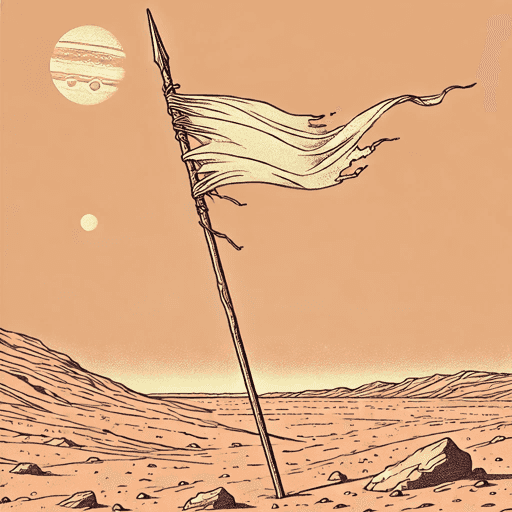
The Archimedes arrives at Io, which is destroyed except for the Garter. To evade detection, they land far from Sungrave, and Darrow and Sevro don Godkiller armor and depart. As he takes in the devastation, Darrow questions whether the people in the Rim are enemies: “If they are truly my enemies, then why do I want to weep?” (421).
Part 3, Chapter 52 Summary: “Darrow: Sungrave”
Darrow and Sevro find Sungrave deserted, and they are joined by Aurae, Cassius, and—to Darrow’s and Sevro’s surprise—Diomedes. Aurae defends Cassius’s decision to bring Diomedes, arguing that the large soldier is “gentle” and will give Darrow his parole if Darrow lets him search for surviving family members. Darrow concedes, and they continue into Sungrave, which is underneath a mountain.
They find the head of the dragon, named Abraxes, that the Ascomanni slaughtered. Then, Darrow and Diomedes separate from the others. Darrow apologizes for the loss of Diomedes’s home, and he offers to help search for Diomedes’s family members.
Part 3, Chapter 53 Summary: “Darrow: Eyes of Stone”
Darrow searches through Sungrave, taking in the gore and listening to Diomedes’s grief. Aurae finds the “omega torch” and sends a message to the Daughters of Ares. Darrow finds Diomedes, who is sitting with the headless bodies of his deceased brothers. He has not found his other family members. Diomedes questions why Darrow has not killed him, and Darrow says that they are not enemies and that the point of war is not to kill all one’s enemies but to find peace with the least amount of violence possible. Darrow suggests that he and Diomedes could be allies, admitting that they have come to the Rim to enlist the help of the Daughters of Ares, who have been stealing ships and supplies from the Raa family for years.
Sevro calls, saying that they’ve made contact with Athena. Darrow is suspicious by the apparent foresight of the Ascomanni, such as how Fa knew the Rim would be undefended.
Cassius calls, having spotted Obsidians gathering people to enslave. Darrow tells Cassius to wait, asking Sevro to help with the Obsidians, but Sevro refuses. Darrow leaves to help Cassius, expecting Diomedes to escape, and he calls Lyria to bring the ship to Sungrave.
Part 3, Chapter 54 Summary: “Darrow: Pella! Pella! Pella!”
Darrow arrives just as Cassius attacks the Obsidians using a battle strategy called the pella maneuver. Darrow taught the Obsidians about the pella maneuver, so they quickly prepare for and thwart Cassius’s attack. Darrow joins the fight, suppressing the Obsidians. When two fighters try to escape, Darrow brings down their ship, almost losing Bad Lass.
Cassius is impressed with Darrow’s fighting— “You’re a menace to savage and civilized alike” (441), and Darrow smiles, having enjoyed the “flow” of the fight. They free the civilians, and more Obsidians arrive.
Part 3, Chapter 55 Summary: “Darrow: Demigod”
A swarm of Obsidians led by Jarl Skarde arrives, and Darrow, knowing that the Obsidians view him as a sort of “demigod” and recognizing that Skarde is scavenging and not on a mission, reveals himself. Darrow criticizes the band of Obsidians for abandoning the Republic: “Guilt has a corrosive effect on self-confidence” (447). At first, they think Darrow is lying. Some attack, and Darrow easily wins, convincing Skarde that he is “Tyr Morga.” Skarde will not attack Darrow, but he urges Darrow to leave. Sigurd, Skarde’s son, speaks out against Fa but stops when the group is attacked.
Part 3, Chapter 56 Summary: “Darrow: Dust Mice”
The Daughters of Ares attack the Obsidians. Darrow finds and captures Skarde, but the fighters do not listen when he tries to hold Skarde ransom. Lyria brings the Archimedes, providing cover. Instead of killing the Obsidians, Darrow uses them to send a challenge to Fa. On the ship, Darrow is surprised to find that Diomedes returned and manned the guns on the ship.
Sigurd, offering to help fight Fa, boards the ship along with Sevro, and the ship takes off, evading the coming Ascomanni forces. They cuff Sigurd, and Darrow meets Cheon, a Daughter of Ares who explains that Athena has taken control of the underwater network of cities in the Deep—a vast, lawless expanse beyond the structured influence of the Core and the Rim—on Europa.
Part 3, Chapter 57 Summary: “Lyria: Lamps in the Storm”
Lyria goes to Sigurd to ask about Volga. He tells her that Volga follows Fa and has been given a fleet of soldiers to command, which Lyria struggles to believe: “That’s not true. She’d never help with this” (457). Leaving Sigurd, she passes through the rescued civilians, thinking of her nephew Liam.
As they approach, Sevro comes to her and speaks of the leviathan Cyraxes that lives in the water. Lyria clarifies that she tried hard to save Pax and Electra—Sevro’s daughter—after unwittingly helping to kidnap them, and she tells him how she helped deliver Ulysses and care for his body after he was killed. Volga, like Lyria, would have done anything to save Ulysses. Sevro explains that he doesn’t want to be a Son of Ares because he saw how the role hurt his father.
Part 3, Chapter 58 Summary: “Lyria: Europa”
They land on Europa. Cassius complains that Lyria has not cleaned the latrines, and he says that he is not coming to the Deep with them. Cassius calls Lyria “mad” for sticking to her plan of finding Volga, asking her to come to him before she decides on a plan. Before parting, Lyria expresses her admiration for Cassius’s decision to save the civilians on Io.
Lyria joins the others, excited to meet Cheon after watching her fight Obsidians. In a submarine, they descend to the Deep, and Lyria holds Aurae’s hand. As they approach the city, Lyria shouts a warning to Darrow, realizing that the Daughters have chains. Sevro panics, and Lyria grabs a gun but is hit and subdued. Cheon says that they cannot forgive Darrow for his earlier transgression against the Sons of Ares. Athena enters and fires Cheon, and Lyria snaps at Aurae for lying.
Part 3, Chapter 59 Summary: “Darrow: Athena”
Darrow wakes up in a room with Athena, first asking about Sevro and Lyria, who are safe. Rather than fighting, Darrow cooperates—“I did not struggle because I smelt rust on the breeze” (472)—and he recites an excerpt from The Path to the Vale, but Athena rejects the Red label. She tells him that he will be subjected to a trial and executed if found guilty, and she gives him a holocube and the key that she took from Darrow.
Left alone, Darrow rages for a moment but then calms himself and watches the footage of the Sons of Ares being tried and executed, many of whom shout his name before dying. He reflects on the individuals’ lost potential.
Part 3, Chapter 60 Summary: “Darrow: The Weight of Guilt”
The Daughters of Ares hold a trial for Darrow. He is draped with a Gold cloak and enters with Aurae, who is saddened by Athena’s aggressive stance. She tells Darrow to show everyone that he is not an “arrogant tyrant.”
The trial begins with Athena stating Darrow’s charges, and Darrow reflects on how he has become “dirty” despite his good intentions. He pleads guilty to all charges. Although admitting guilt, he does not apologize, arguing that he has taken on the role of the Reaper because he believes in the dream of freedom. He speaks of his fear and immaturity, which led him astray in the past. He thought that he was alone in the fight, but he knows now that he is not. Darrow calls for unity between the Republic, the Daughters, and Diomedes. Rather than asking for forgiveness, Darrow implores the Daughters to continue the fight for freedom.
Diomedes’s trial is held next. He says that the HighColors have clearly failed, and he supports the rebels taking their “due.”
Part 3, Chapter 61 Summary: “Darrow: The Three Masters”
Darrow and Diomedes wait in a cell with Cassius while the judges deliberate. Cassius was captured while he was attempting to rescue them. Diomedes tells them about Helios’s imposter, speculating that the imposter is Atlas. Darrow agrees with Diomedes’s suspicions, realizing that Atlas will use Lysander to “play the hero” (484). Cassius and Diomedes reject the idea of Lysander’s involvement, with Diomedes telling them that he saw Lysander’s authentically surprised reaction to the imposter. They speculate that Lysander is dead.
Part 3, Chapter 62 Summary: “Darrow: The Tyrants’ Debris”
Darrow, Cassius, and Diomedes are taken to a war room along with Aurae and Athena to discuss Atlas. Sevro emerges, wearing Ares’s helm. He spoke on behalf of Darrow and Diomedes after the trial, emphasizing how Fitchner was “broken” and how he died too soon, leaving Darrow and Sevro unready to adequately lead the rebellion.
They discuss plans for eliminating Fa. Darrow plans to fight Fa, having challenged him to an ashvar, or “duel of honor” (490). Athena agrees to commute the sentences for Darrow and Diomedes and to provide refuge for the civilians on the surface of Europa. Darrow swears on Pax’s name that he will fight and return for his sentencing. Turning to Diomedes, Athena explains that Aurae told the Daughters long ago that Diomedes would be a fair ruler and not a tyrant. They want him to become their “visionary.”
Part 3, Chapter 63 Summary: “Lyria: Mashed Taters”
Lyria is not included in the war planning, so she steals a uniform and manipulates guards so that she can get to Darrow, but Sevro catches her in the act. Darrow comes to see her hours later. She offers help, and at first, Darrow condescends to her: “Lyria, I’m sure you think you can but—” (496). However, she convinces him that since she is close to Volga, she is a valid asset that he should be using. She defends Volga, arguing that she is a good person being manipulated. Sevro supports Lyria’s request, arguing that either the plan will work or Lyria will die—either way, they will not be inconvenienced.
Part 3, Chapter 64 Summary: “Lysander: The Noble Lie”
Lysander and his Praetorians are portrayed as survivors, and they board the Lightbringer, which has arrived in the Rim. Lysander is greeted by Cicero and Pallas, who assume that they will be departing for Mars. Lysander delivers an inspirational address, arguing that they should remain in the Rim to destroy Fa and restore peace.
Later, he meets with Pytha. He planned to tell her the truth but does not: “[S]hame binds my mouth from telling the truth” (504). He cries, and she comforts him.
Part 3, Chapter 65 Summary: “Lyria: Into the Maelstrom”
Lyria departs with Sigurd and a message from Darrow to Volga. She runs into Cassius, who has come to see her off. He reminds her not to get caught, and they hold hands until they arrive on the surface of Europa and part. Lyria sees someone sneaking in the shadows but is too far from Cassius to tell him. A large fighter emerges from the water, killing several people before disappearing. Sigurd warns that it is a “Harbinger” and that there are likely more enemies coming.
Part 3, Chapter 66 Summary: “Lyria: The Fall of Herkalion”
Lyria and Sigurd follow Cassius as fighting and chaos erupt. She is knocked down by an explosion and trampled. After climbing out of the mob, she finds Cassius and Sigurd, and they run. The shield around the city of Herkalion fails, and ships begin to land.
Sigurd tells Cassius to leave, arguing that his advanced armor will draw the attention of the Ascomanni. Reluctantly, he leaves, kissing Lyria on the head before departing. Sigurd tells Lyria to act like his prisoner as they come across a band of Ascomanni, but Sigurd’s allies—Gudmund and Fenrir—interfere, collecting Lyria to take her to Volga. Sigurd departs.
Part 3, Chapter 67 Summary: “Lyria: Volga”
Gudmund and Fenrir, with Lyria bound like a prisoner, board a warship to deliver Lyria to Volga. Fenrir tells Lyria that Fa’s forces are hunting for Cyraxes. Lyria is taken by enslaved Reds wearing collars into another room. She falls asleep and wakes to Volga listening to the message from Darrow, in which Sevro tells her about Ragnar and about Atlas’s involvement, offering Volga allyship and encouraging her to become queen of the Volk.
Lyria explains that she has come for Volga, but Volga refuses to go with her, arguing that Fa has “opened [her] eyes” (520), denying Atlas’s involvement, and defending Fa’s murder of Ephraim, whom Volga had a family-like relationship with. Lyria understands Volga’s bitterness, having felt it herself, but she now realizes that such bitterness is toxic: “Better to die than live with it in my veins and let it poison me” (523). Lyria is angry but refuses to give up her quest, even after Volga shows her the heads of Gudmund and Fenrir.
Part 3, Chapter 68 Summary: “Lyria: The King and His Court”
Lyria is taken by Nicator, an enslaved person, to the Nixian Isles on Europa after Volga decides to give her to Fa. Nicator points out the hierarchy that Fa has begun to instill, as he places his followers in numbered bands: “They belong to the Fourth Band. Fourth from Fa’s favor” (526). Nicator tells Lyria that she will not be killed.
Lyria and Sigurd are taken to Fa. She warns the surrounding Obsidians that Fa is being controlled by Atlas, but they don’t pay attention to her. Volga asks for Lyria to be spared, asserting that Lyria is enslaved by the Republic and is a friend. Fa refuses, but they are interrupted by shamans delivering news that Cyraxes has been captured.
Part 3, Chapter 69 Summary: “Lyria: Hour of Hunger”
Lyria watches and cries as Cyraxes is killed: “I want to scream […] I feel ashamed even for watching” (534). Fa returns from killing the leviathan, ordering Volga to prove her loyalty by killing several captives, including Sigurd and Lyria. Volga takes a gauntlet from Fa to begin the process.
Part 3, Chapter 70 Summary: “Lyria: Passage of the Stains”
Part 3, Chapter 71 Summary: “Darrow: Ashvar”
Darrow, along with Cassius and Sevro, who were also hiding in the leviathan, approaches Fa, reasserting his ashvar challenge. Fa refuses, arguing that Darrow is not of their people, but Skarde speaks for Darrow, arguing that Darrow has been accepted among the Obsidians. Several others support the claim, and Fa concedes, agreeing to the fight and setting the terms of the battle.
Part 3, Chapter 72 Summary: “Darrow: Full-Metal Panopoly”
Darrow, dressed in his Godkiller armor and wielding Bad Lass and the Pyrphoros from Athena, prepares to fight, with Cassius giving Darrow advice, including to stay on the ground: “You are a razormaster. Not an acrobat” (545). Fa, too, is dressed in heavy armor and wielding a large warsaw. The duelers are decorated with war paint, and Darrow offers Fa the chance to confess. He refuses, and they fight. Darrow uses the fighting technique Willow Way, but Fa counters him, and Darrow is injured.
Part 3, Chapter 73 Summary: “Darrow: The Breath of Stone”
Darrow knows that Fa’s weapons are laced with poison, but he is wearing a blood leech supplied by Athena that counters the poison, though Darrow still feels some of the effects. As he fights, Darrow finds a new “flow” inspired by the “deepmine wind” that blows through the mines on Mars and is featured in The Path to the Vale. His newly emerged fighting style works, and he begins to overtake Fa, repeating his command for Fa to confess. Darrow gains confidence as Fa begins to retreat, and he reflects on his past, letting his memories fill him and make him stronger. Gorgons attempt to interfere, and Cassius calls for Darrow to hurry: “Stop toying with your meal” (555). Others join in Darrow’s calls for Fa to confess.
Volga turns away from Fa, and he rushes to attack her. Lyria stands in front of Volga, and Cassius attacks Fa from behind. Volga takes Lyria and flies away. Fa flees, and the Obsidians kill the remaining loyalists. Darrow, Cassius, and Sevro pursue Fa.
Part 3, Chapter 74 Summary: “Darrow: The Hunt”
Part 3, Chapter 75 Summary: “Lyria: Prove It”
Volga drags Lyria as she tries to escape, fearing that the Obsidians will kill her. Lyria yells at Volga, forcing her to take accountability for her actions. Volga agrees to return to her people.
Part 3, Chapter 76 Summary: “Darrow: By the Laws of the Ice”
Fa continues to flee from Darrow until he reaches the last island in the archipelago. Darrow, Cassius, and Sevro stop nearby, and Diomedes is on his way. Fa tries to bribe Darrow, who does not respond. As Fa cowers, Darrow notes that Fa has been manipulated: “I doubt it is his fault that Atlas made Fa his tool” (568).
Darrow promises not to kill Fa if he confesses, and Fa does, saying that he is truly Vagnar and that he has been working for Atlas. Skarde and others arrive, and Fa encourages Skarde to kill him before Darrow does. If either of them kills Fa, they become king. Instead, Darrow calls over Volga, who has arrived, handing her the gauntlet and letting her kill Fa.
Sevro steps up to address the Obsidians, declaring that they will hold an election and laying out the details. He and Darrow rejoin Athena, Diomedes, and Cassius in the reclaimed Pandora. Sevro diffuses a tense moment by urging them to clear the ship of remaining enemies.
Part 3, Chapters 51-76 Analysis
In the second half of Part 3, Brown explores how war redefines individual identity, reshapes alliances, and tests the fragile trust required for unity. Through detailed setting construction, close character development, and tightly controlled narrative pacing, he emphasizes that survival demands not only force but also emotional clarity, humility, and earned loyalty. The battles are physical, but they are also moral, psychological, and relational.
The inhospitable environment of the Rim moons reinforces the precariousness of human life. Darrow’s reflection—“[I]f our oxygen runs out, the sulfur dioxide in Io’s thin air will react with the water in our lungs to form a strong acid” (419)—highlights the brutal realism underpinning the narrative. Advanced technology offers no immunity from the dangers of the natural world. Brown uses the physical landscape to add tension and mirror the psychological isolation his characters experience. The Rim is both a literal and symbolic frontier, where civilization frays and the consequences of violence are inescapable. Survival depends not only on skill or strength but also on the fragile infrastructures that war constantly threatens to dissolve.
Identity and the nature of “the enemy” are central preoccupations throughout this section. Darrow’s question—“If they are truly my enemies, then why do I want to weep?”(421)—reflects his growing understanding that individuals caught in war or atrocity are rarely evil by nature. Similarly, Cassius’s defense of Diomedes challenges assumptions about loyalty and guilt: “I know you think he’s your enemy. But I was too, once” (423). Brown shows that former enemies can transform into allies, but only through conscious acts of trust and forgiveness. Darrow’s alliance with Diomedes, and his willingness to risk betrayal for the sake of potential unity, marks a shift from vengeance to statesmanship—an evolution central to his Redemption Without Absolution arc. This is paralleled in Lyria’s efforts to reach Volga, whose allegiance to Fa is framed not as innate malice but as the product of manipulation and loss. The emotional complexity of these relationships underlies the fragility of unity within fractured empires.
Brown further explores The Cost of War through Darrow’s trial with the Daughters of Ares. Unlike traditional narratives of heroism, Darrow does not attempt to justify his actions. Instead, he accepts responsibility without offering excuses: “I have no defense. I did sell your kin to Romulus au Raa […] I’ve killed men, women, children, if not with my own hands, then with ships under my command” (478). This moment strips away myth to reveal a man burdened by guilt, aligning with the novel’s broader refusal to romanticize violence. Brown uses imagery—such as Darrow’s comparison of the gulf between him and Virginia as an “abyss” (475)—to portray how internalized grief and guilt fracture personal relationships. Redemption, in Brown’s world, is not achieved through grand gestures but through moral reckoning and the willingness to shoulder one’s consequences.
Brown structures his novel to reflect the emotional stakes of the narrative. He uses slower pacing for moments of introspection and political negotiation, such as Darrow’s trial and strategy sessions. In contrast, sequences like Lyria’s infiltration and Volga’s confrontation with Fa unfold in short, rapid chapters that heighten suspense. These chapters often use cliffhangers, creating a sense of mounting urgency. This structural pacing mirrors the shifting emotional tones: Moments of reflection give way to bursts of action, capturing the destabilizing rhythm of life in wartime. The shifting points of view—particularly Lyria’s—serve to humanize the high-stakes drama and remind the readers of the civilians and outcasts often trampled beneath the boots of power.
Brown shows that unity is both essential and precarious. Trust is not easily earned, and betrayals remain an ever-present risk. Darrow’s moment of doubt—“Was I a fool to trust Diomedes? Athena?” (560)—emphasizes that unity is never guaranteed, even among supposed allies. Meanwhile, Volga’s internal struggle and eventual decision to reject and kill Fa marks a significant transformation, offering a hopeful note in the face of betrayal. Her choice reframes loyalty as a conscious act rather than an inherited burden—mirroring Lyria’s own growth away from vengeance toward responsibility.
This dynamic reaches its apex in the ashvar between Darrow and Fa, which operates as both a literal duel and a symbolic reckoning. Fa’s defeat is framed as a triumph of not only strength but also restraint, empathy, and reclaimed identity. Darrow offers Fa multiple chances to confess and avoid death, underscoring how far he has come from the Reaper who once sought total domination. His refusal to kill Fa himself—and his decision to instead invite Volga to carry out the sentence—repositions justice as a communal act shaped by personal agency, not heroic vengeance. Brown places Volga at the moral center of this moment: Once manipulated by Fa and haunted by Ephraim’s death, she chooses neither submission nor revenge but a reclamation of her own voice and moral compass.
Volga’s arc, intertwined with Lyria’s unwavering belief in her, deepens the novel’s meditation on loyalty and liberation. Lyria’s refusal to give up on Volga, even after witnessing her commit atrocities, reflects a radical empathy rooted in shared trauma rather than automatic forgiveness. Their relationship redefines kinship as something earned through mutual accountability. In contrast to Lysander’s performative redemption or Sevro’s nihilism, Lyria and Volga’s reunion is quietly revolutionary; it asserts that healing does not require forgetting but remembering differently. Their choices echo the novel’s central argument: The future hinges not on might but on who is trusted to wield it and whether they can bear its cost.
Throughout these chapters, Brown frames war as not only a contest of armies but also an ongoing battle for the preservation of identity, loyalty, and humanity. Violence may win wars, but trust, grief, and conviction decide what kind of world emerges afterward. Survival depends as much on emotional resilience and ethical clarity as it does on martial strength, and it is these quieter struggles that shape the true victors of Brown’s universe.

Unlock all 75 pages of this Study Guide
Get in-depth, chapter-by-chapter summaries and analysis from our literary experts.
- Grasp challenging concepts with clear, comprehensive explanations
- Revisit key plot points and ideas without rereading the book
- Share impressive insights in classes and book clubs