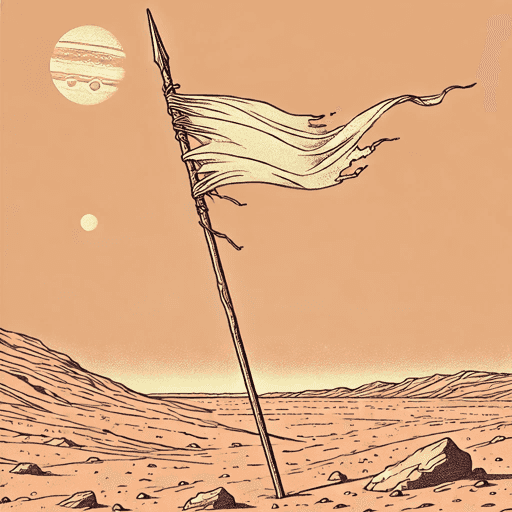
Light Bringer
75 pages • 2-hour read
Pierce BrownLight Bringer
A modern alternative to SparkNotes and CliffsNotes, SuperSummary offers high-quality Study Guides with detailed chapter summaries and analysis of major themes, characters, and more.
Symbols & Motifs
The Path to the Vale
Content Warning: This section of the guide includes discussion of death.
The Path to the Vale, a philosophical book that Darrow reads during his exile, symbolizes his internal journey toward self-forgiveness and wisdom. The book encourages reflection, humility, and acceptance of one’s imperfections, all of which guide Darrow’s transformation across the novel. His repeated meditations—such as focusing on his breath and seeking stillness—contrast sharply with the impulsive rage that defined his earlier battles. The Path to the Vale offers a structured philosophy that emphasizes perseverance without resorting to brutality. By aligning himself with its teachings, Darrow redefines heroism not as victory through violence but as resilience through compassion and ethical leadership. The book also represents a rare moral constant in a universe that is increasingly shaped by compromise, reminding Darrow of the quiet clarity found in his original cause. In this way, the symbol reinforces the novel’s broader assertion that redemption is earned through introspection and action, not absolution.
The Lightbringer and the Morning Star
The Lightbringer, formerly Darrow’s Morning Star, is repurposed as Lysander’s flagship—a physical manifestation of imperial propaganda. Although the ship’s name is intended to evoke hope and rebirth, its function is hollowed out and corrupted, symbolizing how institutions and ideals can be co-opted by new regimes without real change. Lysander uses the ship to stage grandiose military spectacles that mask brutality with pageantry, emphasizing how easily power structures reframe violence as progress. The ship’s transformation from a tool of rebellion into a symbol of conquest highlights the novel’s concern with how unity is often forged through deception and spectacle rather than genuine reform. Its rebranding shows how symbols of resistance can be rewritten by those in power, their original meaning distorted to legitimize authoritarian rule.
Masks and Disguises
Throughout the novel, the motif of masks and disguises underscores how war forces individuals to conceal their true selves for survival. Characters routinely present false fronts: Lysander disguises his political intentions, Diomedes pretends to be loyal while secretly undermining the Core, and Darrow himself takes on the persona of a myth to rally others. This recurring motif illustrates that survival often demands the erosion of authenticity. It also deepens the tragedy at the novel’s core: that in the pursuit of victory, characters are often forced to bury essential parts of themselves, losing personal identity even as they fight for collective ideals. Even those who reject deception—like Cassius—must eventually choose between integrity and survival, revealing how insidiously war reshapes character. Masks, both literal and figurative, thus represent the psychological toll of prolonged conflict, revealing how war consumes both public and private selves in equal measure.
The Garter
The Garter—Io’s critical agricultural system—symbolizes the fragility of civilization in wartime. When Lysander destroys the Garter to consolidate control, he sacrifices the lifeblood of an entire people for strategic advantage. The Garter’s destruction transforms a battlefield victory into a humanitarian catastrophe, illustrating how the logistics of survival—food, water, shelter—are inseparably tied to power. The symbol reinforces the novel’s warning that empires do not crumble solely from military defeat but from the willful neglect of those basic structures that bind societies together. Its loss underlines the novel’s belief that political victories mean little if they leave people starving, displaced, or forgotten. It also highlights the cruel calculus of leadership when power is prioritized over the well-being of civilians.
The Breath of the Stone
Darrow’s discovery and mastery of the Breath of the Stone fighting style symbolizes his personal growth and transformation. After years of relying on brutal force and tactical genius, Darrow’s new method reflects a shift toward patience, balance, and harmony with his surroundings. In contrast to the acrobatic, showy Willow Way, the Breath of the Stone is rooted, enduring, and responsive: “I thought there was no potential beyond mastery of the Willow Way […] No. We were sharpening my fundamentals—so I could then find my art form” (552).
This evolution in his fighting mirrors Darrow’s broader arc of redemption. No longer simply the Reaper who charges headlong into war; he now moves with the wisdom of experience, grounded in a deeper understanding of himself and his place in the world. The Breath of the Stone serves as a physical manifestation of Darrow’s internal transformation—illustrating that true strength lies not in overwhelming force but in resilience, humility, and the hard-earned ability to adapt without losing oneself. Its name evokes geological endurance, linking Darrow’s path not only to strength but also to ancient, unshakable stillness—an antidote to the chaos he once embodied.
Names and Naming
Throughout Light Bringer, names function as more than labels—they are assertions of identity, legacy, and control. From Darrow reclaiming the name “Reaper” and giving it new meaning to Fa being revealed as Vagnar, names often mark a turning point in one’s self-conception or political role. Volga rejects Fa and is crowned queen of the Volk, stepping into a leadership role not through conquest but through choice. Darrow’s new fighting style, the Breath of the Stone, is itself a form of self-naming, an articulation of transformation. Even call signs like Lyria’s “Truffle Pig” and later “Eaglet One” serve as symbols of evolving relationships and personal growth. In contrast, Lysander’s use of the name Lightbringer for his ship is performative, a deliberate invocation of hope to conceal authoritarian ambition. This motif reinforces the novel’s interest in how identity is shaped not just by action but by what we are called and what we choose to call ourselves.

Unlock the meaning behind every key symbol & motif
See how recurring imagery, objects, and ideas shape the narrative.
- Explore how the author builds meaning through symbolism
- Understand what symbols & motifs represent in the text
- Connect recurring ideas to themes, characters, and events