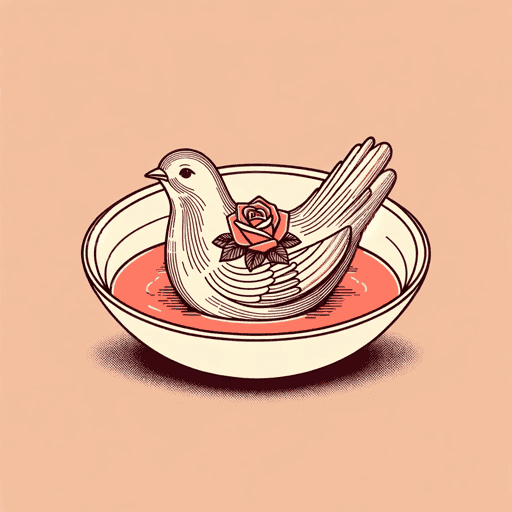
Like Water for Chocolate
Like Water for Chocolate
A modern alternative to SparkNotes and CliffsNotes, SuperSummary offers high-quality Study Guides with detailed chapter summaries and analysis of major themes, characters, and more. For select classroom titles, we also provide Teaching Guides with discussion and quiz questions to prompt student engagement.
Summaries & Analyses
Games
After Reading
Discussion/Analysis Prompt
Reflect on Laura Esquivel’s title Like Water for Chocolate. How does it relate to the story’s ending? Consider the following as you develop your ideas:
- What does the expression “like water for chocolate” mean?
- What does Tita learn about passion from John’s grandmother’s beliefs?
- Why does John give Tita a pack of matches?
- What is the symbolic meaning behind the way Pedro and Tita die?
Teaching Suggestion: If students are struggling to decipher the significance of the title, you might encourage them to consider the multiple meanings of “like water for chocolate” and how each might apply to Tita. This entry from SpanishDictionary.com provides literal and metaphorical meanings behind the phrase, which students might find helpful. Understanding what the novel’s title points to in Tita’s character may help students see how, in the context of Morning Light’s analogy about passion, the novel’s ending is almost inevitable. You could extend this discussion by challenging students to explain what the novel is saying about passion—is there such a thing as too much passion, or is Tita’s fate being celebrated in some way?
Differentiation Suggestion: Although answering this prompt does not require a complete review of the text, it does require a thorough understanding of several sections. For English language learners or those who struggle with reading fluency or attention, you might consider breaking students into groups of four and letting them work together to investigate the bulleted sub-questions before asking for a class discussion or individually written responses. If you choose the latter, a reasonable alternative for students who struggle with written expression might be allowing them to answer the four sub-questions with a few sentences each, along with one or two sentences that answer the main prompt.
Activities
Use this activity to engage all types of learners, while requiring that they refer to and incorporate details from the text over the course of the activity.
“Tita’s Cooking Blog”
In this activity, students will demonstrate their understanding of Esquivel’s genre crossing and Tita’s characterization by recreating a chapter from the novel in the form of an online recipe blog.
A key characteristic of Esquivel’s novel is that it blends several genres. In this activity, you will show your own ability to blur genre lines by adapting a chapter of the novel into a new format: the online cooking blog.
Choose a Chapter and Plan
- What recipe is in the chapter’s title? How is this recipe traditionally prepared?
- What are the key events in this chapter from Tita’s perspective?
- If Tita were writing for the general public, what would she want to say about this recipe and its relationship to culture, family history, and her own life?
Create Your Blog Entry
- Browse some examples of well-known cooking blogs here, here, and here. Notice that the entries generally begin with an introductory section before the recipe itself is given.
- Translate key ideas from the chapter into the format of a first-person cooking blog, using Tita’s perspective on her culture, family, and life.
- Your blog entry should be about 800 words in length, and it should include relevant images as well as an introduction, key events from the chapter, and the recipe.
Reflect on the Activity
- Write a brief reflection (1-2 paragraphs) about the experience of working on this activity:
○ What might it be like to read a whole novel written as a series of cooking blog entries?
○ Esquivel wrote her novel before cooking blogs were popular. If she were writing the novel today, do you think she would be tempted by this format? Why or why not?
Teaching Suggestion: Students will need internet access to research the recipes they choose and find photos for their entries; if this is not an option for your class, you might accept slightly vague directions in the recipe (as long as students do not leave out any novel-related details), and you might give students the opportunity to do without photos or design their own supplementary images. (You could also print out examples of cooking blog formats from the links listed in the “Create Your Blog Entry” section of the activity.) If students do have internet access and will be working on the activity in class, they may enjoy working in small groups, with each group assigned a different chapter, so that they can ultimately assemble an online “cookbook” out of their combined work.
Differentiation Suggestion: Students who struggle with organization may benefit from filling out a graphic organizer as they reread their chosen chapters, perhaps divided into sections for cultural details, family history, and Tita’s own experiences during the chapter. These students, as well as students who struggle with written expression, may need assistance as they plan how to incorporate relevant details into the different sections of their blog entries. After students have gathered details from their chosen chapters and seen examples of cooking blogs, you might lead a brief discussion about how to adapt a chapter into this new format.
Essay Questions
Use these essay questions as writing and critical thinking exercises for all levels of writers, and to build their literary analysis skills by requiring textual references throughout the essay.
Differentiation Suggestion: For English learners or struggling writers, strategies that work well include graphic organizers, sentence frames or starters, group work, or oral responses.
Scaffolded Essay Questions
Student Prompt: Write a short (1-3 paragraph) response using one of the bulleted outlines below. Cite details from the text over the course of your response that serve as examples and support.
1. Frame narratives give authors the opportunity to provide context, add momentum, offer external observations, and/or engage with other points of view. In Like Water for Chocolate, the author uses a frame narrative.
- What function does this frame narrative serve? (topic sentence)
- Offer at least three pieces of evidence that support your interpretation. Explain your ideas carefully and cite any quoted material.
- In your concluding sentence or sentences, explain how this technique unifies the overall narrative through one or more of the novel’s primary themes: Repressed Female Desire and Rebellion, The Intersection of Family and Food, and The Human Experience.
2. While the novel defies being categorized into a single genre, it does include elements of magical realism, which is often used to critique aspects of culture.
- Which aspect of culture is most clearly critiqued by elements of magical realism in this novel? (topic sentence)
- Choose at least three elements of the novel that support your claim. Explain your ideas carefully and cite any quoted material.
- In your concluding sentence or sentences, show how this critique supports one or more of the novel’s primary themes: Repressed Female Desire and Rebellion, The Intersection of Family and Food, and The Human Experience.
3. Like Water for Chocolate focuses much of its attention on food—its preparation, its consumption, and its meaning. Choose a lengthy passage that has food as its primary focus.
- How does Esquivel employ figurative language to convey the symbolic meaning of food in this passage? (topic sentence)
- Identify at least three uses of figurative language and explain their symbolic meaning(s). Cite any quoted material.
- In your concluding sentence or sentences, show how this symbolism supports one or more of the novel’s primary themes: Repressed Female Desire and Rebellion, The Intersection of Family and Food, and The Human Experience.
Full Essay Assignments
Student Prompt: Write a structured and well-developed essay. Include a thesis statement, at least three main points supported by text details, and a conclusion.
1. Like Water for Chocolate is known for its blending of genres. What are the main genres Esquivel combines? Whose perspectives are included, and what does this have to do with the book’s message(s) about women? How does Esquivel’s genre-crossing allow her to highlight the connection between the physical and the emotional/spiritual aspects of human life? Write an analysis of the ways in which Esquivel’s genre-blending supports the book’s thematic concerns with Repressed Female Desire and Rebellion, The Intersection of Family and Food, and The Human Experience. Support your assertions with evidence from throughout the text, making sure to cite any quoted evidence.
2. The temperaments of and relationships among the women in Tita’s family are sometimes read as an allegory for the roles of women in Revolutionary Mexico. Research the roles that women played in Mexican society during the Mexican Revolution, then consider the following: How does the novel characterize Mama Elena, Gertrudis, Rosaura, and Tita? How might each woman correspond to a particular type of woman in this time period? How do the relationships among these women, the choices they make, and their fates all work together to comment on women in Revolutionary times? Write an essay in which you analyze the women in Tita’s family as allegories representing the roles of women during the Mexican Revolution. Show how the allegory supports the novel’s thematic concern with Repressed Female Desire and Rebellion. Support your analysis with evidence drawn from the novel and your research, making sure to cite all quoted material and evidence from the text and outside sources.
3. One of the novel’s primary thematic concerns is The Human Experience: to be human is to be both physical and spiritual, not just one or the other. Which elements of the novel convey the comingling of these experiences within human beings? How do these two aspects “feed” one another in a healthy person? What happens to characters when one of these aspects is neglected? Write an analysis of the relationship between the physical/material and the spiritual/emotional in Like Water for Chocolate. Support your assertions with evidence from throughout the text, making sure to cite any quoted evidence.
Cumulative Exam Questions
Multiple Choice and Long Answer Questions create ideal opportunities for whole-text review, exams, or summative assessments.
Multiple Choice
1. Which is the most defensible interpretation of the symbolism of birds in the novel?
A) They represent childhood.
B) They represent freedom.
C) They represent spirituality.
D) They represent domestication.
2. Which of these foods that Tita prepares has the most uniformly positive effects?
A) The turkey mole with almonds and sesame seeds she makes for Roberto’s baptism
B) The northern-style chorizo she makes on the day the soldiers raid the dovecote
C) The Chabela wedding cake she makes for Rosaura’s wedding to Pedro
D) The quails in rose petal sauce she makes with the roses Pedro gives her
3. What do nearly all the women in the De la Garza family value most?
A) Community service
B) Personal ambition
C) Formal education
D) Family duty
4. Which is the most defensible interpretation of the symbolism of Tita’s bedspread?
A) It represents her resilience.
B) It represents her chastity.
C) It represents her religious faith.
D) It represents her rebellion.
5. Which element of the novel’s structure most clearly demonstrates Tita’s connection to both the past and the future of her family?
A) The months in chapter titles
B) The frame narrative
C) The recipes
D) The use of foreshadowing
6. Which character most clearly functions as a surrogate mother to Tita?
A) Gertrudis
B) Morning Light
C) Chencha
D) Nacha
7. Which is the most defensible interpretation of the symbolism of fire and heat in the novel?
A) It represents anger.
B) It represents passion.
C) It represents love.
D) It represents hope.
8. Which character is most responsible for Tita’s recovery from the traumas of Mama Elena's abuse?
A) Pedro
B) John
C) Rosaura
D) Morning Light
9. Which is the most reasonable interpretation of the unusual impact Tita’s food often has on others?
A) Her passion is so strong that it “infects” the food she prepares.
B) Tita has magical powers inherited from her female ancestors.
C) God is sending messages to people through Tita’s food.
D) Tita is secretly adding psychoactive herbs and plants to her food.
10. Which character’s life story most closely resembles Tita’s?
A) Elena’s
B) Gertrudis’s
C) Nacha’s
D) Chencha’s
11. Which motif in the novel most clearly represents the depth of Tita’s emotions?
A) Light
B) White
C) Wind
D) Tears
12. Which character most clearly represents the emerging independence of women in Revolutionary Mexico?
A) Gertrudis
B) Tita
C) Chencha
D) Rosaura
13. Which is the most reasonable interpretation of why Tita is more attracted to Pedro than John?
A) Pedro respects her mind and emotions more than John does.
B) Pedro appeals to her passionate, physical nature more than John does.
C) Pedro understands her obligations to her family more than John does.
D) Pedro represents the forbidden and taboo more than John does.
14. What do all the De la Garza sisters have in common?
A) All three are in love with the same man at one time or another.
B) All three are deeply supportive of the rebel side of the revolution.
C) Each eventually breaks free from Elena’s expectations, at least to some extent.
D) Each has a unique magical quality, though these manifest in different ways.
15. What does food come to represent to Tita, besides its ability to nourish others and demonstrate familial love?
A) It allows her to rebel in secret as Elena’s oppression worsens.
B) It becomes her voice and means of self-expression.
C) It substitutes for her lack of formal education and worldly experience.
D) It offers her power in a world that tries to keep women submissive.
Long Answer
Compose a response of 2-3 sentences, incorporating text details to support your response.
1. What symbolic meaning is conveyed by the ipecac that Mama Elena takes?
2. Given her own history, what is ironic about Mama Elena’s interference in Tita’s relationship with Pedro?
Exam Answer Key
Multiple Choice
1. D (Various chapters)
2. A (Various chapters)
3. D (Various chapters)
4. A (Various chapters)
5. C (Various chapters)
6. D (Various chapters)
7. B (Various chapters)
8. B (Various chapters)
9. A (Various chapters)
10. C (Various chapters)
11. D (Various chapters)
12. A (Various chapters)
13. B (Various chapters)
14. C (Various chapters)
15. B (Various chapters)
Long Answer
1. Mama Elena believes that people are trying to poison her, and so she takes the ipecac, not realizing that it is actually responsible for the bitter taste in her mouth. This is symbolic of the way she allows her own bitterness to ruin her relationships with others. In the end, she is the one who is “poisoning” herself, and she dies from an overdose of the syrup. (Various chapters)
2. Mama Elena’s family prevented her from marrying Jose Treviño and arranged her marriage to Juan De la Garza. Despite knowing the pain this kind of interference creates, she refuses to allow Tita to marry Pedro and instead arranges for Pedro to marry Rosaura. (Various chapters)

Get in-depth, chapter-by-chapter summaries and analysis from our literary experts.
- Grasp challenging concepts with clear, comprehensive explanations
- Revisit key plot points and ideas without rereading the book
- Share impressive insights in classes and book clubs