Madness and Civilization: A History of Insanity in the Age of Reason
43 pages • 1-hour read
Michel FoucaultMadness and Civilization: A History of Insanity in the Age of Reason
A modern alternative to SparkNotes and CliffsNotes, SuperSummary offers high-quality Study Guides with detailed chapter summaries and analysis of major themes, characters, and more.
Key Figures
Content warning: This section contains descriptions of mental illness, imprisonment, and sexual abuse.
Michel Foucault
Paul-Michel Foucault (1926-1984), often referred to simply as Michel Foucault, was a French intellectual historian and philosopher whose work focused on various institutions of social control and the ideas that enable them to operate. Madness and Civilization was his first book, and it would be followed by four others: The Birth of the Clinic, The Order of Things, Discipline and Punish, and The History of Sexuality. In Madness, Foucault begins to develop ideas and methodologies that he would go on to refine in these later works. For example, he would eventually articulate theories of power, which are at play in Madness, but are not made explicit. He would recall, “When I think back now, I ask myself what else it was that I was talking about, in Madness and Civilization or the Birth and the Clinic, but power? Yet I’m perfectly aware that I scarcely ever used the word and never had such a field of analyses at my disposal” (Gordon). Foucault scholars have thus come to value Madness as containing embryonic expressions of some of the philosopher’s most influential ideas, even though he does not formulate them as elegantly in this book as he would go on to do later.
Born to a conservative upper-middle-class family in Poitiers, France, Foucault would later allude to having had a difficult relationship with his father, who was a surgeon. When the Nazis occupied France in 1940, Foucault was in his mid-teens. His mother sent him to a Jesuit school in Belgium, where he began studying history and philosophy. He would continue these studies after the war ended, eventually receiving admission to the École Normale Supérieure, against the wishes of his father, who wanted him to become a surgeon. During his studies, he was surrounded by Marxist thinkers, including his teacher, Louis Althusser, and joined the French Communist Party. But Foucault encountered a culture of anti-gay bias in the party, and never fully subscribed to Marxist thought. Other key influences include Martin Heidegger, Sigmund Freud, and Friedrich Nietzsche.
As an academic, Foucault served as faculty at many institutions, including the University of Tunis, the Collège to France, and the University of California, Berkeley. Throughout his career, he was a vocal opponent of human rights abuses, racism, and anti-gay bias. In the 1980s, while serving as a Visiting Professor at UC Berkeley, Foucault contracted AIDS. After this diagnosis, he returned to France to deliver a final series of lectures, and passed away in June of 1984 at l’Hôpital de la Salpêtrière (one of the institutions addressed in Madness). He was one of the first national figures to pass away during the AIDS epidemic, drawing widespread attention to the disease in France and around the world. Following his passing, his partner, Daniel Defert founded AIDES, the first French advocacy organization for HIV/AIDS.
l’Hôpital Général
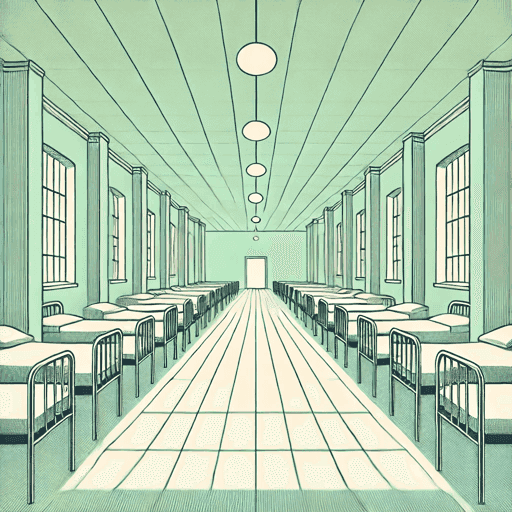
l’Hôpital Général de Paris was an institution founded by Louis XIV in 1656 for the purposes of confining the poor and “mad.” In Madness, Foucault ascribes great meaning to the moment of the hospital’s foundation, using it to mark the beginning of an era that conflated medical treatment of “madness” with its corporal punishment. This era, in his estimation, ended in 1794 when Phillippe Pinel broke the chains used to restrain “mad” inmates. l’Hôpital Général thus becomes the token Enlightenment “hospital” within the book, a stand-in for all such institutions, which were scattered throughout Western Europe during the period. Other institutions addressed in Madness include Bicêtre Hospital, and the Salpêtrière (both of which still operate as hospitals today). Bicêtre is notable for being the location of Pinel’s aforementioned chain-breaking.
The cruel practices of these hospitals are a key area of focus for Foucault, addressing the broader theme of Medical Treatments as Institutional Policing of “Madness.” For example, he describes how basement level cells at Salpêtrière, which would be flooded sewage every time the Seine’s water levels rose, were reserved for the most severe cases of “madness” in patients: “When practices reach this degree of violent intensity,” Foucault asserts, “it becomes clear that they are no longer inspired by the desire to punish nor the duty to correct” (81). Cruelty as a method of dehumanization and control is the model Foucault uses to understand the inhumane policies of these institutions, and a motivation he subsequently assigns to Enlightenment society as a whole.
François Boissier de Sauvages de Lacroix
François Boissier de Sauvages de Lacroix (1706-1767), referred to commonly as Sauvages, was a French botanist and physician who was born in Alès and studied at the University of Montpellier. His major contributions to the field of medical science were concerned with nosology, the classification of diseases. For Foucault, this process of classification, which Sauvages’ work emblemizes, is central to the Classical Period’s relationship to “madness.” Other thinkers that Foucault cites as being involved in this project of classification include Alexander Crichton (1763-1856), Thomas Sydenham (1624-1689), and Robert James (1703-1776), as well as many others. Sauvages’s particular nosological theory was based on the idea that the body and soul responded to fear in a variety of ways that corresponded to a variety of “madnesses.”
William Tuke and Phillippe Pinel
William Tuke (1732-1822) and Phillippe Pinel (1745-1826) were two key reformers of the psychiatric treatment system. In Madness, Foucault treats them as inventors of the modern asylum. However, many medical historians understand institutions, like l’Hôpital Général, that had been imprisoning the mentally ill long before Pinel and Tuke’s reforms to have also been asylums. Although both men revolutionized the medical industry’s attitudes towards “madness,” pushing for more humane treatment conditions, Foucault is careful to highlight the ways in which they perpetuated power structures that oppressed the mentally ill. The humane treatment that they offered, Foucault posits, was predicated on the threat of a return to the medical abuses of the past. He reports, for example, that at Tuke’s Retreat, caretakers threatened that “if [a patient] did not control himself, it would be necessary to go back to the old ways” (254). While Tuke and Pinel represent a form of social progress in Foucault’s eyes, their shortcomings are also a central focus of his analysis.
Phillippe Pinel was born in the French commune Jonquières, and studied medicine at the Universities of Toulouse and Montpellier. In the years leading up to the French Revolution, the restrictive bureaucracy of the ancien régime prevented him from practicing in Paris as he desired. When the Revolution began, he sympathized with the rebel cause, and befriended influential revolutionaries through his connection to Madame Helvétius, who ran one of the most notable salons in Paris.
After the establishment of the First Republic, Pinel was made Physician of the Infirmeries at Bicêtre Hospital, and later Chief Physician at the Hospice de la Salpêtrière, both of which housed hundreds of those who had previously been deemed “mad” by the French state. Upon attaining these positions, Pinel set about reforming the hospitals’ treatment of the mentally ill, and began by ending the use of shackles to restrain inpatients; Foucault cites a popular legend of Pinel personally removing the chains at Bicêtre, when this was in fact done by his colleague Jean-Baptise Pussin. Other key reforms made by Pinel include ending the practice of bleeding, purging, and blistering patients, and replacing these methods with observation and conversation-based treatment.
William Tuke was born in York, England to a Quaker family. In 1791, he was inspired by the case of Hannah Mills, a widow who had died in the care of the York Lunatic Asylum, to found the York Retreat. He envisioned the Retreat as a space where “moral treatment” would be administered to the mentally ill. Foucault places heavy emphasis on how Tuke’s religious values informed his conception of “moral treatment,” writing, “Let us not forget that we are in a Quaker world where God blesses men in the signs of their prosperity. Work comes first in ‘moral treatment’ as practiced at the Retreat. […] Through work, man returns to the order of God’s commandments” (255). This religious moralist underpinning of Tuke’s humane reforms is in contrast to Pinel’s, which Foucault asserts was primarily concerned with establishing a morality based in the secular thought of the French Revolution.
Marquis de Sade
Donatien Alphonse François, Marquis de Sade (1740-1814) was a French nobleman and writer. He is known best for his imprisonment under charges of sex crimes, blasphemy, and authoring pornography. The concept of “sadism,” deriving pleasure from either one’s own pain or the pain of others, borrows its name from him (the word first appears in 1888). In Madness, Foucault utilizes Sade as a case study in the particular forms of “madness” that flourished in the Classical Ages. He writes:
Sadism is not a name finally given to a practice as old as Eros; it is a massive cultural fact which appeared precisely at the end of the 18th century, and which constitutes one of the greatest conversions of Western imagination: unreason transformed into delirium of the heart, madness of desire, the insane dialogue of love and death in the limitless presumption of appetite (218).
A well-known prisoner of high social standing who was able to write about his own experiences, Sade stands out as one of the only voices of those imprisoned for “madness” quoted directly in the text. While using Sade’s accounts in this sympathetic way, Foucault simultaneously omits the violent details of his sexual crimes. Most of these crimes were committed against women and girls who came from lower class backgrounds, rendering them entirely vulnerable to Sade’s predatory behavior. Contemporary scholars often argue that Sade’s behavior actually went beyond what would be clinically classified as sadism by psychologists today, and that treating his crimes as mere sadism is a trivialization of sexual violence. Foucault’s failure to draw this distinction in Madness, treating Sade as though he was the founder of sadism, stands out as a clear bias within the book. This bias may be partially due to Foucault’s personal involvement in sado-masochistic circles in California in the 1970s and 1980s, which the American philosopher James Miller wrote about in The Passion of Michel Foucault (1993).

Unlock analysis of every key figure
Get a detailed breakdown of each key figure’s role and motivations.
- Explore in-depth profiles for every key figure
- Trace key figures’ turning points and relationships
- Connect important figures to a book’s themes and key ideas