Midnight Rider
67 pages • 2-hour read
Joan Hiatt HarlowMidnight Rider
A modern alternative to SparkNotes and CliffsNotes, SuperSummary offers high-quality Study Guides with detailed chapter summaries and analysis of major themes, characters, and more.
Chapters 9-17Chapter Summaries & Analyses
Chapter 9 Summary: “Lady-in-Waiting”
Hannah appears before Meg in her new chambermaid uniform of a striped dress and starched apron. Meg inspects and approves Hannah’s appearance, noting the more fashionable clothes that Mrs. Dudley has used to replace Hannah’s homespun garments. Meg assigns Hannah various duties, including cleaning her rooms, helping her dress, and fetching fresh water. When Hannah empties Meg’s washbowl into a pitcher, she accidentally spills some water before heading to the courtyard well.
At the well, Caleb approaches Hannah and invites her to a shadow play with a hidden purpose, asking her to meet him after candlelighting. He hints that Meg has secret evening “engagements.” When Hannah returns to Meg’s room, Meg shares plans for future carriage rides in an unmarked vehicle to avoid attention due to the rebel unrest in Boston. Meg declares that Hannah will be her “lady-in-waiting” and demands that Hannah respect her privacy. Hannah silently recalls her obligation to report on Meg to Mrs. Gage and tells Meg that she will “do [her] best” (88). When Hannah successfully imitates Lydia, Meg laughs and suggests that Hannah’s mimicry talent might be used for their “amusement.”
Chapter 10 Summary: “Disguised!”
That afternoon, Hannah helps Meg try on several gowns for an upcoming ball and learns about the fabric embargo that prevents Meg from acquiring new dresses. At candlelighting, Meg dismisses Hannah, who joins Caleb in the courtyard. However, when they approach the guardhouse to leave the Province House, a British soldier prevents Hannah from exiting due to her age and the late hour, stating that she would not be safe in a town facing potential riots.
Caleb suggests disguising Hannah as a boy. He takes her to the stables, where she changes into boys’ clothes. When they approach the guardhouse, Caleb claims that the disguised Hannah is his cousin “Hans Gibbs”: a ruse that Hannah strengthens by speaking in a male voice. After successfully fooling the guard, the two head to the house of Paul Revere, a member of the Sons of Liberty, “a special association of patriots” (97). in North Square, Caleb points out important Patriots including Sarah Revere, Dr. Joseph Warren, and Dr. Benjamin Church. The shadow play satirizes British taxes and the quartering of soldiers, with the audience singing the rebel ballad “The Rallying of the Tea Party” (99). As Hannah begins to reassess her own loyalties, she spots Catherine in the audience and realizes that her friend has secret Patriot sympathies.
Chapter 11 Summary: “Nighttime Conspiracies”
After the shadow play, Hannah urges Caleb to return before curfew. While walking through Boston’s streets, they discuss the growing political bitterness between British authorities and colonists. Suddenly, they observe Paul Revere, Dr. Warren, and Dr. Church heading to the Long Room Club in Dassett Alley, a known Whig meeting place. Caleb reveals that he has visited the club himself and makes Hannah promise to keep this a secret.
To avoid suspicion from the guard, Caleb and the disguised Hannah sing loudly as they pass through the Province House gate, feigning drunkenness. After changing out of her disguise in the stables, Hannah returns to find Catherine awake and worried. Hannah confesses to attending the shadow play disguised as a boy and mentions seeing Catherine there. The two agree to keep each other’s presence at the event a secret. Catherine explains Boston’s dangers and warns Hannah against breaking curfew or advertising her political leanings. Before falling asleep, Hannah feels homesick and wonders about Will and Promise.
Chapter 12 Summary: “An Excursion to the Common”
Catherine wakes Hannah early, warning her not to be late for her duties. Hannah brings Meg breakfast only to find her already dressed and announcing plans for an outing to Boston Common. Meg orders a picnic for three people and requests an unmarked carriage so that she can avoid drawing attention due to Boston’s anti-British sentiment. In the stables, Hannah feeds an apple to General Gage’s horse, Gabriel, impressing Caleb, who explains that he needs Mrs. Gage’s permission for the carriage. Frustrated by the delay, Meg likens herself to her caged bird.
When the driver, Joseph, finally brings an unmarked carriage, Meg and Hannah depart for the Common. Meg directs Joseph to stop at a particular spot and dismisses him, ignoring his objections. Lieutenant Chester Pratt soon arrives on a distinctive rust-colored horse and greets Meg intimately. When he questions Hannah’s presence, Meg asks Hannah to display her mimicry talent. Stung by Pratt’s arrogance, Hannah mimics his haughty tone, angering him. Meg diffuses the tension and dismisses Hannah, who walks away and realizes that Meg has planned a tryst. She dozes off and is later awakened by Caleb and Will, who have brought her beloved horse, Promise.
Chapter 13 Summary: “The Tryst”
Hannah joyfully reunites with Promise and Will. He explains that he came to the Province House seeking her and found her with Caleb’s help. Overcome with excitement, Hannah rides Promise across the field, reveling in the sense of freedom. After she finishes her ride, Caleb compliments her by exclaiming that she rides like “a man.” Hannah, Will, and Caleb then discuss political allegiances. Will reveals that he is now a Whig courier for Salem and needs to find work so that he can stay in Boston. Will and Caleb affirm their shared desire for liberty, and Caleb offers Will lodging in the stables as his “cousin.” Hannah explains her disguise as yet another such “cousin” and amuses the boys by mimicking Lieutenant Pratt. Caleb invites her to meet at the stables later that night.
Hannah returns to Meg and Lieutenant Pratt, and the latter complains about Hannah’s perceived insolence. After Pratt leaves after a private moment with Meg, they return to the Province House by carriage. During the ride, Meg reveals that she saw Hannah with Will and Caleb on the Common. She suggests that they each keep each other’ secrets, and she threatens to tell Mrs. Gage about what she assumes to be Hannah’s own tryst with the stable boys if Hannah were to report Meg’s tryst with Pratt. Hannah realizes that she is being blackmailed.
Chapter 14 Summary: “Indentured to England”
After returning from the Common, Hannah tells Catherine what happened and describes Meg’s manipulative nature. Catherine counsels caution. Later, when Meg dismisses Hannah for the evening, Hannah informs Catherine that she plans to meet Will and Caleb in the stables. In Caleb’s quarters, Will explains his role as a courier for the Committees of Correspondence, which involves monitoring British activities and carrying messages between Patriot groups.
Caleb and Will discuss the Coercive Acts (which the colonists call the Intolerable Acts), which have mandated the closing of Boston Harbor and have placed General Gage in the role of enforcing these and other restrictions on the colonists. Will recounts that Salem Patriots defied General Gage’s order to close a town meeting. Caleb then expresses concern about increased danger and surveillance in Boston. Upon learning more about England’s unfair taxation of the colonies, Hannah draws a parallel between the American colonies’ relationship with Britain and her own indentured servitude, comparing both to a state of bondage without rights. Caleb agrees with this analogy, and Hannah expresses a desire to ride Promise again, suggesting using her “Hans” disguise to leave the Province House unnoticed.
Chapter 15 Summary: “A Visit to Long Wharf”
Disguised as Hans, Hannah leaves the Province House with Caleb and Will. They walk to the Valley Acres stables, where Hannah saddles Promise and rides out alone. While riding, she overhears men discussing General Gage’s controversial replacement of judges, as well as new court policies that might send colonists to Britain for trial. When Promise bolts, Hannah accidentally speaks in her female voice, gaining the men’s attention. She rides to Long Wharf, where she observes unusual nighttime military activity involving numerous longboats and British soldiers.
When the soldiers challenge Hannah, declaring that no one is permitted at the wharf, she identifies herself simply as a “friend.” Feeling trapped, Hannah evades the soldiers and flees on Promise. Upon returning to Valley Acres, she tells Caleb and Will about the longboats and soldiers. As they head back to the Province House, the guard warns them about stricter security precautions and General Gage’s concerns about spies.
Later that night, Hannah dreams of riding promise, who becomes a bird and flies and then transforms into Gabriel. Suddenly, she wakes to the sound of troops marching and wonders if the soldiers are heading to Long Wharf. Catherine confirms that General Gage seemed preoccupied at supper.
Chapter 16 Summary: “The Powder House Incident”
While helping Meg dress the next morning, Hannah listens to her complain that Phillis Wheatley’s poetry presentation was boring and that Lieutenant Pratt was absent from the event. Hannah suspects that some military action is underway. Later, she notices increased activity in the stables and courtyard. Caleb informs her that British troops led by Colonel Maddison raided the Quarry Hill powder house at dawn, using the longboats Hannah had seen the previous night. They seized colonial gunpowder and cannons, taking them to Castle William in the harbor. After soldiers see Hannah’s ring (her mother’s wedding ring) and tease her, calling her Caleb’s “wife,” she flees inside and overhears General Gage, Maddison, and other officers celebrating the successful raid.
Two soldiers report that 20,000 outraged colonials are marching toward Boston, incensed over the British troops’ raid on the powder stores. General Gage orders Boston closed and demands that the inhabitants surrender their weapons. Hannah narrowly avoids being seen and returns to Meg’s room, where Lydia summons them to Mrs. Gage’s chambers. Mrs. Gage explains the incident involving the powder house, as well as General Gage’s lockdown of Boston and the possibility of sending Meg to England for safety. As she describes the situation, Mrs. Gage expresses pain over her divided loyalties between her American heritage and her status as the wife of a British governor. Meg laments her confinement in the Province House and vows to find a way out so that she can see Lieutenant Pratt. Silently, Hannah also resolves to escape the Province House for her own purposes.
Chapter 17 Summary: “Caleb’s Secret”
That night, Will announces that Caleb has found him employment with Mr. Hubbard, a cooper and one of the members of the Boston Committee of Correspondence. Because Mr. Hubbard’s barrels are essential to Boston’s businesses, the closure will not affect him and his employees; Will’s new position will allow him to travel as a courier while Promise remains safely stabled. Caleb reveals his plan to post handbills threatening any lawyers who cooperate with the newly appointed Tory judges. Hannah and Will warn Caleb about the increased danger and heightened security, but despite the difficulty of leaving the Province House, Hannah wants to help the cause.
Caleb knows a secret way out of the Province House grounds and makes Hannah and Will swear to keep it confidential. After Hannah changes into her “Hans” disguise, Caleb leads them through the stables’ back way to an old woodshed. He explains that a year ago, while dumping manure, he discovered a hidden trapdoor and tunnel after seeing a mysterious man emerge from it. The passage leads to Baker’s Alley outside the Province House walls. The trio clears away debris to uncover the trapdoor, and when Caleb lights a candle, they see stone steps descending into a dark, secret passageway that will enable their clandestine activities.
Chapters 9-17 Analysis
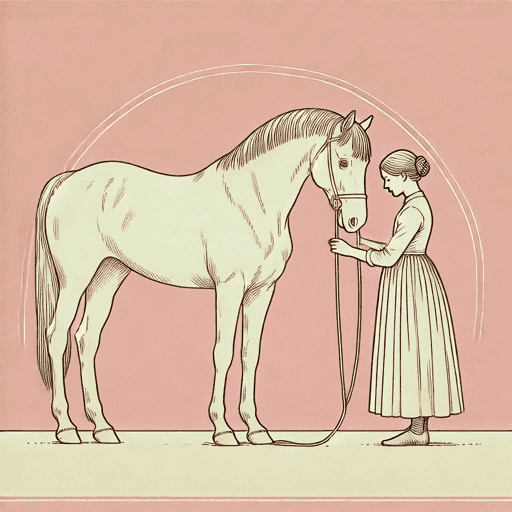
As Hannah begins to find her footing in Boston, the recurring motifs of horses and riding highlight complex ideas such as personal freedom, family heritage, and the importance of engaging in social transgressions in the name of greater liberty. Within this context, Promise simultaneously represents Hannah’s fondest memories of the past and her promises to herself for the future. Likewise, Hannah’s exceptional riding ability challenges contemporary gender conventions and foreshadows her upcoming role in the Sons of Liberty’s subversive activities, as she clearly refuses to be constrained by social expectations. Her compassionate approach to taming horses also contrasts sharply with the British officers’ use of whips, delivering an implicit commentary on the differences between a free society and one dominated by unjust forces. Thus, Harlow frequently uses equine imagery to convey ideas that are far more complex and abstract.
Although Hannah has not yet fully committed to the Patriots’ cause, these early chapters suggest that she is ideally suited to espionage. With Hannah’s transformation into “Hans,” she gains a measure of freedom despite her indentured servitude, and her first daring forays into the Boston streets in the guise of a boy teach her that with Promise back in her life, she now has a vehicle for her political and personal liberation. Whenever Hannah dons male clothing and adopts a masculine voice, she gains access to spaces and experiences that would otherwise be forbidden. For example, the disguise allows Hannah to attend the shadow play at Paul Revere’s house, where she witnesses a satirical performance that dramatizes Boston’s political opposition to British rule. Ironically, even as a member of the audience, Hannah is herself a performer at this event, as she is essentially performing masculinity while she watches Patriots perform political resistance. This stage within a stage creates a complex commentary on the theatrical nature of gender roles and political identity in pre-revolutionary America. The ease with which Hannah adopts her male persona also suggests the arbitrary nature of gender boundaries, while her growing comfort in the role parallels her increasing confidence in challenging authority figures and navigating dangerous political situations.
As the three friends take an important step forward in their alignment with the Patriots, the secret tunnel that Caleb reveals functions as a powerful symbol of the hidden networks of resistance operating beneath the surface of official British control. Harlow deliberately contrasts the tunnel’s concealed nature with the visible displays of British military power throughout Boston, suggesting that true resistance often occurs through covert channels rather than direct confrontation. The dark, dirty, and dangerous setting of the tunnel also mirrors the moral ambiguity and personal risk inherent in the friends’ revolutionary activities. When Caleb describes discovering the passage after seeing a mysterious figure emerge covered in manure, the shadowy presence of this unknown person foreshadows complications to come, as the secret passageway is not so secret after all. As the novel progresses, this tunnel will play a central role in Hannah’s subversive activities, and its very existence within the grounds of British administrative power suggests that resistance networks penetrate even the most secure bastions of authority.
Harlow develops the theme of Personal Bondage as a Mirror for Political Oppression through Hannah’s explicit recognition of the parallels between her individual servitude and America’s colonial status. When Hannah declares, “Americans are indentured servants, just as I am,” Caleb agrees, saying, “We’re all indentured to England” (130). As the conversation demonstrates, Hannah’s realization emerges not from abstract political theory but from her own lived experience of powerlessness. Because she is frustrated at being forbidden to leave the Province House, she can easily understand the rising wrath of Boston’s inhabitants after General Gage’s decision to close the city. Harlow thus uses Hannah’s situation as a microcosm of the broader political struggle taking place in this dramatic lead-up to the Revolutionary War. Ultimately, Hannah’s lack of control over the decisions affecting her life parallels the colonists’ exclusion from representation in Parliament. Likewise, her indenture contract, which legally binds her for seven years, becomes a metaphor for the increasingly restrictive laws that bind America to British rule.
As Hannah struggles to stay afloat in her complex interactions with the Gage family, these scenes illustrate the issues involved in Navigating the Challenges of Divided Loyalties. Hannah is particularly torn between her growing affection for Mrs. Gage and her constant awareness of her own political stance, which stands at odds with that of her employers. Notably, Harlow refuses to create a simplistic storyline with clear-cut heroes and villains; instead, she works to recreate a sense of the moral ambiguities that abound during times of revolution. Although the Gages show kindness on an individual level, they nonetheless represent and uphold a system of oppression. Mrs. Gage’s own conflicted position reflects this issue, as she is American by birth but British by marriage and political necessity. When Mrs. Gage tearfully admits to feeling “caught” between two different factions, her words articulate the emotional cost of divided allegiances that Hannah herself struggles to reconcile.
Additional moral ambiguity can be found in Meg’s manipulation of Hannah through their mutual secrets; although the girls develop a genuine fondness for one another, their personal connections become potential weapons in this time of political tension. Within this precarious framework, Hannah struggles to maintain her cover while serving as Meg’s chambermaid, and she must balance her genuine care for her mistress against her growing involvement in the rebels’ espionage activities. Because Harlow deliberately deals in shades of gray, the story’s ethical complexity prevents it from devolving into simple propaganda. Instead, the author presents revolution itself as a morally ambiguous process that damages personal relationships even as it serves the grander principles of justice and freedom. However, the narrative also carries a note of idealism, as through Hannah’s journey, Harlow suggests that political awareness naturally leads to political action when individuals witness injustice and discover their own capacity to resist it.

Unlock all 67 pages of this Study Guide
Get in-depth, chapter-by-chapter summaries and analysis from our literary experts.
- Grasp challenging concepts with clear, comprehensive explanations
- Revisit key plot points and ideas without rereading the book
- Share impressive insights in classes and book clubs