Moccasin Trail
54 pages • 1-hour read
Eloise McgrawMoccasin Trail
A modern alternative to SparkNotes and CliffsNotes, SuperSummary offers high-quality Study Guides with detailed chapter summaries and analysis of major themes, characters, and more.
Chapters 11-14Chapter Summaries & Analyses
Content Warning: This section of the guide contains depictions of racism, illness and death, and animal cruelty and/or animal death.
Chapter 11 Summary
The morning after the quarrel, Jonnie and Sally greet Jim as if nothing happened, asking no questions about where he sleeps or what he does. This silence continues for several days. When rumors about a mysterious scarred Indigenous man begin circulating, Jonnie only advises Jim to keep his shirt on around settlers. Jim wonders if he has won his battle for independence.
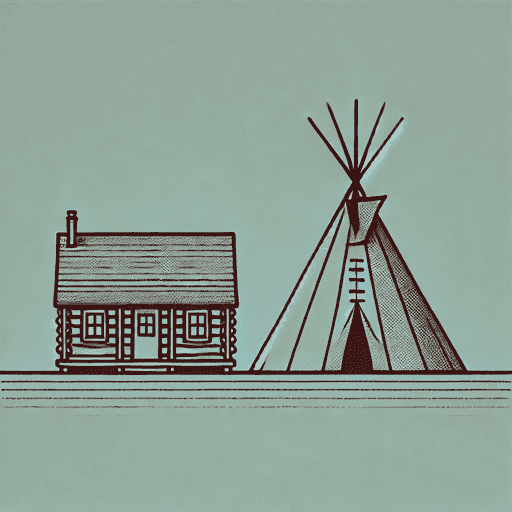
Then Dan’l reveals that Sally intends to make Jim cut his braids. Jim refuses, stating a Crow wears his hair long, and confirms he will not live in the cabin. That same day, he builds a tepee near the oak tree, furnishing it with willow-and-rawhide furniture and moving his belongings inside. This creates the first real break in the family. Jim begins living entirely separately—cooking his own food, using a sweat lodge by the river, and taking no part in finishing the cabin, instead spending time with Dan’l and his dog, Moki.
Jonnie, heartbroken, finds himself in a desperate struggle over Dan’l. The boy loses interest in the cabin and begs to move into the tepee. After Jonnie refuses, Dan’l compensates by spending every free moment with Jim. Jonnie grows increasingly irritable about the work burden. When Dan’l mockingly calls him a “bourgeway”—Jim’s term for a civilized person—and dismisses his domestic efforts as fooforaw, Jonnie explodes, accusing Dan’l of being a rubber stamp of Jim Keath. Dan’l defiantly retorts that he intends to be just like Jim. Jonnie instantly regrets the outburst. Later, their neighbor Mr. Rutledge tells Jonnie he feels sorry for Jim, calling him a homeless critter who belongs nowhere, but Jonnie bitterly disagrees.
As January turns to February, the tepee stands as a constant reminder of the division. Small articles begin mysteriously disappearing and reappearing. Jim feels increasingly caged, thinking no one will build a fence around Talks Alone, his Crow name, and he misses wilderness dangers. His restlessness leads to reckless games with Dan’l. They play a raiding game in which Jim pretends they are stealing horses from a Sioux camp, with the Keath clearing serving as the target. Dan’l steals small items and counts coup by touching Jonnie undetected. When Mr. Rutledge’s son, Ned, has his “Jew’s harp” taken, Dan’l protests returning it. Jim explains one does not steal valuable things from one’s own people, only from enemies. After Dan’l leaves, Jim reflects that there are no enemies in the valley, which makes life uneasy.
Overcome by restlessness, Jim runs to the glades and deliberately frightens Buckskin to provoke a wild ride. Jonnie watches from a ridge. When Jim’s excitement fades, Jonnie approaches and praises his riding, offering a brief truce. Jim impulsively suggests Jonnie try riding Buckskin. Jonnie mounts from the right side, as instructed for an Indian horse, and manages to stay on until he tries to rein her in. She bucks and throws him. Jim helps the uninjured Jonnie to his feet. Jonnie, grinning, says he wishes he had a horse just like Buckskin. When Jim comments that no one is forcing Jonnie to clear stumps, the barriers return between them. As Jonnie leaves to fetch Rutledge’s horse, Jim has what he believes is a brilliant idea for mending the rift: He will get Jonnie a horse.
Chapter 12 Summary
Jim and Jonnie return to find Sally, Dan’l, and the Rutledges talking with four mounted men: Sam Mullins, Ab Selway, Ben Mills, and Clyde Burke. Rutledge explains that eight head of cattle have been stolen from Mills, Burke, and Sam. Boot prints found at two locations suggest a white thief. Their plan is to locate him and wait for the sheriff, currently away in Yamhill County. Dan’l enthusiastically suggests they let Jim handle it. Jim agrees and fetches the mule for Jonnie. Rutledge joins the posse while Sally, Dan’l, Ned, and Moki remain behind.
At Sam’s creek bottom, Jim examines the boot print and finds signs the thief used the creek to hide his trail. After checking the clearer print at Burke’s, Jim announces the thief headed west toward a Cayuse camp he knows of in the hills. The men are skeptical—Cayuses live far east across the gorge, and the boot print suggests a white man. Jim reveals his theory: There was an Indian inside the boot. The print toed inward, showing someone accustomed to moccasins. The men insist on following the tracks. Jim easily follows the obvious trail, privately dismissing local tribes as too weak for such a theft. Jonnie correctly guesses Jim is hoping for a fight, which Jim grins to confirm.
Lost in memories of Crow raids with Eye of the Bear, Many Feathers, and Hides His Face, Jim rides far ahead until the men catch up and demand a plan. Jim finds conclusive proof: cast-off white man’s clothes hidden under a bush. Now convinced, the men follow at a hard pace. Jim and Rutledge peer over a ridge and see the stolen cattle with Cayuse horses in a hollow below.
When Rutledge asks for Jim’s plan, Jim proposes eliminating sentries, retrieving the cattle, then stampeding the horses as a diversion. Rutledge firmly vetoes this, stating he will not start a war. The other men agree and uncock their rifles. Jim seethes with frustration but sees the determined looks on Rutledge and Jonnie’s faces and gives in. He agrees to recover the cattle quietly without bloodshed. His new plan is simply to steal them back. The men approve, and Jim is moved when he sees a look of intense pride on Jonnie’s face. This reignites Jim’s desire to give Jonnie a gift, and he scans the Cayuse horses, searching for the perfect one.
After dark, Jim disappears and signals with owl calls 10 minutes later. The men retreat and find Jim waiting with all eight stolen cattle. After the group rides about a mile and a half away, Jim lights a torch and triumphantly leads in a beautiful cream-colored mare with a white mane—a horse just like Buckskin—as a gift for Jonnie.
The men are stunned. Jonnie’s voice is hard as he rejects the horse, saying it is not his. Jim protests he pulled a coup, but Jonnie accuses him of stealing and breaking the law. Jim argues they just stole the cattle, but Jonnie and Rutledge explain they were recovering their own property, whereas stealing the mare makes them all thieves. Jonnie says with shame that Jim does not understand their ways yet. Burke adds that Jim has provoked the Cayuses. Feeling pain and outrage, Jim declares he will return the mare if Jonnie does not want her. Jonnie states he could never keep a stolen horse. Jim wheels Buckskin around and rides back toward the camp. When Jonnie tries to follow, Jim yells at him to stay back and throws his burning torch in front of Jonnie’s mule to stop him. Jim disappears into the night.
Chapter 13 Summary
Riding furiously, Jim seeks danger in the wilderness after Jonnie rejects his gift. He stops in a clearing to prepare, stripping to his breechclout, eating pemmican, and checking his rifle. He reaches for his medicine bundle for spiritual protection but remembers he left it hidden in a stump back on the claim. Feeling forsaken, he acknowledges that riding into danger without his helpers is foolhardy. Defiantly, he paints his face with vermilion and proceeds with the mare.
He hears Cayuse search parties in the woods but avoids them, noting the noise they make while searching. He realizes they are all searching east, not expecting him so close to camp, giving him an unexpected advantage. He muffles the mare’s hooves with moss and leads her down the gully. When the mare dislodges a pebble, alerting sentries on the ridge above, they fire. Jim ducks under overhanging branches, then leaps onto the mare and gallops into the hollow. He circles it as Cayuses rush to mount their horses, then he rides into the woods behind their lodges.
He finds the specific lodge he took the mare from and ties her back to it. A shadow moves inside; the flap is thrown up, and he is caught in the firelight. A “squaw” screeches, raising an alarm. Jim flees as horsemen converge. He evades them by doubling back between lodges, then breaks into the open hollow and runs for the gully. Spotted, he scrambles up the steep bank, clinging to vines as bullets ricochet. The Cayuses ride below but fail to see him in the darkness. He reaches Buckskin just as the first pursuer emerges.
A wild chase ensues. Jim is shot in the shoulder but fires back, outpacing most pursuers. One skilled rider gains on him. The Cayuse runs out of ammunition, but Jim, hampered by his wound, manages only one more shot before the man’s horse crashes alongside and they grapple violently. The Cayuse wounds Jim’s cheek with a knife, but Jim stabs him twice. The man sags, and Jim breaks free, finally escaping.
Later, Jim collapses by a stream, tending his wounds. The disapproving voices of Jonnie, Rutledge, and Burke echo in his mind. He worries he has started a war but is relieved to remember the “squaw” saw him clearly, ensuring no white settlers will be blamed. He feels no satisfaction from the violence, only shame from the settlers’ disapproval. He asks himself why their opinions matter so much.
As he rests, he reflects on the settlers’ disapproval and realizes he wants friends rather than enemies. He concludes that he is no longer Talks Alone but Jonnie Keath’s brother and a white man, and it is time to act like one. He washes the blood and war paint from his body, dresses, and rides south toward home as dawn breaks. Looking at the valley, he finally thinks of it as his own.
Chapter 14 Summary
Jim arrives at sunrise to find Jonnie huddled in a grizzly robe outside the lodge, having waited all night. Jonnie rushes to Jim, relieved to see him alive. Dan’l bursts from the cabin and hugs Jim, saying he knew Jim would return. Sally, tears brimming, tells Jim that nagging about his braids no longer matters—they only care that he is safe. Jonnie confirms this, promising Jim can live as he pleases as long as he stays.
At Dan’l’s prompting, Jim recounts his escape with pride. A gesture with his wounded arm makes him wince, and Sally immediately insists on treating his injuries. Jonnie follows Jim into the lodge to remove the bullet from his shoulder. When Jim offers his knife for the task, he first cleans the blade, stained with another man’s blood, on a lock of his hair. Jonathan removes the bullet just as Sally arrives with bandages. She dresses both wounds and orders him to sleep until noon.
Jim awakens to Moki’s nose and hears Jonnie approaching. Jonnie tells him someone has come to see him. Jim steps outside to find a tall, black-bearded stranger in buckskins with a large brass star on his chest. Jim freezes, fearing he may be arrested and taken to the jail at Willamette Falls. The sheriff introduces himself as Joe Meek, the legendary mountain man. Jim is astounded. Meek compliments Jim’s tracking skills and notes Jonathan’s resemblance to their uncle, Adam Russell. Delighted, Meek reveals he knew Russell and begins swapping stories with Jim about mutual acquaintances like Tom Rivers.
Sally invites Meek to stay for lunch. During the meal, Jim studies Meek, trying to understand how such a man settled in a valley. After lunch, Meek asks Jim to walk with him to his horse. Jim asks how Meek ended up in the valley. Meek speaks of Oregon’s big future and relates his own difficult adjustment from mountain man to settler, confessing he even planted wheat to survive. He now acts as a wolf hunter for the other settlers.
Meek’s tone becomes serious. He warns Jim that the rules in the valley are different and mentions the trouble at the Cayuse camp. Jim realizes Meek is questioning him about the incident. Meek reveals that Mills, Burke, and Rutledge all refused to give details about the incident, instead praising Jim for recovering the cattle. Meek delivers a clear warning: he will tolerate no more trouble, as trouble is his business.
Jim is astonished that the settlers protected him. He tells Meek he will be too busy planting wheat to cause trouble. Meek says if farming becomes too difficult, Jim can find him—he might put Jim to work as a wolf hunter because of his tracking ability. Meek rides away, leaving Jim with a vision of himself as a lawman. Jim dismisses the fantasy, knowing he must prove himself first.
He goes to the hollow stump to visit his hidden medicine bundle. He respectfully handles it, replaces it, and leaves an offering of cloth and tobacco for his spiritual helpers. Walking back, he ponders what gift Jonnie would truly want. Dan’l runs up and asks to play their raiding game. Jim tells him they will not play that game anymore because what Jonnie thinks now matters. His mind made up, Jim gathers his belongings from the lodge, walks to the cabin, and announces to Jonnie and Sally that he has lost his taste for sleeping outside and is moving into the cabin to live with them.
Chapters 11-14 Analysis
The physical structures of the tepee and the cabin serve as central symbols of the thematic investigation into The Conflict Between So-called Civilized and Wild Identities. By constructing a tepee, Jim carves out a literal and figurative space for his Crow identity within the domesticity of the homestead. This act reflects his rejection of the family’s settled routine, which he perceives as a cage of domestic chores and restrictive social norms. To Jim, the rigid, permanent cabin represents a life where one “built fences around yourself, and turned farmer,” a fate he resists with the thought that “[n]obody’s gonna build a fence around Talks Alone” (142). For Jonnie, the tepee is a constant, painful reminder of the cultural and emotional chasm separating him from his brother. The structure’s presence makes the family’s division visible in the layout of the claim. Jim’s final decision to dismantle his separate life and move into the cabin is therefore a climactic moment, marking his attempt to reconcile his Crow upbringing with his place in the family.
The cattle theft and its aftermath highlight The Clash of Cultural Knowledge Systems, illustrating how different value systems can interpret the same act as honorable or criminal. Jim’s ability to track the thief by reading subtle signs, such as the inward-toeing boot print, demonstrates the efficacy of his Crow-taught woodcraft, a knowledge system the settlers lack. This expertise, however, is immediately subordinated to the settlers’ ethical and legal framework. Rutledge’s veto of Jim’s violent recovery plan in favor of a non-bloodshed approach underscores the community’s commitment to a specific code of conduct that prioritizes peaceful coexistence over warrior justice. This clash culminates in Jim’s gift of the stolen mare. In Crow culture, such an act is a coup, a display of skill and bravery meant to bring honor. Within the settlers’ world, it is simply theft, a crime that makes them all outlaws. The profound misunderstanding is captured in Jonnie’s pained statement that “[h]e don’t understand yet” (164). This moment reveals that the deepest divides are not of skill but of worldview, where concepts of property, law, and honor are fundamentally misaligned.
These chapters chart a shift in Jim’s character development, moving him from reactionary defiance to a more deliberate understanding of his identity. Initially, his identity is rooted in opposition; he defines himself as Talks Alone, the Crow warrior who resists the confinements of the “bourgeway” world. The raiding games he teaches Dan’l are a way of performing this identity and reinforcing his separateness. The humiliation he suffers after Jonnie rejects the mare strips away this warrior persona. The violent chase that follows is not a triumphant display of skill but a desperate flight that forces a painful introspection. In his wounded solitude, Jim experiences an epiphany, realizing that his deepest needs have shifted from a craving for individual glory to a desire for community. He articulates this transformation with the internal realization that “it ain’t enemies you want, it’s friends!” (174). This moment marks his transition from living as a product of his past to actively choosing his future as a member of his family and the valley community.
The introduction of the legendary mountain man Joe Meek provides a model for Jim’s potential future, suggesting a path for successful integration that does not require the complete erasure of his past. Meek embodies a synthesis of the two worlds Jim has struggled to reconcile. He is a figure of the frontier who has adapted to the settled valley community, repurposing his skills to serve the new social order as its sheriff. Meek’s own admission of a difficult adjustment validates Jim’s struggle, while his offer of a job as a wolf hunter presents a vision of how Jim’s unique abilities can be valued by the community. Furthermore, the valley community’s decision to protect Jim by withholding details of the Cayuse incident from Meek demonstrates their nascent acceptance of him. This collective act of solidarity, which astounds Jim, solidifies his emerging sense of belonging and provides the external affirmation needed to complete his internal transformation. Meek’s presence thus functions as both a narrative catalyst and a thematic resolution, illustrating that a man can be both a product of the wilderness and a pillar of the community.

Unlock all 54 pages of this Study Guide
Get in-depth, chapter-by-chapter summaries and analysis from our literary experts.
- Grasp challenging concepts with clear, comprehensive explanations
- Revisit key plot points and ideas without rereading the book
- Share impressive insights in classes and book clubs