Moccasin Trail
54 pages • 1-hour read
Eloise McgrawMoccasin Trail
A modern alternative to SparkNotes and CliffsNotes, SuperSummary offers high-quality Study Guides with detailed chapter summaries and analysis of major themes, characters, and more.
Important Quotes
Content Warning: This section of the guide contains depictions of racism.
“His appearance was unusual, even for the time, which was 1844, and the place, which was the wilderness of the great Oregon territory. He wore the leggings and fringed buckskin shirt of a white trapper, but his long dark hair was braided like an Indian’s, and an eagle feather was stuck into it.”
(Chapter 1, Page 3)
This description introduces Jim as someone shaped by both settler and Crow cultures. His trapper clothing marks his white background, while the braided hair and eagle feather show his life among the Crow. The contrast signals the identity conflict that shapes his journey throughout the novel.
“He looked back at the woman and suddenly laughed aloud, gripping the necklace and feeling a fierce joy spurt through him. […] That joy was his first step toward savagery.”
(Chapter 1, Page 11)
This moment occurs after Jim survives the grizzly attack and takes the animal’s claws as a trophy. The narrator describes his excitement as a step toward “savagery,” reflecting how the novel frames his growing identification with Crow warrior culture. The necklace and scars become visible reminders of the life he begins to adopt after this experience.
“They was white man’s words in the dream. Many Horses, he said they was big medicine and never to fergit ‘em. Now here they turn up in this paper. You see how the stick floats, Tom? They’re tellin’ me what to do.”
(Chapter 2, Page 27)
This passage shows how Jim interprets the letter through both Crow and Christian ideas. He treats the written words as a spiritual sign connected to a Crow “medicine dream.” The moment highlights how Jim blends elements of the two cultures that shaped his upbringing.
“Jim, if you’re still alive, come help us. […] Now me and Sally and Dan’l is all that’s left. We are just across the Snake bound for the Willamette Valley, and none of us old enough to claim land after we get there, except you. […] It’s our only chance. Jonnie.”
(Chapter 3, Page 39)
Jonnie’s letter provides the reason Jim begins the journey west. The siblings need him because he is the only one old enough to legally claim land in Oregon. The appeal places responsibility on Jim and establishes the importance of family duty in the story.
“‘Stole her, a-course.’ Jonathan stopped in his tracks. ‘You what?’”
(Chapter 4, Page 49)
This exchange shows the different cultural values that shape Jim and Jonnie. Among the Crow, stealing a horse from an enemy can be seen as an act of bravery. Jonnie, raised within settler society, interprets the same act as theft, highlighting their contrasting perspectives.
“He halted abruptly. Those eyes were looking straight into his, and they were bright with hostility. She was his enemy before they’d spoken a word.”
(Chapter 5, Page 54)
This moment shows the tension when Jim reunites with his sister after years apart. Sally reacts with suspicion and hostility before they even speak, largely because Jim’s appearance and manner reflect the life he lived among the Crow. Her reaction reveals how unfamiliar and unsettling he seems to his own family.
“‘You ain’t got no more idee than a beaver kitten what you’re up agin!’ he roared. […] ‘Long as I got meat we all got meat, and we all eat it, understand? I’m takin’ over around here till I git you in shape. Now set down.’”
(Chapter 5, Page 61)
In this scene, Jim takes control of the situation when he sees that his siblings are unprepared to survive on the frontier. His harsh tone reflects both frustration and urgency as he insists that food and resources must be shared. The moment marks the beginning of Jim assuming responsibility for the group’s survival.
“‘Meat’s meat,’ Jim had told them flatly. ‘You’ll find out if you ever git hungry enough.’”
(Chapter 6, Page 67)
Jim’s statement reflects his practical approach to survival after years living in the wilderness. For him, food is simply a necessity, regardless of the animal it comes from. His siblings, who still hold to settler customs and preferences, struggle to accept this perspective.
“‘That’s half what I’m worryin’ about!’ snapped Sally. She dropped the skillet and grabbed the boy by the shoulders. ‘Don’t you listen to that Injun talk of his, you hear me? Don’t you—’”
(Chapter 6, Page 68)
Sally’s warning to Dan’l shows her fear of the influence Jim may have on the younger boy. She views Jim’s knowledge and speech as something dangerous rather than useful. Her reaction highlights the mistrust that shapes the family’s early interactions with him.
“He heard Moki’s yelp, felt a bright flash of pain as he seized the meat; the dog’s jaws had closed on his hand. Under him the hairy steel-muscled body thrashed and clawed as they struggled together, filling the air with snow. Moki’s savage snarls mingled with his own no less savage Crow cursing.”
(Chapter 7, Pages 83-84)
This scene shows the desperate conditions Jim faces as he fights the dog for a piece of meat needed to feed Dan’l. The physical struggle emphasizes the harsh realities of survival in the wilderness. Jim’s determination to secure food demonstrates how strongly he feels responsible for protecting his younger brother.
“Behind it, like a world infinitely far away, lay Powder River and Absaroka, the Plains and Taos, and Tom—all his old, familiar haunts and his free-roaming life. He was cut off from all that now, every mile of that snowbound trail rose a separate barrier. What was ahead?”
(Chapter 7, Page 90)
This passage shows Jim reflecting on the life he is leaving behind as he continues the journey with his siblings. The places he remembers represent the freedom and independence he experienced while living among the Crow and traveling the frontier. As the trail carries him farther away from that life, he begins to question what his future will look like with his family.
“She hesitated, then moved toward him tentatively and stretched out one hand—her first gesture across that invisible line. ‘You’re just standin’ here all alone—’ […] He turned and fled through the trees, plunging deeper and deeper […] until both music and laughter had faded and there came to his ears only the small, secret noises he knew and trusted.”
(Chapter 8, Page 103)
In this moment, Sally cautiously tries to reach out to Jim, hoping to ease the tension between them. Jim, however, feels uncomfortable and withdraws into the woods, where he is more at ease with the sounds of nature than with the settlers’ gathering. His reaction shows how unfamiliar and isolating the new environment feels to him.
“Violently he plunged the quill into the ink and bent over those hateful papers. Next minute he had signed a bold, black ‘JIM KEATH’ at the bottom of the page—in writing, with every one of Dan’l’s flourishes preserved and embellished.”
(Chapter 9, Page 115)
Here Jim reluctantly signs the legal papers needed to claim land in Oregon. Although he clearly dislikes the process, he is able to write his name confidently, surprising those who expect him to be illiterate. The moment shows that Jim possesses skills and knowledge that others have underestimated.
“By golly, you mean you won’t do it! You won’t even try, you won’t face up to it, you run away! That’s what you been doin’ all your life, is run away! Let the goin’ get a little tough and you’re on your way, you’re gone, you’re runnin’!”
(Chapter 10, Page 135)
Jonnie accuses Jim of avoiding responsibility and running away whenever situations become difficult. His repeated use of the phrase “run away” reflects his frustration and misunderstanding of Jim’s behavior. The argument deepens the tension between the brothers and pushes Jim further away from the family.
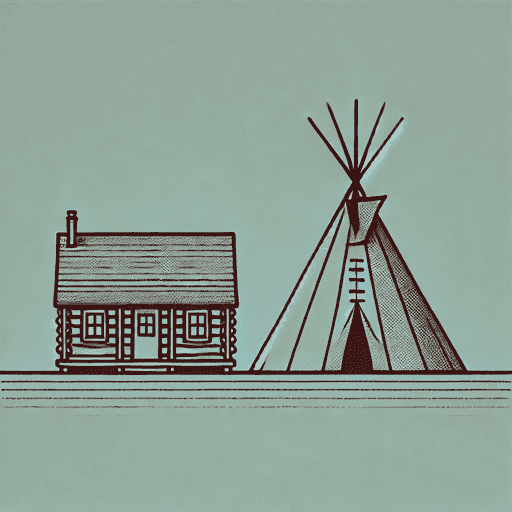
“He worked on it for several hours, making a back rest and a bed frame of willow and rawhide to furnish it, hanging more hides in a heavy circular curtain inside, stuffing dried grass snugly under the outer edges until it looked uncivilized and good and natural.”
(Chapter 11, Page 139)
After the conflict with his siblings, Jim builds a tepee beside the cabin rather than living inside it. The structure reflects the way he feels more comfortable with the lifestyle he learned among the Crow. By creating his own space, Jim physically separates himself from the rest of the family.
“He don’t seem to belong nowheres. He ain’t a Injun, but he ain’t quite a white man neither. He’s a kind of a homeless critter.”
(Chapter 11, Page 141)
Rutledge comments on Jim’s unusual position between two cultures. He observes that Jim does not seem to fit comfortably into either Indigenous or settler society. This description highlights the uncertainty surrounding Jim’s identity and the difficulty others have in understanding him.
“Jim grinned. ‘But they was a Injun inside of the boot.’”
(Chapter 12, Page 153)
Jim explains why he believes the cattle thief is Indigenous even though the men have found a boot print. Drawing on his experience as a tracker, he recognizes details in the footprint that suggest the person normally walks in moccasins rather than boots. His observation shows how his knowledge of the land allows him to interpret signs that others overlook.
“Jim heard them through a fog of pain and outrage. ‘You ain’t in no fix,’ he growled. ‘If Jonnie—don’t want her, I’ll go put her back. Right whar she come from.’”
(Chapter 13, Pages 164-165)
In this moment, Jim reacts angrily when the men accuse him of stealing the horse. Hurt and frustrated, he offers to return the horse if Jonnie does not want it. His response shows both his pride and his desire to avoid causing trouble for his brother.
“You fool, he thought. It ain’t coups you care about, it’s what them men think of you. It ain’t enemies you want, it’s friends! Without knowing it he’d outgrown this sort of life. He’d changed.”
(Chapter 13, Page 174)
In this moment, Jim reflects on his actions after returning the stolen horse and begins to reconsider what truly matters to him. His thoughts reveal that he no longer values acts of bravery meant to impress others in the same way he once did. The realization suggests that his priorities are beginning to shift toward relationships and belonging.
“‘Slow and steady, that’s the—’ Jim stopped. Jonnie was smiling broadly. There was a silence in which a blue jay jeered raucously from the nearby hazel bushes. Jim gave his ax a toss, caught it, and began to laugh.”
(Chapter 15, Page 189)
As Jim and Jonnie clear the land, Jim becomes frustrated with the work. Jonnie acts as his foil in this conversation, making a calm allusion to “The Tortoise and the Hare” to underline the virtues of slow, steady work. As with other cultural allusions in this novel, this reference to Aesop’s Fables, which date back to Ancient Greece, is meant to portray the virtues of a Western perspective on hard work.
“It was an act of chaos and daring, of courage so reckless that it etched itself on Jim’s mind never to be erased. […] Stubborn, brave, magnificent fools, who didn’t know an impossibility when they saw one. Fools? They were heroes! They had a medicine so big nothing could withstand it.”
(Chapter 17, Pages 218-219)
Watching the emigrants struggle to move their wagons down Laurel Hill changes Jim’s perspective on them. What first appears to him as reckless determination gradually seems admirable as he sees the effort and courage involved. The moment leads him to reconsider his earlier judgment of the settlers.
“A swirl of mist drifted between them, blurring the trapper’s outlines until he seemed almost to dissolve like a ghost, lacking all solid substance. And a ghost he was, Jim realized slowly—a man whose day was past, whose way of life had vanished, heading back to a world which no longer existed.”
(Chapter 17, Pages 222-223)
As Jim and Tom say goodbye, Jim notices how Tom seems to fade into the mist as he rides away. The image reflects Jim’s growing sense that the wandering trapper lifestyle Tom represents is disappearing. Their separation emphasizes that Jim and Tom are moving toward very different futures.
“What a mess he’d made of everything, what trouble he’d set in motion the day he’d turned his back on Powder River and ridden westward to The Dalles! But no, the trouble had started long before that. Its roots stretched back to Absaroka, back to that grizzly—back, back to that long ago, fatal morning he’d run away from home.”
(Chapter 18, Page 234)
While lying captive, Jim thinks back over the events that led him to this point. His thoughts trace the trouble in his life back through earlier choices and experiences. This reflection shows how deeply his past continues to shape his present situation.
“With a swift motion he had his knife out, then he seized a braid. One ruthless slash and it dropped, slithering and glossy, at his feet; an instant later the other followed. He snatched the coup feather out of his hair and flung it down beside the braids.”
(Chapter 19, Page 242)
In this dramatic moment, Jim cuts off his braids and throws down the feather from his hair. The action represents a visible change in how he presents himself to others. By doing this in front of Dan’l, Jim tries to reassure his brother and show that he intends to remain with the family.
“‘That’s your medicine, Jim,’ Jonnie said softly. ‘The Bible. The twenty-third psalm. Mother allus read it to us when we was sick, remember? […] You been a white man all along, clean through.’”
(Chapter 19, Pages 245-246)
Jonnie explains that Jim’s “medicine song” is actually the 23rd Psalm from the Bible, which their mother used to read to them. The revelation helps Jim understand that a part of his childhood remained with him even during the years he lived away from his family. The moment brings together the different parts of his past as he returns to his siblings.

Unlock every key quote and its meaning
Get 25 quotes with page numbers and clear analysis to help you reference, write, and discuss with confidence.
- Cite quotes accurately with exact page numbers
- Understand what each quote really means
- Strengthen your analysis in essays or discussions