Moccasin Trail
54 pages • 1-hour read
Eloise McgrawMoccasin Trail
A modern alternative to SparkNotes and CliffsNotes, SuperSummary offers high-quality Study Guides with detailed chapter summaries and analysis of major themes, characters, and more.
Themes
Content Warning: This section of the guide contains depictions of racism and animal cruelty and/or animal death.
The Conflict Between So-Called Civilized and Wild Identities
In Eloise Jarvis McGraw’s Moccasin Trail, the strain between identities labeled “civilized” and “wild” within frontier culture shapes Jim Keath’s difficult return to his family. Jim moves between the customs of his white childhood and the Crow habits that shaped him in Absaroka. The book reflects a frontier worldview that treated Indigenous life as “wild” and settler society as “civilized,” a hierarchy that supports settler colonial expansion by casting Indigenous belonging as lesser and whiteness as the standard. Yet Jim’s experience repeatedly complicates that division. His years with the Crow continue to shape him, and the pressure to choose a single identity exposes how a past like his cannot be cut in half without leaving him unmoored. The novel shows how these labels function as rigid social expectations within the settler community and how they police who is allowed to count as “civilized.”
Jim feels this break inside himself even before he meets his siblings. After the beaver trade collapses, he drifts through the mountains and realizes that he belongs neither to the Crow camp he left behind nor to the white trappers whose world is “crumbling under his feet” (13). He ran from the Crow village because he felt “lonesome for his own kind” (4), yet the years with the tribe changed how he moves, thinks, and reacts. When he tries to return to white society, the old patterns no longer fit him. This mix of loss and instinct shows that his conflict grows out of a split within his own sense of self. Jim’s upbringing has been shaped by two cultural systems, making the expectation that he simply return to one identity unrealistic.
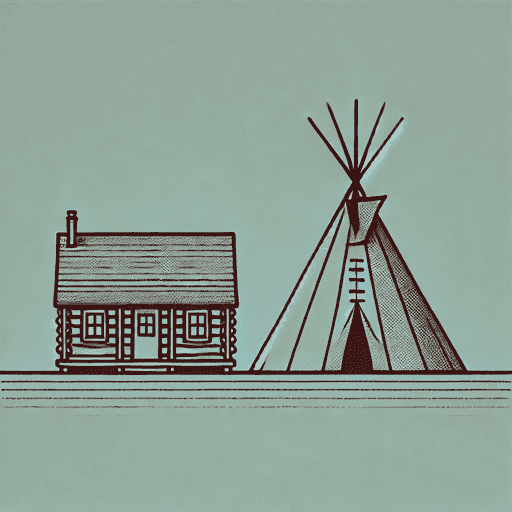
Once Jim finds his siblings again, Jonnie and Sally speak for the rigid ideas of the world they know. Their reactions mirror the suspicion toward Indigenous culture that shaped many settler communities in the American West. They treat his Crow habits as a stain rather than a part of him. Jonnie reacts first, telling Jim, “You do look Injun, blamed if you don’t! More Injun than white! What’s happened to you, anyways, Jim?” (50). Sally’s anger goes even further. She refuses to call him Jim, complains about the castoreum smell in his clothes, and pulls back from his “Injun talk” (68). Her demand that he cut off his braids and give up his claw necklace and coup feather shows how strongly she wants him to erase the past six years. When Jim puts up a tepee beside the cabin instead of moving in, the space between the two shelters marks a boundary he cannot cross without losing parts of himself.
The conflict reaches its clearest moment when Jim decides to cut his braids. His choice is not a joyful turn toward settler life. He makes the change so he can stay with the family and protect Dan’l, who has begun to admire his wild ways. Jim says the haircut is “the last you’ll see of a Crow around this here claim” (243), a line that links identity to the settler idea of a “claim,” where land is treated as available for taking despite Indigenous presence and displacement. Yet the gesture does not wipe away his history. Jonnie, who has watched Jim’s strength and quick judgment, finally admits that the Crow made Jim “fast and strong and brave” (247). Although the story ultimately moves Jim toward reintegration with his settler family, it also closes by treating that reintegration as the safest and most acceptable outcome, even as it relies on what Jim learned among the Crow to make that outcome possible.
Redefining Family Through Survival and Obligation
In Moccasin Trail, the Keath children shape their idea of family through need and hard labor. Blood ties bring them together, but the story shows how real kinship grows out of shared work, danger, and sacrifices made for one another. Their westward push forces them to rely on one another, and the resentment and distance that built up over nine years slowly give way to a bond grounded in the struggle to stay alive. Set against the backdrop of westward expansion and the race to secure land claims, a process that often displaced Indigenous communities already living on those lands, the family’s unity develops less from childhood affection than from the responsibilities they assume for one another on the trail.
This shift begins when Jonnie’s letter reaches Jim. Jonnie does not write about affection; he writes about necessity and calls Jim the family’s “only chance” (39) to reach Oregon and hold land. Jim answers because he reads this plea as a direction from his “medicine,” not because he feels pulled by old memories. Their first days together function almost like a practical arrangement. Jim brings the skills Jonnie, Sally, and Dan’l lack, and the siblings offer him a place he might settle. That practical start forces them to build trust through what each person does, since the years apart have left them strangers to one another.
Their hardest moments create the closest ties. During the fight for food on the mountain trail, Jim chooses Dan’l’s survival over his own comfort and even over his bond with Moki. When he bites Moki’s ear to take a scrap of mink meat for Dan’l, the moment reveals the harsh choices survival demands and the priority Jim gives to protecting his younger brother. Dan’l echoes this sacrifice when he refuses his own food after seeing Jim starve himself, telling Jim, “We’re brothers!” (82). Their actions, one physical and one emotional, pull them together across the cultural divide that had stood between them.
By the end of the book, the family no longer leans on Jim only for wilderness knowledge. They begin to feel his absence as loss. After Jim brings Dan’l back from the Umpquas, Sally’s tears mark her shift from fear of his Crow habits to gratitude for the way those same habits saved her brother. Jonnie, who once saw Jim only as the key to a land claim, waits through the night after their fight about the cabin. His worry shows that he now sees Jim as a brother whose place in the family matters. The family bond that emerges is therefore shaped less by nostalgia for their shared childhood than by the responsibilities and sacrifices they make for one another during the journey west, even as the skills that make Jim essential come largely from the life he lived outside settler society.
The Clash of Cultural Knowledge Systems
Moccasin Trail sets the settlers’ strict farming habits against the flexible skills Jim Keath gained from the Crow and the mountain men. The novel connects survival in the West to careful attention to the land and the ability to adjust quickly when conditions change. Jim’s experience in Absaroka gives him that approach, yet Jonnie and Sally often treat his skills as strange or suspect. This tension reflects the broader encounter between settler expectations and Indigenous knowledge systems in the American West. Their rigid methods leave them exposed to danger because they cannot read the land. Jim instead treats every sign in the woods as useful information.
McGraw builds this contrast early through Jim’s quiet, exact movements. He walks through brush without snapping a twig and keeps his mind trained on “noticing, remembering, judging, interpreting” (3) each track and rustle. Jonnie and Sally stumble by comparison. Jonnie’s stiff “factory boots” (48) cut into his feet, and he moves so loudly that Jim jokes he could have taken Jonnie’s scalp twice. These moments reveal how differently the siblings understand the land. Jim approaches it as something that can be read through careful observation, and his family meets it as a threat they hope to overpower.
The book sharpens this divide through small, practical moments. Jim builds a focused fire with a few sticks, but Jonnie’s “white man’s fire” (58) burns so widely that no one can stand near it. When Jonnie’s feet split open, Jim reaches for oks-pi-poku, the sticky root from Crow medicine, and the relief is immediate. Jim’s tracking during the chase after the cattle thieves offers the clearest picture of his skill. He reads a boot print that turns inward, the pebbles washed out of place in a creek, and a false trail laid down to mislead the group. Where the other men see scattered signs, Jim reads a single story about the thief’s path and motives.
As the Keaths move toward Oregon, they depend more and more on Jim’s choices. Their passage through the Columbia Gorge and the snowy ridge only works because they accept his lead and take his food and guidance. Jonnie, who once brushed off Jim’s methods, starts to ask questions and tries to see the country through Jim’s eyes. At the same time, this reliance highlights a historical contradiction of westward expansion: Settlers frequently depended on Indigenous knowledge even as settler colonial expansion displaced Indigenous communities from those same landscapes. The family eventually settles on a farm by the novel’s final pages, yet their safety comes from the mix of settler endurance and the land-based knowledge Jim learned while living among the Crow. The novel therefore shows how frontier survival often required skills drawn from multiple cultural traditions rather than from a single system of knowledge.

Unlock every key theme and why it matters
Get in-depth breakdowns of the book’s main ideas and how they connect and evolve.
- Explore how themes develop throughout the text
- Connect themes to characters, events, and symbols
- Support essays and discussions with thematic evidence