46 pages • 1-hour read
Mrs. Quinn's Rise to Fame
A modern alternative to SparkNotes and CliffsNotes, SuperSummary offers high-quality Study Guides with detailed chapter summaries and analysis of major themes, characters, and more.
Symbols & Motifs
The Cassock-Blue Recipe Book
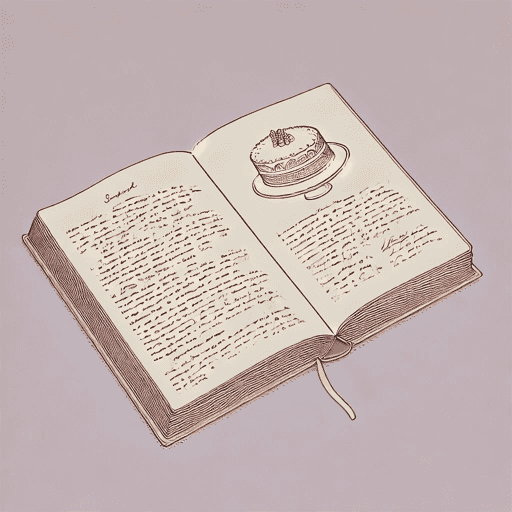
Before placing her baby for adoption, teenage Jenny writes three recipes in a small book which she leaves with the family. Jenny’s use of recipes from this book on Britain Bakes leads to her reunification with her son, who kept and used the book and recognized the recipes. The recipe book acts as a symbol of the power of food to bring people together, enabling Jenny to be a part of her son’s life even after they are separated, connecting to the theme of The Connection Between Food, Memory, and Love.
Throughout the book, Jenny refers to the recipe book as “cassock-blue” in color. The reference to a cassock, or a holy robe, reflects the sacred power of the recipe book in Jenny’s imagination. As a teenager, Jenny believes that “there’s something of love in food” (235), and she hopes that leaving her son a book of family recipes will help her communicate her love for him after they are separated. Jenny believes that when her son “sees [she’s] written him recipes, he’ll know that [she] care[s]” (235). On the day they are separated, Jenny leaves him with the book, hoping that “through this she would be with him always” (271). Ultimately, she is correct, as her son recognizes recipes from the book during her Britain Bakes performance.
Jenny explicitly reflects on the communal power of food while competing on Britain Bakes. In an interview about her use of family recipes in the final, she argues that “recipes are very precious things” that “contain little pieces of history, of nostalgia, and of people—exactly as they were at the time when they wrote them” (296). Jenny ultimately concludes, “I thought I was alone […] but I never really was” (296). Jenny’s belief that using family recipes allowed her to reconnect emotionally with people she had lost foreshadows her son’s use of her recipe book to reconnect with her in real life.
Jenny’s Cast Iron Scales
The old-fashioned cast iron scales that Jenny uses to bake act as a symbol of her age and her distance from mainstream culture. Just as Jenny stands out as the oldest of the Britain Bakes contestants, her cast iron scales stand out on set, “looking particularly worn among the shiny new equipment” (158). Influencer Sorcha explicitly connects the antique scales with Jenny’s age, remarking rudely that “only Victorians used [cast iron scales]” (74). Although she cringes at these reminders of her age, Jenny refuses to consider modern digital alternatives, wondering why people felt “a constant need to fix things that weren’t broken” (4). Even when she acknowledges that digital scales offer a more accurate weight, she refuses to switch, explaining, “[I]t’s hard to shake a lifetime’s habit when you’ve been alive as long as I have” (171). Jenny’s resistance to mainstream culture at the age of 77 is manifested in her use of cast-iron scales.
Because they are so unusual, the Britain Bakes producers decide to highlight Jenny’s old-fashioned equipment in their depiction of her on the show, causing an unexpected fad. While filming introductory shots before the start of the competition, producers ask Jenny to measure out flour and sugar in her “beautiful scales.” Later, they allow her to bring her scales to set and highlight them in her segments. Newspapers report “record sales of cast-iron scales” since her appearance on the show, with secondhand sets “going for a small fortune,” making it “virtually impossible to get hold of a pair” (317). The popularity of cast iron scales after her appearance on the show affirms Bernard’s belief that Jenny’s experience and unique perspective are what make her successful.
Kittlesham
References to Jenny’s home of Kittlesham as an idyllic village appear throughout the novel as a recurring motif associated with the genre of cozy fiction. Usually, cozy novels are also associated with other genres, such as mystery or romance. Books belonging to the cozy subgenre often take place in small towns and are designed to foster a sense of escapism. Jenny’s home of Kittlesham meets these requirements. The town is introduced as a “quintessential village of delightfully uneven houses and medieval pubs” (11), and throughout the novel it is deliberately contrasted with “the heat and the noise of central London” (319), which Jenny visits to audition and later for interviews about the show. The town is introduced in winter, with frost and snow “making it look as if someone had coated it in icing sugar” (11). This light-hearted depiction of the idyllic village of Kittlesham establishes the novel’s place in the growing genre of cozy fiction.
The novel’s initial description of the village subtly references these genre expectations by referring to other examples of the genre. On their first visit to Kittlesham, Jenny and Bernard feel “like they had stepped into the secret garden or through the back of a wardrobe, and they had both agreed that it would be the perfect spot to spend their final chapter” (11). In this passage, the use of the word “chapter” and the references to the novels The Secret Garden and The Lion, The Witch, and the Wardrobe explicitly recall escapism and fantasy, highlighting the idyllic nature of Kittlesham.

Unlock the meaning behind every key symbol & motif
See how recurring imagery, objects, and ideas shape the narrative.
- Explore how the author builds meaning through symbolism
- Understand what symbols & motifs represent in the text
- Connect recurring ideas to themes, characters, and events