My Friend Flicka
59 pages • 1-hour read
Mary O'HaraMy Friend Flicka
A modern alternative to SparkNotes and CliffsNotes, SuperSummary offers high-quality Study Guides with detailed chapter summaries and analysis of major themes, characters, and more.
Chapters 28-36Chapter Summaries & Analyses
Content Warning: This section of the guide includes discussion of animal death.
Chapter 28 Summary
As the end of the summer approaches, McLaughlin is desperate to finish the work on the ranch while the weather is still good. He hires several men to help, which leads to issues with reliability and skill. Through it all, Ken tends to Flicka, introducing her to different parts of the ranch. Whenever he asks his father for advice, he is impatient and irritable, causing Ken to spend much of his time alone.
One day, Ken notices that Flicka is very thin. She eats twice a day yet does not seem to be gaining any weight. Her wounds look better, so Ken decides that she is still just recovering from her infection.
Chapter 29 Summary
One evening, Nell prepares dinner. Her work has increased, as she is regularly responsible for feeding the extra hands. She decides to hunt for rabbit. However, she encounters the mountain lion. She runs back to the ranch to tell McLaughlin.
When Nell spots her husband, he is arguing with Tim. McLaughlin yells at him for putting the cows in the wrong pasture. However, Tim tells him that Nell wanted him to put them there. McLaughlin then yells at Nell, insisting that he is the only one that can give orders to the men. She yells back, pointing out that the cows are her responsibility. Embarrassed and angry, Nell goes inside.
Nell gets dressed and decides to go into town. McLaughlin comes in and, when she tells him her plan, gives her money. He sees her off at the car but does not apologize.
In town, Nell feels free from the constraints of the ranch. The commotion, lights, and people remind her of being in the city. She goes to a movie theater and watches a movie, then returns home.
When Nell gets back, late into the night, she goes up to bed. McLaughlin joins her and lies down next to her, putting his arm around her. He asks her what scared her earlier in the day. She tells him about the mountain lion. She caught two rabbits, then set them down to climb onto a rock to watch the sunset. When she got down, she came face-to-face with the lion. They stared at each other, then the lion took off.
McLaughlin tells her that he had recently seen tracks in the corral. She admits that she is afraid for Flicka, but McLaughlin insists that the lion will continue to leave them alone.
A loud cry in the night interrupts their conversation. It is the “scream” of the mountain lion. Both McLaughlin and Nell agree that it is a “gorgeous” sound. Now wide awake, they go into the kitchen and share hot chocolate.
Chapter 30 Summary
As school nears, Ken finishes his essay. He goes with his mother to mail it. Nell writes a note to his teacher explaining all the work he put into it.
Since McLaughlin is so busy with the farm, he rarely gets to see Flicka. However, one day, when he spots her in the Nursery, he is shocked by her appearance. She has lost all her weight, struggles to move, and is near death. McLaughlin instructs Gus to shoot her.
Over the next couple days, Ken comes to accept Flicka’s death. Although it upsets him, he knows that the fever was too much for her. Despite this, he still goes to her each day, coaxing her to eat and drink. He also watches the guns on the wall, knowing that Gus will take one soon.
When Ken notices that a gun is gone one day, he stares at the guns, overwhelmed with grief. His father comes up behind him and puts his arm around him, consoling him. After, Ken goes to Flicka’s Nursery. He asks Gus to wait one more day, so Gus promises that he’ll wait until the next morning.
After Ken goes to bed, Flicka lies in the grass, struggling to move. She lets out a neigh, the sound of which travels to Banner. Banner neighs in return, calling out a “loud, kingly cry” that “burned a cross-fire of hope into the fever” (295). Hearing the sound, Flicka makes her way to the stream. She drinks from it, then collapses into it.
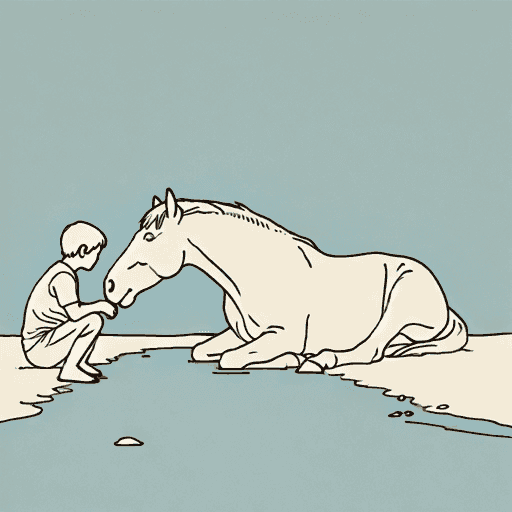
Once Ken is certain that his parents are asleep, he sneaks out of the house. He goes to Flicka’s Nursery. He finds her submerged in the stream with only her muzzle sticking out. Using all his strength, Ken pulls her mostly out from the water. He holds her head out of the stream, his own body submerged. They stay like that through the night, “the cool running water wash[ing] and wash[ing] her wounds” (298).
Chapter 31 Summary
Ken stays with Flicka, holding her through the night. Although Flicka begins to be rejuvenated, the opposite happens to Ken: He begins to shiver and is overwhelmed by the cold.
Just after the morning begins, as Ken is drifting in and out of sleep, he is woken by the sound of “screaming” animals. He sees the mountain lion attacking a heifer. The cow fights back, but the lion ultimately wins, taking it down and killing it. Ken does not react, instead watching the kill, then drifting off again.
Chapter 32 Summary
When Gus wakes up, it is with a sense of dread at the thought of having to shoot Flicka. He goes to the stream and discovers Ken in the water. He drags Flicka up onto shore and carries Ken back to the house.
McLaughlin spots Gus carrying Ken. He comes outside and takes Ken from Gus, with Gus explaining how he found Ken. McLaughlin and Nell put Ken back into bed, heating blankets for him and trying to warm him.
Gus returns to Flicka. He checks her over and realizes that her fever seems to have broken; her swelling has gone down, she is no longer hot, and the wounds look clean. He hesitates, knowing that he was given an order by McLaughlin but also knowing that things have changed.
Chapter 33 Summary
Nell sits by Ken’s bed all day. He drifts in and out of consciousness, never seeming to be fully coherent. Despite the blankets, he is frequently overcome by chills. His temperature rises to 104. It rains intermittently all day and begins to storm.
In the early afternoon, McLaughlin brings Dr. Scott to their home. He checks Ken over. He tells them that he has some kind of infection, though he isn’t sure what yet. In the end, Dr. Scott recommends medication for Ken. McLaughlin follows him into town to bring it back while Nell stays by Ken’s bed.
Chapter 34 Summary
Gus and Tim do work on the ranch throughout the day. They never discover the body of the heifer. The lion lies, full, beneath the caves to the north of the pasture, waiting until he needs to eat again.
In the afternoon, as it begins to rain, Gus checks on Flicka again. She struggles to stand up, succeeding only briefly before falling. However, Gus thinks that she is continuing to look better. He feeds her and gives her water. With Tim’s help, he then constructs a sling to hold her.
That night, on the way back to the bunkhouse, Gus stops to see Nell. He tells her about Flicka. She asks him to set up a cot in Ken’s room for her. As Gus works, Nell tells her son that Flicka is still alive. For the first time, Ken stirs in response, opening his eyes and trying to speak. He asks Gus if McLaughlin changed his mind about killing Flicka. Gus admits that he still has an order to do so; however, he is hopeful that McLaughlin will change his mind.
For the rest of the night, Ken lies alert in bed. Nell can tell that he is listening for the sound of his father’s car.
Chapter 35 Summary
As McLaughlin makes his way back from town, the storm worsens. He gets a flat tire and is forced to change it in the rain. He is overwhelmed with anger, mostly blaming Flicka for getting Ken sick and forcing him to go into town.
When McLaughlin gets back to the house, Gus tells him that Flicka is alive. McLaughlin is adamant that she should still be shot. Nell begs him to reconsider, but McLaughlin dismisses her. He takes the gun himself. Gus warns him that he has only one bullet.
McLaughlin goes to Flicka’s Nursery. He sees Flicka in the distance. In a flash of lightning, he also sees the heifers gathered in fear, as well as a shadow nearby. When the light flashes again, he sees the dead heifer, but the shadow is gone; he realizes that it is the mountain lion.
McLaughlin raises the gun and searches the area. He spots two eyes looking at him from the brush. He fires at it but, when lightning flashes again, realizes that he missed. However, he is confident that the lion won’t come back soon out of fear.
Spotting Flicka, McLaughlin makes his way over to her. She looks much healthier than she did before, holding some of her own weight despite the sling. He realizes that he cannot let Flicka die. Instead, he decides to stay with her through the night to protect her.
When the rain stops a while later, Nell comes down from the house. She tells him that she knew he only had one bullet and, when he didn’t return, guessed that the lion was nearby. She brings him a rifle and revolver. She also explains that Ken heard the gunshot and assumed that Flicka was killed. They decide not to tell Ken yet, as he has “accepted” Flicka’s death and they aren’t sure she will recover.
With Nell’s help, McLaughlin builds a fire. He stays between the fire and Flicka with the loaded rifle, keeping an eye on both. Nell returns to the house.
For the rest of the night, McLaughlin falls asleep intermittently. Just before dawn, he hears Flicka neigh and recognizes her “terror.” He spots the mountain lion nearby. He shoots and kills it.
Chapter 36 Summary
Over the next few weeks, Ken slowly begins to recover. For a stretch, he has pneumonia, and Dr. Scott visits every day. Ken starts waking up more frequently. He spends much of the night talking with his mother. She tries to interest him in things related to the ranch or current life, but he seems uninterested; instead, he talks about things from their past.
McLaughlin goes to speak with Ken’s teacher about school. The teacher agrees to let Ken move into the sixth grade, insisting that Ken wrote a strong essay. McLaughlin brings the essay home to Nell, and they read it for the first time. It is supposed to be a story about Gypsy, the horse McLaughlin brought home from West Point. However, it is mostly about Flicka, insisting that she is not “loco” and will be a good horse like Gypsy and Banner. Both Nell and McLaughlin agree that he is a great writer.
When Nell goes to Ken’s room, she decides to hold off on telling him about school and about Flicka surviving. Ken talks about how much things have “changed” over the last few months. In response, Nell insists that Ken is the one who is changing. He looks at the pictures in the room, stopping on the one at the end of the room with the quote. He reads the first two lines again, “Intreat me not to leave thee / Nor to return from following after thee” (340) and feels as though he finally understands them.
One day, Nell and Dr. Scott talk about how much Ken has changed. He praises her for finding a solution to his “day-dreaming,” with Flicka teaching him about many important things like life, death, and love. She asks if she should tell him about Flicka being alive; he instructs her to follow her strong motherly instincts. That night, she tells Ken in his sleep.
A couple of months later, as it begins to snow, Ken has greatly improved but still spends much of his time in bed. One day, he asks Nell where Flicka is. He explains that, at one point, he thought Flicka was dead because of the gunshot, but, in his dreams, he slowly realized that she was alive somewhere. Nell tells him the story of the night that McLaughlin killed the lion. She asks if Ken wants to see Flicka, but he is unsure.
A few weeks later, McLaughlin comes to the house and urges Ken to go in the car with him. Although it exhausts him, Ken agrees. They drive up the hill to the edge of the woods. McLaughlin points out a large deer with a full set of antlers standing in the snow. In that moment, Ken’s “detachment” from the world ends. He is certain that he wants to return to Flicka.
That afternoon, Ken leaves the farmhouse. Flicka grazes nearby. She regularly stands each morning, listening and watching for Ken to return, only to be disappointed when he doesn’t. Now, hearing the door, she runs to the corral. She sees Ken excitedly running down the path, calling her name, and neighs in return.
Chapters 27-36 Analysis
This section of the text underscores the realities of living on Goose Bar Ranch, further developing the primary conflict between Ken’s view of the world and his father’s and invoking The Clash Between Romanticism and Realism. As the summer comes to an end, McLaughlin becomes increasingly engrossed with caring for the ranch. At the same time, Ken spends more and more time with Flicka, caring for her all day while continuing to train her. However, McLaughlin’s preoccupation with the ranch prevents him from seeing Flicka’s deteriorating health for what it truly is, causing Flicka to be on the verge of death before McLaughlin finally realizes. While McLaughlin struggles with the realities of his responsibilities on the ranch, Ken becomes engrossed in the ideal he has created with Flicka; however, he also fails to recognize just how severely her health is failing. As a result, when McLaughlin makes the decision to kill Flicka, the conflict between romanticism and realism comes to a head for Ken.
Through McLaughlin’s actions in this section of the text, his anger and his temper are highlighted. The conflict that occurs between him and Nell when she tells the men to put the cows in the wrong pasture results in McLaughlin angrily berating her in front of the other men. Additionally, when McLaughlin goes into town for medicine and gets a flat tire, he is overcome with anger toward Flicka because of the situation he is in. As he changes his tire, he thinks, “Flicka. Flicka, Flicka, Flicka—that was all he heard all summer… good God, if it hadn’t been for Flicka, Ken wouldn’t be sick, and he himself wouldn’t be here this minute, with streams of water running into his boots and down the back of his neck” (319). This shift in perspective builds suspense leading up to McLaughlin’s return to the ranch, highlighting the fact that he is still convinced that killing Flicka is the right decision.
For McLaughlin, it is ultimately his family that grounds him and changes him throughout the novel. This idea is best encapsulated by his confrontation with Nell. Nell, who has been a devoted wife and caretaker despite her own internal conflict of being on the ranch, initially reacts to McLaughlin’s anger by leaving the ranch and going into town. However, when she returns, she acknowledges that “[s]he never felt that she had quite completed an experience until she had shared it with Rob” (287). Despite their difficulties, they both find comfort in each other and quickly put their dispute aside. Similarly, when McLaughlin sees the dedication and commitment that Ken has to staying with Flicka, he changes, deciding to protect Flicka throughout the night. It is clear in this moment that McLaughlin has come to understand his son’s perspective and the value that Flicka holds—even if she will always be difficult to train.
Another key shift in perspective comes when the novel provides the point of view of Banner in what are presumably Flicka’s final moments, reflecting Humanity’s Struggle to Control Nature. As Flicka awakes on her final night, she crawls toward the stream for a drink, letting out a neigh. In response, the narration shifts to Banner, who let out a “loud, kingly cry [that] drifted across the miles, across the roads, across the barbed-wire barricades that intervened, and burned a cross-fire of hope into the fever that was consuming Flicka” (295). This moment evokes the power of the relationship between the animals, lending an almost supernatural quality to their communication and to Flicka’s subsequent recovery. Despite everything that Ken has done to try to control Flicka, what ultimately saves her is her deep connection to her sire, Banner. Even though McLaughlin decries Flicka’s bloodline throughout the novel, it is, in the end, the thing that saves her.
The final pages of the novel encapsulate the shift that has occurred within Ken, reflecting his growth and maturation throughout the novel and reinforcing The Power of Human-Animal Relationships. This growth is noticed physically, as Dr. Scott and his parents both comment on how Ken has grown. At the same time, his growth is emotional as well, as Ken has learned the harsh realities of living on the ranch. After he recovers from his illness, Nell notes how detached and distant he has become from life on the farm, a fact which emphasizes his new understanding: He struggles to return to Flicka for fear of going through the pain of losing her again. However, when his father takes him to see the buck by the forest, Ken is awed by the “nobility,” “magnificence,” and “courage” he sees (345). In other words, Ken is reminded in this moment of the beauty of nature and its creatures. Despite the hardship that he has been through, he returns to Flicka, valuing the bond that he has developed with her even if it is accompanied by moments of difficulty and heartbreak.

Unlock all 59 pages of this Study Guide
Get in-depth, chapter-by-chapter summaries and analysis from our literary experts.
- Grasp challenging concepts with clear, comprehensive explanations
- Revisit key plot points and ideas without rereading the book
- Share impressive insights in classes and book clubs