My Friend Flicka
59 pages • 1-hour read
Mary O'HaraMy Friend Flicka
A modern alternative to SparkNotes and CliffsNotes, SuperSummary offers high-quality Study Guides with detailed chapter summaries and analysis of major themes, characters, and more.
Important Quotes
Content Warning: This section of the guide includes discussion of animal death.
“High up on the long hill they called the Saddle Back, behind the ranch and the country road, the boy sat his horse, facing east, his eyes dazzled by the rising sun.”
(Chapter 1, Page 3)
The opening lines of the text emphasize the importance of the ranch, both in its beauty and in its importance to Ken. The use of the word “dazzled” connects both to Ken’s awe of the ranch and his aloof, imaginative demeanor, introducing The Clash Between Romanticism and Realism. The sun that rises is a metaphorical representation of the new summer dawning before him.
“He had been saying that for a long time. Sometimes he said it in his sleep at night. It was the first thing he had thought when he got to the ranch three days ago. He said it or thought it every time he saw his brother riding Highboy. And when he looked at his father, the longing in his eyes was for that—for a colt of his own.”
(Chapter 1, Page 4)
The third-person point of view, which begins by following Ken, gives the reader insight into Ken’s motivations from the start of the novel. He deeply desires a colt, introducing both the important role that Flicka will play and his willingness to do whatever he can to protect her. Additionally, the fact that Ken shows this “longing” to his father repeatedly introduces one of the novel’s central conflicts: Ken’s father’s unwillingness to grant his wish.
“Neither motherhood nor the hard living at the ranch had deprived Nell of her figure or her maidenliness […] [A]s she walked, there was a lightness about her which came partly from natural vigor and partly from the way her narrow head lifted from the shoulders to face whatever was to be faced, a danger, a storm, a loved one, a hope or a fear.”
(Chapter 2, Page 11)
The first description of Nell introduces one of her key characteristics: her strength. While she struggles internally with her longing for home, she is also dedicated and committed to her husband, her children, and life on the ranch. This introduction foreshadows the important role that she will play, both physically and emotionally, in the development of both Ken and her husband.
“‘Yes, I had it all planned. I was going to write the story about how you lost your polo mare. How the Albino stole her from Banner—’ Ken’s eyes went to his father’s. ‘We could write anything we wanted, it had to be at least two pages—’
‘And you never even started?’
Howard said, ‘He was looking out the window all the time. I saw him.’
Tears were crowding at the back of Ken’s eyes. He wished his father would stop looking at him.”
(Chapter 2, Page 15)
When Ken returns home for breakfast and is confronted by his father about his grades, this passage gives key insight into two important parts of Ken’s character. First, it shows how he is easily distracted and struggles to focus, both when he is doing his work and when he tries to explain it to his father. It also shows the tension that exists between Ken and McLaughlin, as Ken is so intimidated that he can’t explain how he feels and even begins to cry.
“As she looked down into the upturned face, her heart misgave her at the passion and intensity of his longing, but she understood. Yes, she, too, was like that—all my own—and she turned away and began to clear the table.”
(Chapter 2, Page 22)
In direct contrast to McLaughlin, Nell is characterized as someone who sympathizes with and understands Ken. After Ken is too intimidated by his father to explain, Nell pulls him aside to try to talk with him about getting a colt. The sympathy and compassion that she shows emphasizes her connection with Ken, with the words “she, too, was like that” underscoring how different both she and her son are from McLaughlin.
“His father was rounding up the mares with their foals, getting them out of the woods, bringing them back through the meadow slowly. He never ran them. He’d keep them walking slowly all day, let them stop to graze. He said scornful things about riders who galloped and yelled and drove horses on the run.”
(Chapter 3, Page 35)
As Ken watches his father round up the horses, his perspective complicates McLaughlin’s character. To this point, he has been portrayed as someone who is harsh and uncompromising, as he refuses to sympathize with Ken and dismisses his wife’s concerns at breakfast. However, as he works with the horses, he is patient and understanding. This conflicting characterization highlights McLaughlin’s understanding of the animals on his ranch: He knows how to raise them and does so with kindness and respect, even though he must face Humanity’s Struggle to Control Nature when dealing with the wild horses.
“Ken felt as if he had been put out of the ranch, out of all the concerns that Howard was in on. And out of his father’s heart—that was the worst. What he was always hoping for was to be friends with his father, and how this, so soon after getting home—His despair made him feel weak.”
(Chapter 3, Page 39)
After Ken inadvertently stampedes the horses, he is faced with deep regret over his actions. The diction here is important because it emphasizes just how much his relationship with his father means to him, noting that it was “the worst” to be put “out of his father’s heart.” This moment also thematically evokes the clash between romanticism and realism. In the moment, Ken was excited to see the horses being driven in, emphasizing his idealistic views of the ranch; however, after the stampede, he is faced with the realities and dangers of the act.
“‘There’s a responsibility we have toward animals,’ said his father. ‘We use them. We shut them up, keep their natural food and water away from them; that means we have to feed and water them. Take their freedom away, rope them, harness them, that means we have to supply a different sort of safety for them. Once I’ve put a rope on a horse, or taken away its ability to take care of itself, then I’ve got to take care of it.”
(Chapter 4, Pages 46-47)
Throughout the novel, McLaughlin repeatedly lectures his children about the importance of animals, as he does here, emphasizing the respect and care required to raise them. These words emphasize the theme of The Power of Human-Animal Relationships. McLaughlin views the relationship as going both ways: Humans take advantage of animals and use them to their benefit, so they must, in turn, provide basic necessities like care, food, and comfort.
“[Ken] looks at me sometimes as if he was afraid of me. Don’t like the way he turns his head away and looks down. Never comes to me for help. That’s bad. He ought to turn to me…my fault somehow…or else he’s just at an impossible age…but Howard wasn’t…got to get friends with him…maybe this summer.”
(Chapter 5, Page 57)
The shifting perspective is used to give insight into McLaughlin’s thoughts after Ken accidentally stampedes the horses. The frequent use of ellipses emphasizes the internal conflict that McLaughlin faces. The reader learns here that he cares deeply for his son, yet also needs to do what is best for the ranch, two ideas which stand in opposition to each other (in McLaughlin’s eyes) because of Ken’s immaturity.
“As Nell read out the list of yearlings and the names of their dams Ken began to feel queer. These were definite flesh and blood animals; named, described, tagged, in a book; not the colts that had kicked their heels and played and tossed their manes in his dreams. He felt the sense of loss which every dreamer feels when the dream moves up, comes close, and at last is concrete.”
(Chapter 7, Pages 76-77)
As a bildungsroman, the novel explores Ken’s growth and maturation but also the sense of loss that comes with it. The idea is introduced here, when Nell reads out the names of the colts, and Ken begins to realize that his dream of having one is becoming a reality. This moment emphasizes the theme of the clash between romanticism and realism: Ken romanticized the idea of having a colt and, now that it has become true, he will face the realities of being responsible for one and the maturation that comes with it
“I’ll give you a little help just with the first breaking, but you’ll train her, and she’ll train you. I want you to make a good pony out of her. I want her to make a man out of you.”
(Chapter 10, Page 98)
McLaughlin’s words to his son when he emphasizes the importance of a colt for Ken evoke the power of human-animal relationships. McLaughlin makes it clear to his son that the relationship works both ways. While the colt will help Ken grow and mature, Ken also has a duty to it to train it, respect it, and care for it.
“It was a place he used to play and be happy in; quite secret, no one knew he was there; and safe, because he had everything his own way; pleasant, because there were no unhappy endings. In the real world just about everything had an unhappy ending or tripped him up somehow, but there, there were no endings at all—dreams don’t end.”
(Chapter 13, Page 123)
These words describe how Ken feels once he begins to take more responsibility, evoking the clash between romanticism and realism. This moment marks the point where he begins to change—and one that is filled with feelings of loss for the childhood he is leaving behind. While he has been defined by his idealism and romanticization of owning a colt in the past, he now begins to realize the harsh realities of the adult world.
“She had just come to him. His own because of that second’s cry for help that had come from her eyes to his; his own because of her wild beauty and speed, his own because his heart burned within him at the sight and thought of her; his own because—well, just his own.”
(Chapter 13, Page 129)
These words describe Ken’s feelings as he watches Flicka for the first time, making the decision that this is the colt that he wants to raise. His feelings draw a parallel between who Flicka is and who Ken is, underscoring her role as a symbol in the novel. Ken views her as needing “help,” paralleling his own need for friendship and connection and speaking to the power of human-animal relationships.
“[Ken] lit a candle in his room and stood staring at the flickering light. This was like a last day. The last day before school is out, or before Christmas, or before his mother came back after a visit in the East. Tomorrow was the day when, really, his life would begin. He would get his colt.”
(Chapter 15, Page 141)
This simile, which compares the night before Ken makes his decision about Flicka to a “last day” before a vacation or holiday, underscores the threshold that Ken finds himself on in this moment. Physically speaking, he stands on the verge of a change in his life because he will now have a colt to care for and, in his eyes, a friend. Metaphorically speaking, he stands on the threshold of adulthood, one day away from taking on mature responsibilities and truly entering the world of work on the ranch.
“Every rancher is proud of his ranch sign, under which all visiting cars must pass, and exercise great ingenuity in thinking up something striking and effective. McLaughlin’s sign was a high square arch. On the broad horizontal board which was the span of it, he had painted GOOSE BAR RANCH, in red letters against a blue ground. To each side were reproductions of his brands.”
(Chapter 17, Page 166)
The sign on the road to the ranch is described in vivid detail. It serves as a source of “pride” for McLaughlin initially, denoting the work he has done on Goose Bar. However, it soon after serves as a source of frustration, as it is responsible for Rocket’s death as she leaves the ranch. Ultimately, this speaks to humanity’s struggle to control nature: Although McLaughlin tries to sell Rocket, she foils his schemes at the last minute by rebelling one last time.
“It was hard to keep track of each other. Suddenly Ken was lost—the others had vanished. He reined in Shorty and sat listening. The clouds and mist rolled around him. He felt as if he were alone in the world.”
(Chapter 19, Page 186)
When Ken, his father, and the other workers go out to bring in the yearlings, the mood created by the fog underscores the symbolic importance of storms and weather in the novel. Although driving in the yearlings should be a routine job, it instead is complicated by the confusion, darkness, and sense of isolation created by the fog around them. This mood raises the tension and evokes a sense of danger, ultimately foreshadowing the trouble that bringing Flicka off the range will cause.
“Flicka heard them too. Suddenly she was aware of danger. She leaped out of the clover to the edge of the precipice which fell away down the mountainside toward where the yearlings were running…[She] whirled back toward the bank down which she had slid to reach the pocket. But on the crest of it, looming uncannily in the fog, were four black figures—she screamed, and ran around the base of the bank.”
(Chapter 19, Page 189)
The point of view shifts during the pursuit of Flicka in the fog, providing the reader with her perspective. This shift invites sympathy for Flicka, giving the reader her feelings of fear and danger as the men try to catch her through words like “looming” and “black.” This diction foreshadows the reaction that Flicka will have to being corralled, ultimately leading to her injury and infection and reflecting humanity’s struggle to control nature.
“Ken longed for the filly to escape the noose—yet he longed for her capture. Flicka reared up, her delicate forefeet beat the air, then she leaped out; and Ross’s rope fell short again.”
(Chapter 19, Page 189)
As the men try to lasso Flicka to bring her into the corral, Ken faces an internal conflict over how he feels about her. On the one hand, he wants to begin training her and forming a connection with her. On the other, he knows that she wants to be free, so bringing her in creates a sense of fear for him. This conflict further raises the tension surrounding Flicka’s capture and the difficulty she will cause for Ken and the ranch workers.
“Flicka ought to be running on the upland too, her flags flying in the wind, golden and beautiful like Banner—not the hole…if he could have undone it all then, and put her back on the range, free and alone, he would have.”
(Chapter 21, Page 208)
After Flicka is injured trying to escape the corral, Ken’s internal conflict is further exacerbated by Flicka’s injury, her isolation, and her strong desire to be free again. This moment underscores the clash between romanticism and realism: Ken longed to have Flicka, yet is now faced with the reality of what having her means. Ultimately, he recognizes that what he is taking from Flicka may not be worth what he is gaining, a fact that is reflected in his desire to have her be “free” again.
“Flicka stood looking at him. Her large eyes were dull and not fully opened. All her hair was very untidy. Her legs were not quite straight under her, but a little splayed out. But her ears were forward, she seemed to be listening, to be paying attention, and she was not frightened.”
(Chapter 22, Page 215)
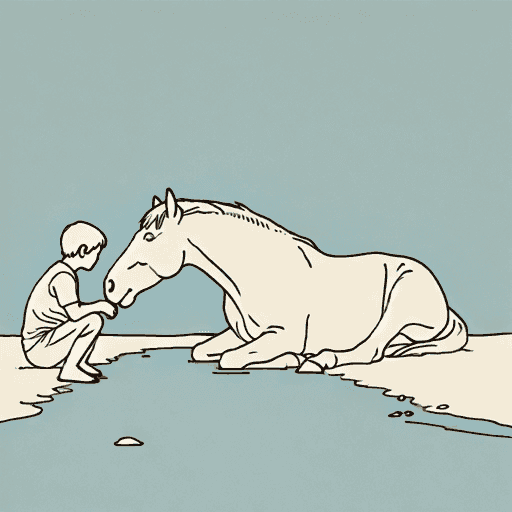
As Ken begins to care for Flicka after her injury, she begins to change, underscoring the power of human-animal relationships. This moment reflects the first time that her change is seen, as she begins to “listen” and is “not frightened” for the first time. From this point forward, their relationship will allow them both to grow, relying on each other to survive.
“Ken went up to his room and stood before his book shelf. He picked out the Jungle Book, then ran downstairs and out, across the Green, into the Calf Pasture, and down the path by the fence to Flicka’s Nursery. She was drinking at the brook when he came. He greeted her with a stream of talk […] Then he seated himself on the bank of the hill under the cottonwoods and began to read.”
(Chapter 24, Page 233)
This allusion to Rudyard Kipling’s 1894 novel The Jungle Book thematically connects the two stories with regard to Ken’s relationship with Flicka. Mowgli, the protagonist of the first three stories of The Jungle Book, is raised by wolves in the jungle and learns from characters like Baloo the bear and Bagheera the panther. Like Ken, he exists in a liminal space, both between the worlds of animals and humans and in the time between childhood and adulthood. Both novels emphasize the importance of understanding between these worlds while conveying the power of human-animal relationships.
“But through the agony ran a thread of something so exciting that [Ken] was strung like a taut bow. There was the first, thrilling whiff of real achievement. It was not only his hands that had changed. All the listlessness of the day-dreamer, the sliding away from reality, had gone. He looked, stood, moved, eagerly and with determination.”
(Chapter 26, Page 250)
This passage of reflection on Ken’s feelings comes when he is raising Flicka in her Nursery and their connection continues to grow between them. Just as he had been feeling a sense of loss earlier in the novel, these words emphasize that loss—but also the maturation that comes with it. Through his relationship with Flicka, Ken has grown and developed into someone who is more aware of the world and “determined” in his actions.
“When Ken saw that, he stopped walking. He felt dizzy. He kept staring at the gun rack, telling himself that it surely was there—he counted again—he couldn’t see clearly.
Then he felt an arm across his shoulders and heard his father’s voice. ‘I know, son. Some things are awful hard to take. We just have to take ‘em. I have to, too.’
Ken got hold of his father’s hand and held on. It helped steady him.”
(Chapter 30, Page 292)
With Ken’s change, he has also developed a better relationship with his father, as is shown by the support McLaughlin offers him when he realizes that Gus has taken the gun to kill Flicka. His words, that some things are “awful hard to take,” underscores the clash between romanticism and realism. An unfortunate reality of caring for Flicka over the last several weeks is the fact that she may not recover from her illness, ultimately forcing Ken to handle her death. Fortunately, Ken has also grown closer with his father, allowing McLaughlin to support him in this difficult moment.
“In the darkness that followed the lightning came a rush and a roar of wind that sucked through the Gorge, bent every tree on the Hill and slammed the kitchen door. Nell lit the kerosene lamp and the doctor stood up and looked down at Ken. The boy’s eyes were closed now, and he lay motionless, drawing rapid breaths through dry, parted lips.”
(Chapter 33, Page 311)
This moment emphasizes the symbolic meaning of storms throughout the novel. When Ken is found in the river after staying with Flicka all night, Nell brings him inside. The storm that rages—bringing high winds, flashing lightning, and slamming doors—reflects the emotional turmoil within Nell in this moment, creating a moment of pathetic fallacy. The storm creates a tense mood and feeling of danger, underscoring the possibility that Ken may not recover from his night spent protecting Flicka.
“‘Did you know it, Nell—that Ken is brilliant?’
‘I suspected it.’
‘What on earth made you think that? He’s always failed at everything—till this summer.’
‘Well—’ Nell spoke slowly, thoughtfully, ‘a dreamer—you know—it’s a mind that looks over the edges of things—the way Ken can do what he calls ‘getting into other worlds’; gets into a picture; gets into a drop of water; gets into a star—anything.’”
(Chapter 36, Page 336)
In this moment, after McLaughlin reads Ken’s essay about Flicka, McLaughlin acknowledges that Ken is “brilliant.” This view of his son stands in direct contrast to his inner turmoil at the start of the novel where he was concerned about Ken’s aloofness and irresponsibility. At the same time, Nell reaffirms what she has always known about Ken: He is intelligent even if he thought and acted differently than his father. This conversation underscores the clash between romanticism and realism toward the close of the novel. While McLaughlin represents realism and Ken represents romanticism initially, McLaughlin finally recognizes that there is value in both.

Unlock every key quote and its meaning
Get 25 quotes with page numbers and clear analysis to help you reference, write, and discuss with confidence.
- Cite quotes accurately with exact page numbers
- Understand what each quote really means
- Strengthen your analysis in essays or discussions