My Friend Flicka
59 pages • 1-hour read
Mary O'HaraMy Friend Flicka
A modern alternative to SparkNotes and CliffsNotes, SuperSummary offers high-quality Study Guides with detailed chapter summaries and analysis of major themes, characters, and more.
Character Analysis
Content Warning: This section of the guide includes discussion of animal death.
Ken McLaughlin
Ken is the 10-year-old protagonist of My Friend Flicka. He goes to boarding school during the year and then spends each summer at Goose Bar Ranch, a ranch in Wyoming owned by his family. At the start of this summer, he is afraid for his parents to find out that he did poorly in school, causing him to have to repeat the fifth grade. When confronted about his poor performance by his father, he admits that he spent most of his time getting distracted and day-dreaming about the ranch. His primary motivation throughout the novel is his desire to raise a young horse as his own, emphasizing to his mother that it would make him feel like he had a true “friend” for the first time.
Ken’s primary characteristics at the start of the novel are his immaturity and his irresponsibility. While his father expects him to help around the farm and take on more responsibility, Ken’s lack of focus prevents him from doing so despite his desire. For example, when Ken learns that his father is bringing the three-year-old horses down from the pasture to begin their training, his father does not trust him to help. He insists that it is too dangerous, reminding Ken that Ken frequently breaks and loses riding equipment. Instead of listening to his father, Ken sneaks into the hills to watch the horses from a distance. However, he falls asleep, then wakes up and startles the horses, nearly causing them to stampede over a cliff. This moment emphasizes the two key characteristics of Ken: His love of the ranch and his immaturity. In his desire to be involved, Ken makes the situation for his father worse, further exacerbating their relationship.
When Ken finally gets his colt to raise, Flicka, Ken begins his change toward maturation and responsibility. As a bildungsroman, the novel tracks Ken’s development and growing sense of belonging within his family and the ranch. Ken is a dynamic character who changes as he becomes a key part of the range. By the novel’s end, he is helping with the chores daily and is even considered responsible enough to stay at the ranch alone, leading to his heroics in saving the neighbor’s heifer from being trapped in the barbed wire fence. Additionally, when his father and the ranch workers insist that Flicka cannot be trained or that she is too injured, Ken ignores them, instead spending every day by her side and slowly getting her used to his presence. This Ken, who devotes all of his time and energy to Flicka, stands in direct contrast to the one at the start of the text who would get distracted, day-dream, and cause further problems for his father.
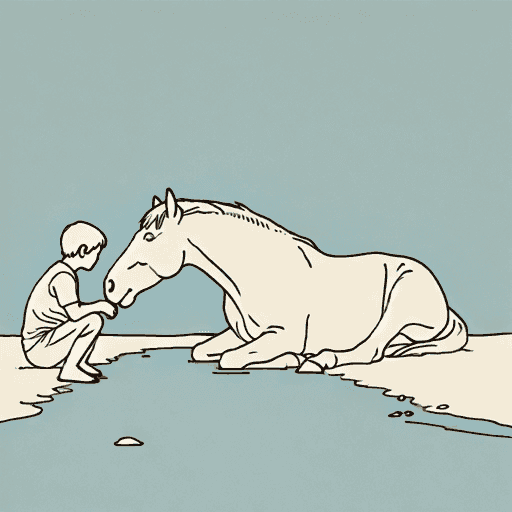
Ken’s relationship with Flicka is a key component of the theme of The Power of Human-Animal Relationships. Their relationship works both ways, as Ken helps Flicka heal while also learning about responsibility and maturity from her. Just as his mother predicted, the introduction of his own colt into Ken’s life led directly to his growth and development. By the novel’s end, he is an asset to the ranch, he completes the schoolwork that he missed the year before, and he has a strong relationship with his father for the first time—all as a result of the responsibility he undertook in healing and training Flicka.
Rob McLaughlin
Rob is Ken’s father and Nell’s husband. He is the owner and person in charge of Goose Bar Ranch. As a former Army captain, he is frequently referred to as “Captain McLaughlin” or just “McLaughlin,” emphasizing the respect and loyalty that he commands. As Ken reflects, “He and Howard had to say Yes, sir, and No, sir, to their father because he had been an Army officer before he had the ranch, and he believed in respect and discipline” (5-6).
This devotion to discipline becomes McLaughlin’s primary characteristic in the novel, as he is defined by his commanding rule of the ranch and his family. For example, when Howard and Ken are excited to go into town, at the last moment he makes Howard stay behind to brush and clean his colt. Despite his strong relationship with Howard and his appreciation for what Howard does, he still holds him to a high standard, emphasizing the importance of caring for his animals over the enjoyment of the rare trip to town.
In addition to the respect that McLaughlin commands from those around him, he emphasizes a similar respect for the animals on the ranch, demonstrating his appreciation of nature and animals. Repeatedly throughout the novel, McLaughlin teaches his sons lessons about caring for the horses. He teaches them to train them with firm kindness instead of anger, gives them the freedom of the range, and tells them to learn to communicate and respect what the horses need. In one key scene, as Ken stresses over the idea of saddle-breaking Flicka, his father makes a joke of the situation to show Ken how simple it can be. Instead of forcing Flicka to be ridden or commanding him, he instead has Ken simply hook up the saddle and Flicka willingly follows him. This moment emphasizes McLaughlin’s deep respect and understanding of nature, as he runs a humane ranch that values its animals.
As a dynamic character, McLaughlin changes throughout the course of the text as he learns an even deeper respect and understanding from Ken. Despite McLaughlin’s treatment of his animals, he also focuses on the value of bloodline and stock, repeatedly telling Ken that Flicka will never be trainable because of who her ancestors are. McLaughlin’s opinion of Flicka reflects his shortcomings, as he values profit and common sense when it comes to his stock, choosing to get rid of Flicka’s siblings rather than putting in the effort to train them.
While McLaughlin’s expertise has value and he is acting in response to the needs of the ranch, he also learns from Ken just how big of a role emotional connection and support can play. When Flicka ends up recovering from her illness largely thanks to Ken’s support, he realizes both that Flicka truly can be trained and that her friendship is invaluable to his son. As McLaughlin stands vigil and protects Flicka the entire night, it is clear that he has changed, valuing his son’s relationship with Flicka over the potential for profits or wasted money training her.
Nell McLaughlin
Nell is Rob’s wife and the mother of Ken and Howard. She is 37 years old. She is a skilled horse rider, with “tanned” skin and “a long, slender waist [with] curves held where they belonged by trained muscles” (11). Although not much of Nell’s backstory is given, it is explained that she moved out West from Boston after she met Rob and learned of his dream to start a ranch. Although she often thinks of the difficulties of their life, their financial struggles, and the strain of what they are doing, she is nonetheless dedicated to helping her family succeed. While McLaughlin is strict and demanding to everyone in the novel, Nell is the only character who questions him and sways his opinion, doing so only in private while publicly supporting him.
Throughout the novel, Nell faces an internal conflict over the life she is living versus the one that she used to have. The first time that she is introduced, she stands at the window and looks out at the trees, thinking of how they remind her of the sounds of “the sea” back home. Her life on the ranch requires her to care for the children, clean the house, cook, and, occasionally, care for the cows. Instead of feeling like this work is overwhelming, she decries her lack of ability to help in other areas. When the ranch workers call her “Missus,” she always thinks of the weight that that title carries, largely meaning that she is to stay within the home and take care of the duties there. Instead, she longs to do more work and physical labor on the farm.
As a compromise, McLaughlin encourages her to ride the horses and seeks her help in breaking the ones, like Rumba, who need extra care and attention. Instead of being controlling or demanding, McLaughlin seeks Nell’s advice and allows her freedom with the horses, while maintaining expectations for the work that she does on the farm. Ultimately, Nell is not unhappy; although she longs for some parts of the life that she used to live in the city, she is devoted to McLaughlin and her family and willingly does the duties required of her to help the ranch succeed.
Howard McLaughlin
Howard is Ken’s older brother. He is 12 years old. He is described by his mother as being “formed and already possessed of a definite character,” with hair that is “black, like his father’s, with a meticulous center part” (12). Although a minor character in the novel, Howard serves as a foil to Ken to emphasize Ken’s immaturity and aloofness. Unlike Ken, Howard is responsible and hardworking. He helps his father daily on the ranch, often taking on tasks that Ken would be incapable of performing. He has had his own colt since before he was Ken’s age, earning the responsibility because of his maturity. Additionally, he gets good grades in school, giving his parents hope that he will become a veterinarian one day.
Each of these characteristics stands in stark contrast to Ken, serving both as a point of comparison and a point of pressure for who Ken is supposed to be. It is repeatedly emphasized that Howard takes after his father while Ken follows his mother. In the end, when Ken becomes responsible and hardworking like his brother, it conveys the ability of children to learn, grow, and adapt, even when they have very different personalities and strengths.

Unlock analysis of every major character
Get a detailed breakdown of each character’s role, motivations, and development.
- Explore in-depth profiles for every important character
- Trace character arcs, turning points, and relationships
- Connect characters to key themes and plot points