My Friend Flicka
59 pages • 1-hour read
Mary O'HaraMy Friend Flicka
A modern alternative to SparkNotes and CliffsNotes, SuperSummary offers high-quality Study Guides with detailed chapter summaries and analysis of major themes, characters, and more.
Symbols & Motifs
Content Warning: This section of the guide includes discussion of animal death.
Flicka
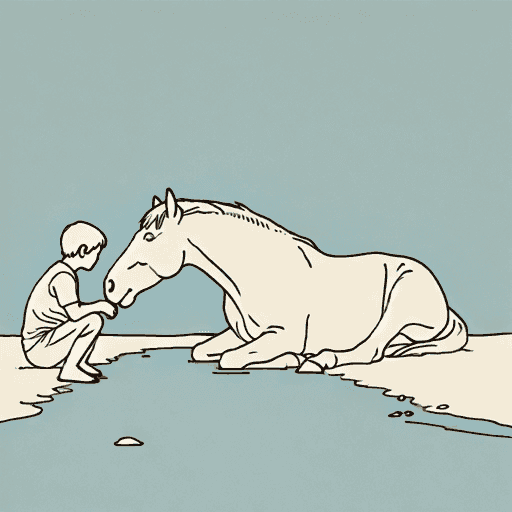
Flicka is a symbolic representation of Ken’s youthfulness and innocence. The primary conflict in the novel is the clash between Ken’s imaginative personality and the harsh realities of life on Goose Bar Ranch. Due to Ken’s immaturity, he lacks the understanding that his father has of the responsibility, hard work, and focus required to run the ranch. As a result, when Flicka is introduced, McLaughlin is adamant that she is not worth the energy required to train her. Flicka desires a life of freedom, repeatedly trying to escape the confines of the ranch and Ken’s desire to train her. These attributes parallel Ken, who desires the joy of having his own colt without fully understanding the hard work and training required.
As Flicka and Ken’s relationship develops, they both undergo a transformation, developing the theme of The Power of Human-Animal Relationships. Since Flicka symbolizes Ken’s immaturity, her training and her growing devotion to Ken reflect Ken’s own maturation in the novel. Their mutual relationship allows Flicka to survive her severe illness while also teaching Ken about responsibility and the hard work required to succeed on the ranch.
Storms
Throughout My Friend Flicka, the weather often reflects the turmoil, danger, hope, and other emotions of the characters, forming an important motif. In particular, the frequent storms symbolize the dangers of a life of ranching, developing the theme of The Clash Between Romanticism and Realism. For example, when Flicka is first injured trying to escape the pasture, she is unable to move. As Ken lies with her and comforts her, a storm begins:
The hailstones were like ping-pong balls—like billiard balls—like little hard apples—like bigger apples—and suddenly, here and there, they fell as big as tennis balls, bouncing on the ground, rolling along, splitting on the rocks. One hit Ken on the side of the face and a thin line of blood slid down his cheek with the water. (199)
O’Hara uses several similes, comparing the hail to different, increasingly larger objects, to emphasize the severity of the storm. In this way, the storm conveys the dangerousness of the situation that Ken is in both figuratively and literally: He is in danger of losing Flicka both to her injuries and to the storm. By extension, Ken’s love and devotion is conveyed through his willingness to injure himself to protect her. When the storm clears, “a clear silver light shone out, and the grass rose up again, every blade shimmering” (199), emphasizing the hope that will come with Flicka’s survival through the storm. While Ken romanticizes his relationship with Flicka, he now faces the reality of what it means to protect, train, and love her.
Similarly, on the night that McLaughlin decides to kill Flicka, he goes to her Nursery. The lightning storm dominates the scene, exacerbating the danger McLaughlin feels when he discovers the mountain lion’s presence: “[A] flash of lightning showed him that [the lion’s eyes] were in the centre of a mass of shrubs. The lion had hidden himself in those shrubs and was looking out at him from there” (322). McLaughlin’s ability to see only by the flashing lightning creates a mood of suspense and danger, both for Flicka and McLaughlin himself. Then, after McLaughlin scares off the lion, he still weathers the storm to stay by Flicka’s side and protect her throughout the night. Like other storms in the novel, this one emphasizes the realities of Goose Bar Ranch. While Ken romanticizes the idea of having a colt of his own, both he and his father risk their lives to ensure her survival.
The Painting
The painting which hangs in Ken’s room symbolizes the power of loyalty, which he will soon feel toward Flicka. It is first seen at the start of the novel when Ken is sent to his room to study. He gets distracted during the entire hour, staring at the different pictures on his wall. The “strangest picture of all” depicts “a desert land” with a man preparing the leave a home (29). The woman he is waiting for has gone back to the house and is hugging another woman there. There is a quote in the corner of the picture which reads, “Intreat me not to leave thee / Nor to return from following after thee / For whither thou goest I will go / And where thou lodgest I will lodge” (28). The quote is a passage from the Hebrew Bible, Ruth 1:16, which tells the story of Ruth and her mother-in-law, Naomi. After Naomi and Ruth’s husbands die, Naomi returns to Bethlehem. She gives her daughters-in-law permission to stay in Moab, but Ruth insists on going with her, speaking the words above.
Both the biblical story and the picture depicted in Ken’s room convey the ideas of love, loyalty, and belonging. In the picture, the woman is preparing to leave with the man, presumably her husband, saying goodbye to the woman in the home. Similarly, when Ruth decides to stay with Naomi, she decides not to return to her own family or stay in Moab to remarry; instead, she commits to being with her husband’s mother. Both stories emphasize the idea of what “family” means, exploring the intersection between new families in marriage and birth families.
When Ken studies this picture at the start of the novel, he notes how it depicted “something completely grown-up and mysterious and a little exciting” (29). Then, at the end of the novel, when he examines the picture again, he thinks, “[b]efore, he had felt something mysterious about it which he couldn’t understand. Now he understood. He closed his eyes and didn’t want to look at it” (340). Ken has now learned of love and loss, as he is still under the belief that Flicka has died when he examines the picture again. Seeing the picture at the end and not “want[ing] to look at it” conveys the heartache the idea now causes him, as he has a deeper understanding of what it means to have loved something and—so he assumes— to have lost it.

Unlock the meaning behind every key symbol & motif
See how recurring imagery, objects, and ideas shape the narrative.
- Explore how the author builds meaning through symbolism
- Understand what symbols & motifs represent in the text
- Connect recurring ideas to themes, characters, and events