My Friend Flicka
59 pages • 1-hour read
Mary O'HaraMy Friend Flicka
A modern alternative to SparkNotes and CliffsNotes, SuperSummary offers high-quality Study Guides with detailed chapter summaries and analysis of major themes, characters, and more.
Themes
Content Warning: This section of the guide includes discussion of animal death.
The Power of Human-Animal Relationships
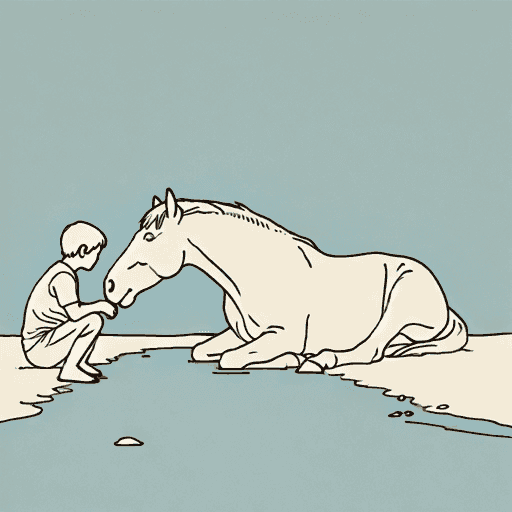
As a bildungsroman, My Friend Flicka explores Ken’s development over the course of one summer during his childhood. Central to his maturation is the relationship that he develops with Flicka, which explores the power of human-animal relationships.
At the start of the novel, Ken is irresponsible and imaginative. He breaks horse riding equipment, fails the school year, and makes his father’s work more difficult through his mistakes on the ranch. As the narrative continues, however, he makes several key changes that reflect his maturation. First, he is devoted to raising Flicka, spending hours each day with her and even risking his life to stay with her through the night. Ken gradually becomes a valuable asset to the ranch, taking on more responsibility and completing chores throughout the summer. Finally, he begins to understand the importance of his schooling, both because of the financial cost to his father and his desire to succeed, a fact which culminates in his completion of his essay and praise from his teacher. Each of these changes comes as a direct result of his father’s decision to allow Ken to raise Flicka. Once he becomes committed to training Flicka, valuing the friendship and companionship that she offers, he also begins to mature as a person.
At the same time, the novel emphasizes the importance of Ken’s relationship to Flicka herself. Since Flicka’s family line is connected to a wild bronco, the thing she desires more than anything else is her freedom. She repeatedly escapes the corral, injuring herself on the fence, then breaking through a window to escape. However, once she is forced to rely on Ken for her survival, she allows him to tame her, in turn developing a deep connection with him. The novel’s shifting third-person perspective gives the reader insight into Flicka’s character, noting how, at the end of the novel, she had come “every day, for weeks [and] had looked for [Ken],” turning around in “disappointment” when he did not appear (346). Thanks to Ken’s care, she has grown and developed into a “big horse, with speed and power and fire” (346). Although Ken acknowledges that his decision to corral Flicka also led to her injury, there is power in the relationship that they develop. With Ken’s care and support, Flicka now has the protection, guidance, and comfort of life on the ranch.
Ultimately, the novel emphasizes the importance of human-animal relationships, conveying them as mutually beneficial as long as the animals are treated with the kindness, respect, and care emphasized by both Ken and Goose Bar Ranch as a whole.
The Clash Between Romanticism and Realism
The primary conflict in My Friend Flicka occurs between Ken and his father. From the start of the novel, it is clear that McLaughlin struggles to understand his son. While McLaughlin is responsible and understands the difficulties of life on the ranch, Ken is aloof and imaginative, often getting distracted when he is supposed to be helping. Both characters are flawed, with McLaughlin often acting harshly toward his family as a result of the severity of ranch life and Ken failing to take things seriously enough. The conflict between them speaks to the clash between romanticism and realism on the ranch.
Ken romanticizes life on the ranch, desiring a colt, sneaking off to watch the excitement of the yearlings being driven in, and damaging equipment in his strong desire to ride the horses. Conversely, McLaughlin acts methodically, with strict rules about the care of the horses while making difficult decisions to sell or euthanize those that do not benefit the farm or are ill. This conflict comes to a head when Ken finally gets Flicka, giving him a chance to raise a colt of his own. To this point, he has romanticized the idea of having a colt, picturing grooming her, riding her, and developing a friendship with her. However, after he actually raises her, he begins to understand the difficulties when she is hard to corral, gets injured, and, ultimately, gets sick and nearly dies. Within Ken, there is a clash between the excitement of having a colt and the realities of actually raising one.
Instead of succumbing to the difficulties of ranch life, Ken grows and matures to rise to the challenge. To his father’s surprise, Ken becomes more responsible through his relationship with Flicka, then stands by her side throughout her illness and injury. Ken is able to connect with Flicka and then, in turn, fully train her to be a loyal horse despite McLaughlin’s concerns about her bloodline. At the same time, McLaughlin changes, as he begins to see the possibility of raising Flicka and training her.
In the end, the novel presents the idea of moderation as a solution to the conflict between romanticism and realism. The changes that occur within Ken and McLaughlin reflect the need for balance, as Ken learns to value hard work and responsibility at the same time that McLaughlin sees Ken’s imaginative nature and love for Flicka as assets for the first time.
Humanity’s Struggle to Control Nature
Written at the start of the 1940s, the text reflects how the West was seen as an idyllic land, with people believing that westward expansion, land acquisition, and ranching led to a life full of adventure and excitement. As Ken sees it, Goose Bar Ranch is a place full of beauty and natural wonders. However, McLaughlin’s difficulties in managing his livestock and keeping the ranch profitable speak to humanity’s struggle to control nature for their own benefit.
Through Goose Bar Ranch, the novel explores this struggle in the relationships that McLaughlin has with his animals. He is portrayed as someone who is respectful and responsible, both in his treatment of his animals and the land. He repeatedly emphasizes to his children the importance of caring for the animals, noting how it is their “responsibility” to ensure that they are raised properly and not mistreated. Despite his conscientiousness, he also faces challenges in raising his animals. For example, the deaths of Rocket and the horse who escapes from the truck highlight the risks of raising and selling horses—even when it is done correctly. Additionally, McLaughlin repeatedly struggles to control his animals, relying on Banner to stop their stampeding, bring them into the corral, and drive them to be broken. These difficulties show that attempting to tame wild animals is far from easy and that success is never guaranteed.
In addition to the animals themselves, another aspect of nature that is prevalent throughout the novel is the weather. Storms are an important symbol in the novel which underscore the dangers of a life that relies on good weather and cooperation from nature to succeed. At key moments in the novel, such as McLaughlin’s efforts to bring Flicka into the corral, Ken’s time spent trying to heal Flicka, and McLaughlin’s trip into town to find medicine for Ken, the scenes are dominated by strong storms with high wind and thunder. This weather builds tension and creates a mood of danger, emphasizing the precariousness of these situations when McLaughlin is doing his best to fulfill his duties on the ranch.
Ultimately, the novel acknowledges both the struggle to control nature and the importance of respect and knowledge when dealing with the natural world. Despite the difficulties of training the horses and the unpredictability of the weather, McLaughlin does have a successful ranch. Central to that success is McLaughlin’s respect and appreciation for nature, fostering a mutual relationship rather than one of strict control or exploitation.

Unlock every key theme and why it matters
Get in-depth breakdowns of the book’s main ideas and how they connect and evolve.
- Explore how themes develop throughout the text
- Connect themes to characters, events, and symbols
- Support essays and discussions with thematic evidence