72 pages • 2-hour read
Omeros
A modern alternative to SparkNotes and CliffsNotes, SuperSummary offers high-quality Study Guides with detailed chapter summaries and analysis of major themes, characters, and more.
Part 1Chapter Summaries & Analyses
Content Warning: This section of the guide includes discussion of racism and substance use.
Part 1, Chapter 1 Summary
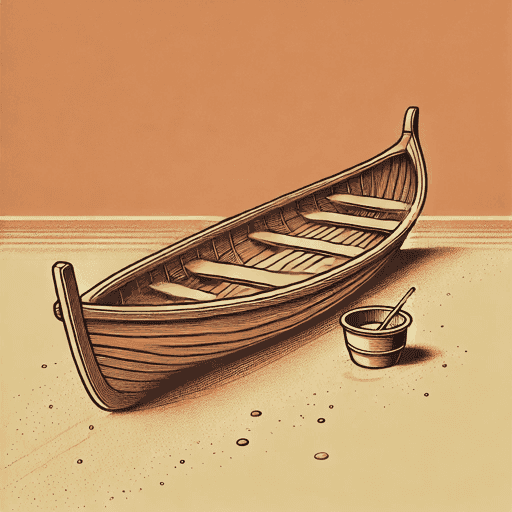
Philoctete is a fisherman on the island of Saint Lucia. He “smiles for the tourists” as he explains how canoes are manufactured (3). If the tourists pay him extra, he will show them a wound on his shin that refuses to heal. The wound was caused by a rusted anchor. The poem’s narrator, Derek Walcott, explains that the laurel woods on Saint Lucia are evidence of the history of European colonization on the island.
Achille, another fisherman, cuts down a laurel tree to make a canoe. The felled tree is like a “dead god” (6); it has fallen just like the old gods of the island fell. Achille fashions the felled tree into a pirogue, which is then blessed by a priest. Achille names the boat “In God We Troust” (8), refusing to alter his own spelling. He prepares to make his first voyage at dawn. He and the other fisherman drink absinthe together. This ritual pleases Achille, as the men stand together, “feeling their day begin” (9).
Part 1, Chapter 2 Summary
Hector is also a fisherman, as are Theophile, Placide, Pancreas, Chrysostom, Maljo, and Philoctete. As the men prepare, Philoctete feels overwhelmed by the pain from his wound. He visits the store run by Ma Kilman, where she serves him white rum to numb the pain. The other fishermen launch their canoes onto the water. Hector hopes that he will return before dark.
Seven Seas is a man who has lost his sight due to a disease. He finds his way around his house by listening to sounds, as though moving “by a sixth sense” (12).
Derek, the narrator, likens himself to the Greek poet Omeros (the Greek name for Homer) as he wakes. His grasp of Omeros’s epic poems allows him to understand life on the island. He finds references to the Greek poems everywhere: The lighthouse is like the eye of the Cyclops, and the “the surf lines wandering like the shambling fleece” are the Cyclops’s sheep (13). Derek explains that Antigone motivated him to write his poem. She taught him the Greek name for Homer, whose foam bust she had. Antigone is from Greece, and she misses her home. Studying her body and thinking of his island, the poet sketches a history of colonialism on Saint Lucia. His poem, however, will focus on fishermen rather than heroes.
Part 1, Chapter 3 Summary
Achille and Hector fight about a tin bailing cup that Achille supposedly borrowed. They are both armed with cutlasses. When Hector rips Achille’s shirt, Achille feels “shame” (17). Their true disagreement is over a woman named Helen; Achille feels as though the ripped shirt is really his heart being ripped out by Hector.
Ma Kilman’s bar is named No Pain Café in tribute to her late husband. She listens to Seven Seas but does not understand his “dark language of the blind” (17). As Philoctete approaches, she readies the rum that helps him deal with his pain. Philoctete tells her that his unhealable wound is actually a blessing—an ever-present reminder of the pain of his enslaved ancestors, who were brought to the island with manacles around their ankles. Philoctete thanks her and leaves, sure that his wound will never heal.
Part 1, Chapter 4 Summary
Reflecting on his pain, Philoctete visits his yam garden. His wound aches, and with his cutlass in his hand, he thinks about amputating his own leg; instead, he hacks at the yams. He curses the yams as he slashes at them, asking whether they “see what it’s like without roots in this world” (21). He sits down amid the slashed yams with tears in his eyes. Rolling onto his back, he studies the clouds. He thinks about God and forgiveness, resolving to endure his pain and be “the soul of patience” (22).
On the beach, Derek sits in a restaurant. He watches as a waiter carries a tray of drinks across the sand to a group of tourists. In the distance, “a mirage” draws the attention of Derek and the waiter (23). The mirage is actually Helen, an attractive local woman. When a tourist asks a waitress about Helen, the waitress claims that Helen is “too proud” (24).
Part 1, Chapter 5 Summary
Major Dennis Plunkett is an Englishman who lives on Saint Lucia with his Irish wife, Maud. They share a drink at their usual bar, sitting in silence. They have been married for 25 years, having retired to Saint Lucia after Dennis was wounded in World War II. Now, he runs a pig farm while she cultivates her garden (particularly her orchids). Dennis does not like the club attended by most British people on the island. He feels that the people there are “pompous arses” who pretend to be imperial officers when they are really insignificant (25). Dennis dislikes their affectations and airs.
Thinking about today’s “class war” (26), Dennis wonders who and what he fought for. He served in Africa under Field Marshal Bernard Law Montgomery; in those days, social class was just as much of an issue. Maud reaches for his hand as his eyes well up with tears. Dennis remembers fellow soldiers Tumbly and Scott who were seriously injured during the war. Dennis himself awoke in a hospital and “could remember nothing for months” (27). Derek notes that Dennis, like all his characters, “has to be wounded” since this is a theme of the poem (28).
Dennis brought Maud to Saint Lucia after the war to search for their own peaceful Eden. They have no children, and Maud has the occasional desire to return home.
Dennis and Maud watch Helen pass. Helen wears the yellow dress that she stole from Maud. Maud is concerned for Helen, while Dennis pities her. He feels a quiet guilt for the British colonization of the island. He thinks about the “ebbing” British Empire (30), comparing its decline to the decline of his marriage. Dennis wants to write a history for Helen. He ponders the Homeric allusions of her name, likening her to Helen of Troy. Helen is both a woman and the island itself, he suggests, since Saint Lucia was known as the Helen of the West during the era when control of the island regularly switched between Britain and France.
Dennis settles his bill, musing on the “mythical hallucination” of the two Helens (31). As he signs his bill, he likens it to the treaty signed between Britain and France after the Battle of the Saints, which returned the island to British control. Soon, he knows, Hector and Achille will compete in the village Olympiad. Their “true bounty” will be Helen (32).
Part 1, Chapter 6 Summary
Helen complains about waitressing work. Her white manager claimed that she was “too rude” (33). She believes that he only said this because she refused to allow the tourist men to touch her. She quit the job, but her friends do not know of any other work for her. Helen is pregnant, but she is unsure whether the father is Achille or Hector.
As Helen walks down the beach, singing the Beatles song “Yesterday,” Derek, the narrator, discusses the conflation between Black Helen and “white Helen” (34). Derek imagines the burning of the city of Troy, just like in Homer’s poem. That was in the past, the “yesterday” of Helen’s song, as are many other moments in the bloody history of Saint Lucia. Derek remembers the “rage of her measuring eyes” as Helen braided white tourists’ hair on the beach (36). He got up the courage to approach her stall, but she seemed bored and angry with him and then walked away.
Part 1, Chapter 7 Summary
In the local market, the “iron roar” brings the whole community together (37). Derek, the narrator, imagines its patrons mixing with the ancient world and events from the island’s past. He imagines the goods that were sold to the Conquistadors from Spain, including people to be enslaved.
In the market, Helen fights with Achille. She screams at him, and he pushes her up against Hector’s van. Helen fights back, clawing and biting, only for Achille to rip her yellow dress. Hector intervenes, leading Helen into his van and driving away. Achille is left devastated in the market, picking up spilled fruit. Achille can remember when he realized that Helen was untrustworthy. He was diving for conches, planning to sell them to tourists. Since this is illegal, he was forced to do so at night. He needed the money to impress Helen, but she was never his any more than the conches were. From the harbor, he saw Helen with Hector and felt “horned like the island” (40). Derek reflects on love and betrayal.
Part 1, Chapter 8 Summary
In the local museum, there is a famous bottle of wine. The aged bottle is covered in fool’s gold. People debate its origins, suggesting that it may be from a Spanish galleon or a ship sunk during the Battle of the Saints. People hope to find the sunken galleon, as it may be filled with treasure. Achille hopes to find the treasure, believing that he could use the money to win Helen back. He ties a block to his ankle, preparing to dive into the sea. He is unsure of success—even if he finds the treasure, it is unclear whether Helen still loves him or whether “love [is] dead inside her already” (44). Achille sinks below the water, surrounded by curious sea life. Underwater feels like an underworld, “not a world meant for the living” (45). Though he believes that he sees the galleon, he never finds the treasure. He loses faith in finding the ship or winning Helen back. Philoctete tries to repair the friendship between Achille and Hector, suggesting that the sea is their “common bond” (47). However, they are as stubborn as their literary predecessors.
Part 1, Chapter 9 Summary
Due to the hurricane season, Achille cannot continue to make money from the sea. With Philoctete’s help, he gets a job on the pig farm owned by Major Dennis Plunkett. Helen was fired from the Plunkett residence, but Achille is relieved to have the job, even if he dislikes his duties and misses his old work. Maud Plunkett laments the heavy rains; she misses the light rain and the seasons of her home country, Ireland. At night, Achille pictures Hector with Helen and makes himself miserable. During one particularly strong storm, Hector tries to navigate his canoe back to shore. He is thrown into the sea but is fortunate to emerge in the shallows.
The narrator imagines the hurricane as a gathering of the old gods, such as the African gods of lightning, love, and iron and war. The gods of Africa and Europe unite to cause chaos, Derek imagines, resulting in floods and destroyed crops on the island.
Once the storm passes, people inspect the damage. Achille finds his canoe and relishes the “brilliant days” ahead (54), at least until the next storm.
Part 1, Chapter 10 Summary
Dennis Plunkett does not like hurricane season. He feels depressed and isolated from his work and his wife. Maud tries to preserve her garden and works on an embroidered quilt. She also plays the piano. Dennis dislikes her maudlin traditional Irish songs. When he slams the piano shut, Maud retreats to her room in tears. Dennis comforts her, both of them weeping “the forgiving rain of those who have truly loved” (57). They tour the island together in their car, inspecting the damage caused by the hurricane. The distant volcano reminds Dennis of literary depictions of hell, kindling his “ancient fear” (59). The smell of sulfur reminds him of the concentration camps in World War II. Passing an abandoned sulfur mine, Dennis wonders what became of its English owners. Dennis feels as though his native England is “merely the place of his birth” (61); his true life is on the island. Maud does not feel the same, as there is plenty about the island that she hates. The sight of a butterfly reminds Dennis of Helen, who pleaded with him not to fire her for stealing Maud’s dress. Maud feels overwhelmed and oppressed by the stillness and beauty of the island, comparing it to the Garden of Eden “without all the sin” (63).
Part 1, Chapter 11 Summary
Since he runs a pig farm, Dennis has developed a dislike of the “swinish” colonial empires of the past (63). He admires the Indigenous people of Saint Lucia, though many of their more admirable qualities rile the expectations of white people. Helen is an example of this: She was a fastidious and proud housekeeper when she was employed by the Plunketts, though she often acted “as if [the house] were her own” (64). Though Maud claimed that Helen stole the yellow dress, Helen claimed that it had been a gift. Dennis hopes to empower the people of Saint Lucia, including Helen, by finding for them a “true place in history” (64).
His newfound obsession with historical research makes Maud wonder whether he is affected by an old war wound. Feeling lonely, she spends more time on the embroidered birds that she is turning into a quilt. Maud thinks about her life on the island with Dennis. Before she arrived, she had a romantic vision of Saint Lucia. The reality of her life is very different. She feels as though losing Helen is a great loss, even if Helen stole the dress. She appreciates the people of the island, smiling at the misspelled name of Achille’s canoe.
Part 1, Chapter 12 Summary
Derek returns to his childhood home, which is now a printing shop. There, he sees the ghost of his father, Warwick, who tells Derek about being raised in this “obscure Caribbean port” (68). Warwick was interested in literature but always felt like he was on the periphery of literary circles; literature is what he has passed down to his poet son. They walk through the streets and study the nearby houses and the local church. They hear the church bells ring. Only Derek can see Warwick, who leads him to a park that seems like a “paradise” (70). Derek chooses not to ask his father about the afterlife.
Part 1, Chapter 13 Summary
Warwick describes his childhood. He was imbued with a love of reading after finding an edition of The World’s Great Classics in the local barbershop. His portrait hung in the barbershop, alongside many others. They pass the barber and the man who took the photograph. Next, they venture to the harbor, where Warwick describes Derek’s duties as a writer: He should marry “[his] heart to [his] right hand” (72)—one day, he might be famous. Warwick compares fame to the giant white ocean liners that visit the port. Tourists throw money at the local children; as the children dive into the harbor to grab the coins, the tourists take photographs. Warwick describes the hard labor of the women who carry coal in baskets on their head. To him, they are “Helens from an earlier time” (73). Derek watches white men tally the baskets of coal. Warwick will not tell his son anything about life or death. Instead, Derek must bear his burden, just like the coal-carrying women. This burden is to be a witness to the past and to turn this painful past into literature, making sure that the suffering of these people will never be forgotten. Derek must give them “a voice” (76). Noticing the time, Warwick leaves for an appointment with his barber.
Part 1 Analysis
Omeros opens with a visit to the No Pain Café. Its name alludes to the way in which The Cycle of Suffering is tightly bound to the stories of these characters. Philoctete has the most obvious wound, but most of the fishermen, like Achille, are also in psychological pain. Walcott’s characters are plagued by deep, festering emotional wounds that they struggle to manage and heal. In the No Pain Café, Ma Kilman offers her patrons escapism: alcohol to numb the physical pain and a sense of community to mitigate emotional damage. While the café cannot heal the wounds left by Saint Lucia’s long history of colonialism and imperialism, it is evidence of the fact that the community has tried to recover in small, significant ways. Just as the promise of the No Pain Café is to alleviate what everyone feels but no one can quite understand, Walcott’s poem is an attempt to provide the same service—to satisfy “the itch in the sore” (19)
Major Dennis Plunkett is caught in a difficult position. As the only white British male character in this section of the poem and in this small community in Saint Lucia, he feels caught at the intersection of a multi-layered “class war” (26). Unlike the patrons of the No Pain Café, he cannot find belonging. On the island, Dennis refuses to join the other British people, “pompous arses” whose social clubs feel like festering pools of vestigial class distinctions that he had hoped to leave behind in Britain (25). This rejection of his own community makes Dennis feel isolated. At the same time, he remains distinct from the people of Saint Lucia. His military background means that he was once a part of the imperial machine responsible for many of the post-colonial issues across the island. Finally, he also cannot fully relate to his wife, Maud; she is from Ireland, the colonial history of which has more in common with Saint Lucia than England. Dennis is isolated by his identity and by an awareness of his identity, and the resulting Colonial Guilt and Trauma alters his behavior. He is not furious about Helen stealing a yellow dress, for example, because he fears that people from his country have already stolen so much from the people of Saint Lucia. Nevertheless, he has a somewhat patronizing attitude toward Helen, who he feels needs “a history” more than a dress (30). Dennis’s role in the poem is to provide a self-aware counterpoint to the post-colonial suffering of the locals.
The narrator contrasts Dennis’s pursuit of the island’s Indigenous history with the history that prioritizes colonial powers. Derek describes a bottle of wine that, after sinking to the bottom of the ocean, has become “crusted with fool’s gold” and is on display in the Saint Lucia museum (43). The bottle represents the externally dictated creation of cultural significance; it is symbolically caked in fool’s gold, a worthless mineral that appears to be a precious metal. Like the fool’s gold, the bottle only appears valuable because it is in the museum; the objects that fishermen like Achille find in the ocean are presumed to be less historically valuable because they do not come from the colonial powers that once occupied the island. The museum thus bestows value and assigns cultural significance: The wine bottle is presented as a key part of Saint Lucia’s history—more important than the bodies of those who “perished in the crossing” (45). This limits the understanding of real history; displaying only the bottle centers the “deep evil” of the colonizing forces and marginalizes the history of Indigenous people or the current population (46). The wine bottle creates the impression that Saint Lucia’s past is little more than the detritus left behind by colonial expansion and withdrawal.

Unlock all 72 pages of this Study Guide
Get in-depth, chapter-by-chapter summaries and analysis from our literary experts.
- Grasp challenging concepts with clear, comprehensive explanations
- Revisit key plot points and ideas without rereading the book
- Share impressive insights in classes and book clubs