One Came Home
47 pages • 1-hour read
Amy TimberlakeOne Came Home
A modern alternative to SparkNotes and CliffsNotes, SuperSummary offers high-quality Study Guides with detailed chapter summaries and analysis of major themes, characters, and more.
Chapters 7-12Chapter Summaries & Analyses
Content Warning: This section of the guide includes discussion of graphic violence and animal death.
Chapter 7 Summary
After a good night’s rest, Georgie wakes to the smell of Billy cooking the bacon she brought. Thinking he raided her food stash, she tears out of bed, only to find the world outside the lean-to filled with pigeon feathers—both floating and littering the ground. At once, Georgie concludes this camp belongs to pigeon hunters who hire local workers to help with the birds so the hunters can then sell the meat in the city. The feathers remind Georgie of when Mr. Olmstead asked to court Agatha. After a walk with him, Agatha returned with a book about birds from the Olmstead Hotel’s library. It was obvious to Georgie that Agatha loved the book, and Georgie was furious because she Agatha promised to stay with her and run the store—not get involved with the first suitor who gave her a nice book.
The sisters’ argument was halted by the arrival of the nesting pigeons, which brought hunters and tourists from all around the country. The store was abuzz with activity from opening to closing. Their grandfather put Georgie to work cleaning pigeon droppings, and she resented that Agatha was allowed to leave whenever she wanted, as long as it involved Mr. Olmstead. The couple even went to visit the nesting sites, and this actually convinced Georgie that Mr. Olmstead cared about Agatha because “why else would a man let himself be shat upon by thousands of birds?” (76). Still, Georgie wondered if Agatha was only using Mr. Olmstead for his library.
Back in the present, Georgie notices Billy cooking the bacon and starts to appreciate his company. She doesn’t know if he might still have feelings for Agatha, but she knows she can’t send him away if she wants the truth. As a bonus, he is handy with chores and an excellent cook.
Chapter 8 Summary
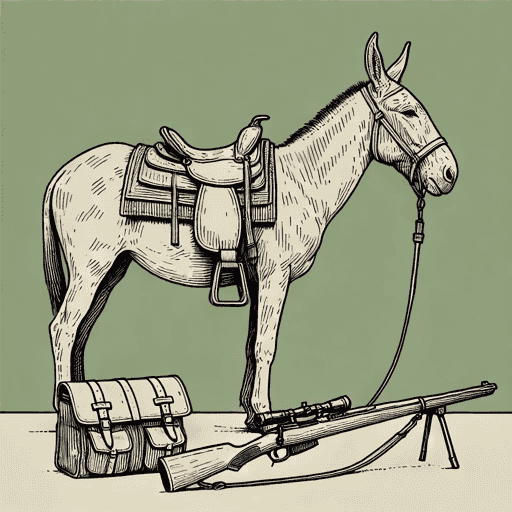
Just like the night before, Georgie’s mule only follows Billy’s horse, and Georgie struggles to control the animal. The two pass through the woods and the previous site of the pigeon nesting, where Georgie is amazed to find 99 nests in a single tree. The mule becomes more and more spooked as they travel through the trees. Georgie thinks things will be better when they reach a clearing; however, when she reaches the clearing, she finds that Billy has disappeared, and the clearing is full of carnivores eating the remains of baby pigeons from felled trees. The mule becomes more agitated. Georgie tries to coax the animal forward, which seems to work for a moment until a cougar suddenly leaps at them.
Chapter 9 Summary
The mule tries to run, but Georgie halts it, amazed that the animal listens. In her panic, Georgie remembers all the terms for a cougar, including catamount. She recalls her grandfather saying: “By the time you see a catamount, that catamount has been following you for at least half an hour” (88). Georgie pulls out her rifle but drops it by mistake. In desperation, she starts throwing her belongings at the cougar and yelling for it to go away. To her shock, it leaves. Billy arrives at a full gallop. Shaking, Georgie explains what happened and starts to cry. Billy offers a comforting hug, and Georgie doesn’t pull away.
Chapter 10 Summary
For the rest of the day, Georgie tries and fails to stop shaking at the thought of the cougar. When she and Billy finally stop for the night by the river, Georgie pretends to be unaffected and goes to take a bath, hurrying as she washes up because she doesn’t want to be alone. When Billy goes to take a bath, Georgie struggles to remain calm until he returns. When he does, she realizes how attractive he is—something she’s never noticed before. To distract herself from this revelation, she asks why Billy is risking his relationship with his new fiancée to look for Agatha.
Billy explains that he was in love with Agatha for years and finally got up the courage to ask her to marry him. When she said no and started seeing Mr. Olmstead, Billy felt betrayed. He says he didn’t think Mr. Olmstead had a right to go after what belonged to Billy, and Georgie silently scoffs at this because he speaks of Agatha as if “she was […] some item stocked on a store shelf” (105). When she mentions this, Billy says he loves his new fiancée and that Georgie is too young to understand.
Later, Billy announces he’s going to bed. Georgie is terrified of being left alone but pretends not to be. Billy sets up a tent for her and offers to sleep outside so she’ll be safe. Georgie accepts, feeling grateful; she also feels some other emotions she chooses not to examine.
Chapter 11 Summary
The next day, Billy and Georgie arrive in Dog Hollow—the town where Agatha’s supposed remains were found. Georgie goes to the general store, where the woman who runs the place is rude and overcharges her. Though she doesn’t want to, Georgie shows the woman a picture of Agatha and asks for information. The woman remembers Agatha and says that one of the men in her group was selling snake oil powder. It’s likely Agatha’s companions are the type who won’t hesitate to break the law, and Georgie becomes determined to either find Agatha or find “something that made it impossible for [her] sister to be the body wearing that blue-green dress” (117).
After she leaves the store, Georgie sees Billy exit the telegraph office down the street. She confronts him, thinking he telegraphed Agatha. In truth, Billy sent a telegraph to his father. He says both Billy’s father and Georgie’s grandfather know about the trip, and they let Georgie go, figuring she’d realize Agatha is dead and start dealing with her grief. Georgie feels betrayed but is still determined to find out what she can about Agatha. She barely talks to Billy for the rest of the day, and he only pulls her aside to explain that the kiss between him and Agatha was a goodbye.
Chapter 12 Summary
Georgie expects the place where Agatha supposedly died to be picturesque and meaningful. Instead, it’s so unremarkable that she and Billy go right past it until Billy looks twice at the map from the Dog Hollow sheriff. At the site, Billy doffs his hat in respect for the dead. Georgie is enraged and runs up a nearby hill, certain she’ll find a note or some other clue from Agatha. After searching through every nook and cranny among the rocks, she sees nothing but bugs. She howls in grief, and then she dispiritedly joins Billy at the bottom of the hill. The two split up to search more thoroughly, but Georgie doesn’t hold out much hope.
Chapters 7-12 Analysis
These chapters highlight Georgie’s growing understanding of The Inevitability of Change. Her encounter with the cougar is the first instance of events not going as Georgie intended, and her reaction shows her adaptability when she is forced to improvise. Though Georgie has heard about cougars and has information about how to deal with them from her grandfather, she has never encountered one in person. As with reading the book about travel, Georgie realizes that there is a difference between theoretical knowledge and lived experience. While she’s practiced shooting her rifle at bottles, her targets were stationary, and the situation was completely within her control. She was similarly in control when she shot at a non-threatening pigeon in Chapter 6. But now, Georgie is afraid and faces a creature she knows can overpower her. In addition, she sits atop a nervous mule that only occasionally obeys her. As a result, her hours of practicing her shooting skills prove useless, especially since she drops her rifle because she is overwhelmed. Her inability to follow the steps she has rehearsed several times throws her into unfamiliar territory, and she survives by improvising: She throws all her belongings at the cougar. Though she doesn’t immediately realize it, this moment marks a significant step out of her comfort zone. As her journey continues, Georgie gets better at responding to unexpected situations and adapting to change.
This section also begins to complicate Georgie’s understanding of relationships, including her growing feelings for Billy. As her emotional responses shift, she begins to realize The Difficulty of Finding the Truth. Georgie was initially perplexed by Agatha’s involvement with both Billy and Mr. Olmstead, which highlights her own youth. To Georgie, duty and productivity are the most important things, so she doesn’t understand why her grandfather allows Agatha not to work at the store when a potential suitor is involved. Georgie also doesn’t understand why Agatha doesn’t simply choose between Mr. Olmstead and Billy. On her journey, Georgie frequently questions her sister’s actions, both mentally and by interrogating Billy. However, her capacity to understand the truth is complicated by her age, as well as by how Billy withholds information. As with the journey itself, Georgie initially expects that finding the truth about Agatha will be straightforward and go exactly as she plans; however, she starts to realize—even though she doesn’t want to admit it—that she didn’t truly understand Agatha.
Georgie is resistant to admitting that her image of Agatha is not the same as who Agatha truly was. She cannot reconcile her beloved sister with the complexities involved in Agatha’s choices and her conflicting desires for intellectual fulfillment, affection, and stability. Instead, Georgie obsessively searches for the reason Agatha left, believing that if she finds it, she will restore the orderly world that Agatha’s disappearance disrupted. Only later does she finally realize that Agatha would have left irrespective of her relationships with Billy and Mr. Olmstead. Her choice to leave was motivated by her rebellion against the expectations placed upon her in Placid, highlighting The Impact of Societal Expectations on Individual Choices.
When Georgie realizes that her grandfather planned for Billy to accompany her on the trip, this marks a critical point in her journey. This is the moment when it becomes clear to her that she is expected to adhere to an approved version of the truth. Her grandfather believes Agatha is dead and that there is nothing more to be learned about her disappearance, and he intends for Georgie to arrive at this same conclusion so she can put her questions to rest. However, she is not content to accept her grandfather’s version of the truth, and this symbolizes Georgie’s first departure from passive obedience. She realizes she has her own internal drive for the truth and that she can use her own agency to make decisions about what she wants to know. In this moment, she starts to understand why Agatha left—to get away from a world where her grandfather’s authority shapes all decisions.
Despite this, Georgie’s internal journey is not linear. She experiences a setback in Chapter 12 when it appears as if Agatha truly is dead. However, this moment of grief is necessary for Georgie to move forward. It forces her to confront her pain and to accept that the answers she seeks may not be the ones she wants. This jumpstarts the second portion of her journey in the next section, where she completely veers from where she expected to go, as well as from the direction her grandfather wants her to take.

Unlock all 47 pages of this Study Guide
Get in-depth, chapter-by-chapter summaries and analysis from our literary experts.
- Grasp challenging concepts with clear, comprehensive explanations
- Revisit key plot points and ideas without rereading the book
- Share impressive insights in classes and book clubs