One for the Blackbird, One for the Crow
55 pages • 1-hour read
Olivia HawkerOne for the Blackbird, One for the Crow
A modern alternative to SparkNotes and CliffsNotes, SuperSummary offers high-quality Study Guides with detailed chapter summaries and analysis of major themes, characters, and more.
Parts 1-2Chapter Summaries & Analyses
Content Warning: This section of the guide contains depictions of graphic violence, illness or death, abuse, and sexual content.
Part 1, Chapter 1 Summary: “After He Took Himself Off to Jail”
Set in Wyoming Territory in 1876, the novel centers on the neighboring Bemis and Webber families. The narrative shifts between four perspectives: Cora Bemis; Nettie Mae Webber; Nettie Mae’s son, Clyde; and Cora’s daughter, Beulah. Beulah narrates in the first person, while the others narrate in a third-person perspective.
The story begins when 13-year-old Beulah hears a gunshot and understands her father, Ernest Bemis, has shot Substance Webber. After securing her younger siblings, Beulah watches Ernest return with her weeping mother, Cora. Ernest confirms what he has done and says he will confess to the Webbers then turn himself in. Refusing a faster horse, Ernest gives Beulah the rifle, asking her to protect the family and tell Cora he still loves her. As he leaves, Beulah understands she must now run the farm.
Part 1, Chapter 2 Summary: “Clyde”
Sixteen-year-old Clyde Webber watches Ernest ride away after confessing. He hears his mother sniffling, though she never cries, and recalls his father physically abusing her. Clyde decides he must bury his father, Substance, before scavenging animals arrive. Over his mother Nettie Mae’s protests, he takes a spade and rides to the river. There, he finds his father’s body. Overcome with nausea and grief, he digs a grave and buries the corpse. Unable to pray, he breaks down but is steadied by his horse’s presence. Clyde returns home, aware he is now head of the Webber household.
Part 1, Chapter 3 Summary: “Cora”
Three days later, Cora Bemis remains withdrawn, reliving the shooting and her role in it. She recalls her youth in St. Louis higher society, though she was poorer than other ladies around her. Beulah runs the household until the children’s hunger and her daughter’s strain rouse Cora. The sheriff arrives from Paintrock to inform Cora that Ernest received a two-year sentence. Panicked about surviving the winter, Cora is spurred by Beulah’s suggestion to join forces with the Webbers. Seeing it as penance, Cora resolves to ask Nettie Mae for help.
Part 1, Chapter 4 Summary: “Nettie Mae”
The next day, Nettie Mae confronts Cora as she approaches, asking about the affair and Ernest’s sentence. Cora confirms the two years, which Nettie Mae scoffs is not enough. Cora apologizes and asks for help to get her children through the winter. Nettie Mae refuses, citing Cora’s betrayal and violation of the Commandments before slamming the door. As Cora walks away, Nettie Mae thinks of her own four children who have died.
Part 2, Chapter 5 Summary: “What Needs Doing Can’t Be Stopped”
Several days later, Beulah sees Clyde ride in with a scythe, leading the Bemises’ lost calf. He releases the calf and, without asking, begins to harvest the corn. Beulah joins him. They acknowledge the conflict between their fathers and admit that neither feels much sorrow for Substance. Understanding that Nettie Mae disapproves, they nonetheless fall into a steady, wordless rhythm of work. Beulah recognizes that they both now carry the responsibility for their households.
Part 2, Chapter 6 Summary: “Clyde”
On the first cold morning of autumn, Clyde tends his ewes gently, unlike his father’s rough ways. Nettie Mae forbids him to help the Bemises, but he defies her and goes to the Bemis cornfield. There, he and Beulah harvest together. Beulah shows him a corn kernel, explaining its vitality and how it holds the pattern of new life. Clyde accuses her of being indifferent to his father’s death. She counters that Substance was not a good man and that Clyde is not truly grieving either. She presses the kernel into the earth, suggesting a connection between Substance’s burial and the possibility of renewal.
Part 2, Chapter 7 Summary: “Nettie Mae”
That same day, Nettie Mae harvests squash and watches Cora struggle in the distance, feeling grim satisfaction. In the orchard, she worries that Substance’s malevolence has seeped into the trees and fears for Clyde’s character. Her tension eases when she sees Clyde cross to the Bemis’s place, and she decides he may be escaping his father’s influence. Nettie Mae goes to the pasture and, remembering Substance’s cruelty to animals, suddenly lunges at her favorite ram as her husband would have. The flock scatters, leaving her alone.
Part 2, Chapter 8 Summary: “Cora”
That evening, Cora studies the dwindling woodpile and resolves to cut firewood in the foothills herself. She watches Beulah and Clyde finish in the field and thanks Clyde with bread and jam. Later, while Beulah bathes, Cora notices how much her daughter has grown and feels an urgent need to protect her. She decides they must leave the prairie and determines that when Ernest returns, she will press him to take the family back to St. Louis to safeguard Beulah from the wilderness.
Parts 1-2 Analysis
With each chapter told from one of four characters’ perspectives, the novel’s narrative structure foregrounds the subjectivity of experience after a trauma. The first four chapters begin with the repeated phrase, “After he took himself off to jail,” a device that anchors the inciting incident while refracting it through four distinct consciousnesses. This repetition insists that Ernest Bemis’s act is not a singular event but a catalyst that produces separate realities. The third-person limited perspectives of Clyde, Cora, and Nettie Mae create an intimate but fragmented understanding. In contrast, Beulah’s first-person narration introduces a different mode of perception, informed by what she calls the “knowing that comes to me from the movement of wind […] or the sound of a gunshot by the river” (3). This mystical awareness positions her as a unique interpreter of events, one whose understanding transcends the personal grievances that trap the other characters. By juxtaposing conventional perspectives with Beulah’s intuitive worldview, the narrative establishes a central tension between human-centric emotional responses and a broader, nature-based understanding of existence.
The crisis of Ernest’s imprisonment serves to deconstruct and re-examine prescribed gender roles in the 19th-century American West. The absence of the patriarchs creates a vacuum that forces the female characters and the adolescent Clyde into unconventional positions. Cora, initially paralyzed by guilt, is compelled by necessity to contemplate the masculine task of cutting firewood. Nettie Mae, the hardened matriarch, subverts her stoic facade when she lunges at her ram in an imitation of her husband’s dominance, revealing a buried capacity for violence. Conversely, the narrative begins to chart The Redefinition of Masculinity Beyond Patriarchal Violence through Clyde. He rejects his father’s legacy of brutality, choosing to shear his sheep with gentleness. His resolution, “If I am ever a father someday, I won’t be a father like you” (38), marks a conscious departure from a model of manhood based on force. Beulah, a 13-year-old girl, most fully embodies this inversion of roles by immediately assuming control of the Bemis farm. This upheaval of traditional dynamics suggests that survival on the prairie depends not on adhering to established social structures but on the fluid assumption of necessary labor, regardless of gender.
Through Beulah’s perspective, the narrative introduces the theme of The Breakdown of Traditional Roles and Binaries—in this case, contradicting the common binary of life and death as opposites. Her worldview challenges the linear understanding of mortality that governs the other characters. During the corn harvest, her fascination with a single kernel—which contains “a whole stalk inside” (44)—frames life not as a singular event but as a process of endless regeneration. This concept is presented as a corrective to Clyde’s grief. When he accuses her of being unapologetic for his father’s death, Beulah counters his literal interpretation of loss by planting a kernel, likening its burial to Substance’s and promising its eventual renewal. Her statement, “Your pa ain’t gone either, Clyde” (45), is not a denial of physical death but an assertion of his continued existence within a larger natural system. This moment establishes the motif of seeds and planting as a recurring symbol of this cyclical promise. The setting, poised between the end of the harvest and winter, further reinforces this theme, situating the human drama within the seasonal transitions of decay and rebirth.
The conflict between the Bemis and Webber families establishes the barriers to resolution despite The Necessity of Forgiveness in the Wake of Tragedy. Nettie Mae embodies the initial reaction to betrayal, her grief curdling into an anger that fuels her rejection of Cora’s plea for help. Her internal conflict between Christian duty and her personal wound highlights the difficulty of reconciliation. She believes her rage is necessary to keep from collapsing. This burden is intensified by Substance’s lingering influence. Nettie Mae fears his violent nature has metaphorically seeped into the apple trees and, more literally, into their son. While Clyde consciously rejects his father’s cruelty, burying Substance forces him into a traumatic confrontation with the finality of death, a reality that opposes Beulah’s more spiritual understanding. These initial interactions position forgiveness not as simple absolution but as a monumental task essential for mutual survival, a task complicated by unresolved grief and the threat of inherited violence.
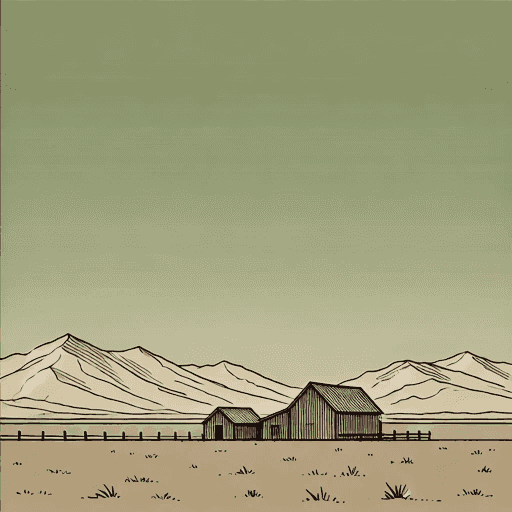
The Wyoming landscape functions as a symbolic entity, its meaning shifting according to the observer’s perspective. For Cora, the prairie is a “wilderness” defined by isolation and moral decay. She perceives the Bighorn Mountains not as majestic but as menacing, “poised to stride out with great feet of stone, crushing whatever huddled helpless on the prairie below” (57). Her desire to return to St. Louis is an attempt to escape the overwhelming presence of the wild. In contrast, Beulah’s identity is linked to the natural world; it is the source of her wisdom. For her, the land is not a hostile wilderness but a communicative presence. Clyde occupies a middle ground. He was raised on the prairie and feels connected to its landscape and wildlife, yet he feels burdened by the violent human histories enacted upon it. His labor in the cornfield with Beulah suggests a potential for a more harmonious coexistence with the land, one that moves beyond the human conflicts that define his parents’ generation. The landscape is thus not a passive backdrop but a mirror reflecting the characters’ internal states.

Unlock all 55 pages of this Study Guide
Get in-depth, chapter-by-chapter summaries and analysis from our literary experts.
- Grasp challenging concepts with clear, comprehensive explanations
- Revisit key plot points and ideas without rereading the book
- Share impressive insights in classes and book clubs