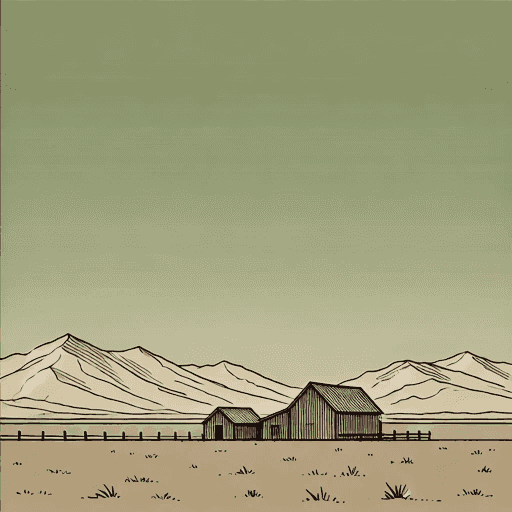
One for the Blackbird, One for the Crow
55 pages • 1-hour read
Olivia HawkerOne for the Blackbird, One for the Crow
A modern alternative to SparkNotes and CliffsNotes, SuperSummary offers high-quality Study Guides with detailed chapter summaries and analysis of major themes, characters, and more.
Parts 11-13Chapter Summaries & Analyses
Part 11, Chapter 40 Summary: “The Frogs Began to Sing”
Early spring brings a new rhythm as Beulah nears her 14th birthday. The Bemises move back home, but both families continue to work the land together. Beulah experiences her first menstruation and begins to see Clyde in a romantic light. They meet in secret. On the night of May 1, a full moon draws them to the riverbank. Clyde admits his affection, and as the spring frogs begin to sing, they share their first kiss.
Part 11, Chapter 41 Summary: “Nettie Mae”
That night, Nettie Mae realizes Clyde is not home. She goes out and witnesses his kiss with Beulah. Feeling betrayed and afraid for her son’s future, she goes to the Bemis house the next morning and informs Cora that, for Clyde’s sake, the Bemises must go to Paintrock. Nettie Mae urges Cora to sell the china to fund the move, saying she will hire help for her own farm. Cora reluctantly agrees. Nettie Mae returns home, convinced she is protecting Clyde despite the cost to her fragile peace with Cora.
Part 11, Chapter 42 Summary: “Cora”
Cora spends the morning unsettled by Nettie Mae’s demand, admitting a move might teach Beulah about reputation. Grieving the friendship that had begun, she chooses a parting gift and begins sewing a kerchief for Nettie Mae. As her hands move by habit, she thinks about their mutual dependence and her own regrets with Ernest. When she looks down, she has worked two spring flowers rising from a single stem.
Part 11, Chapter 43 Summary: “Clyde”
Crushed by news of the Bemises’ departure, Clyde walks to the small grave where he and Beulah buried the coyote and the two-headed lamb. Runoff has scattered the bones; the lamb is gone. He gathers the coyote’s skull, and the memory of the killing returns. He takes the skull to his father’s grave, sets it on the mound, and vows to be a different kind of man. Beulah arrives with wildflowers. They hold hands, and she tells him she will marry him one day.
Part 12, Chapter 44 Summary: “A Long Way Down”
Days before the departure, Clyde proposes one last secret ride. They climb into the foothills, where the two farms seem to join as one. He leads her to a fallen pear tree that still sets fruit. Beulah sits within the tree’s curve, feeling bound to the land and to Clyde. They agree to ride home separately to avoid Nettie Mae’s notice.
Part 12, Chapter 45 Summary: “Clyde”
Clyde reaches the yard first and distracts Nettie Mae so she will not see Beulah return. Hoofbeats erupt outside. They run out to find Beulah’s horse, riderless. Nettie Mae turns to Clyde, who admits they rode together. Putting Beulah’s safety first, he tells his mother to fetch Cora, then drives his mount hard toward the hills, blaming himself for hiding his relationship with Beulah.
Part 12, Chapter 46 Summary: “Cora”
Cora finishes packing when Nettie Mae bursts in and tells her Beulah fell and never came home. Nettie Mae steadies a frightened Cora, insisting they focus on the search. She calmly tells the Bemis children to stay inside until she returns. Cora grabs her shawl, and the two women leave to find Beulah.
Part 12, Chapter 47 Summary: “Nettie Mae”
They comb the pasture as the sun sets. Cora hears crows and urges they follow. Nettie Mae resists the omen but agrees. The crows lead them to the clearing by Substance’s grave, where they find Beulah unconscious but breathing. Clyde arrives, and they carry her on a saddle blanket to the Webber house. Nettie Mae orders Clyde to ride for the doctor, telling Cora she will pay the fee, then goes to bring the younger children over.
Part 13, Chapter 48 Summary: “When We Woke From Dreams”
While unconscious, Beulah dreams of blackbirds, cornfields, and the two-headed lamb. She wakes in the Webber sitting room to find her mother, Nettie Mae, and Dr. Cooper. The doctor diagnoses a concussion and prescribes rest. Beulah explains that crows startled her horse near the grave. She sees Clyde, spent from riding all night. As the house quiets, she drifts off, sensing him asleep upstairs.
Part 13, Chapter 49 Summary: “Clyde”
After Beulah wakes, Clyde feels he must act. He rides to the fallen pear tree and carves a piece of coyote bone into a ring. He tucks the ring and a fresh pear blossom into the wooden box Mr. Bemis gave him. Back at the well, he tells Nettie Mae he intends to court and marry Beulah. Nettie Mae answers that the Bemises will not move after all. She gives him her blessing without reservation.
Part 13, Chapter 50 Summary: “Nettie Mae”
Relief floods Nettie Mae. She hums as she prepares a large supper for both families. The previous night, while they watched over Beulah, Cora had given her the embroidered kerchief, and in that moment, Nettie Mae had told Cora to stay. Now she calls the Bemis children to help set the table. The house fills with voices as she pulls the meal together to mark Beulah’s recovery and the families’ new accord.
Part 13, Chapter 51 Summary: “Cora”
Cora wakes beside Beulah, grateful for her daughter’s recovery. She decides to write Ernest a new letter affirming her choice to stay and build the life they began. She helps Beulah dress, and they go down to supper. At the table, Cora stops short. Nettie Mae has set out the president’s china. Nettie Mae welcomes them and seats Clyde next to Beulah. Both families gather. Nettie Mae reaches across, Cora meets her hand, and they say grace together.
Part 13, Chapter 52 Summary: “Beulah”
After supper, Beulah slips away to Substance’s grave. The place feels quiet; his spirit has moved on. She notices the coyote skull Clyde left there and straightens it. On the path back, she spots a corn seed in the dust. She cleans it, then sees a fresh coyote track. She presses the seed into the pawprint, covers it with soil, and whispers for it to grow before turning toward home.
Parts 11-13 Analysis
The novel’s resolution uses crisis as a catalyst for catharsis, unifying different perspectives through a single event. Beulah’s riding accident functions as a turning point, forcing the tensions between the Webber and Bemis families to a healing climax. The author orchestrates this resolution through rapidly shifting points of view—from Clyde’s panic to Cora’s terror and Nettie Mae’s pragmatic fear—that converge on the goal of saving Beulah. This structural choice demonstrates that individual resentments are subsumed by the instinct for collective survival. The dramatic irony is significant: Nettie Mae’s decision to expel the Bemis family is immediately rendered moot by an accident that proves her own future is dependent on them. Her desperate march to Cora’s house collapses the distance she had tried to reestablish. This narrative construction suggests that true community is not a matter of choice but a state of interdependence revealed through shared adversity.
Beulah’s fall provides the impetus for the final realization of The Necessity of Forgiveness in the Wake of Tragedy, particularly in the relationship between Cora and Nettie Mae. In their joint search through the twilight, their identities as adversaries dissolve. When Cora collapses in fear, Nettie Mae’s sharp command, “Get up, Cora […] this instant” (445), is not cruelty but a transfer of strength, forcing Cora beyond her helplessness. This moment marks a fundamental shift in their dynamic; Nettie Mae, who once stood in judgment, now acts as a support. This shared trial transcends the personal history of betrayal that had defined their interactions. Nettie Mae’s subsequent promise to pay the doctor’s fee and her decision to bring the Bemis children to her home dismantle the last vestiges of their feud. The resolution culminates in the symbolic use of the president’s china. Previously a source of division, the set is finally brought out for a communal feast. In this final scene, the china is transformed from an emblem of social hierarchy into an instrument of shared grace, signifying the formation of a new, blended family founded on mutual care and forgiveness.
These concluding chapters solidify Clyde’s arc in relation to The Redefinition of Masculinity Beyond Patriarchal Violence. His journey moves from a reflection of his father’s rage to a conscious embodiment of protective stewardship. After learning of Beulah’s impending departure, Clyde returns to the grave of the coyote he killed, a site representing his capacity for inherited violence. By placing the coyote’s skull on Substance’s grave mound, Clyde performs a ritual of separation, symbolically laying his own violence to rest with his father’s. This act is a firm vow to construct a different form of manhood, defined not by dominance but by empathy and thoughtfulness. His all-night ride to fetch the doctor stands in contrast to his earlier pursuit of the coyote; one ride was an act of destruction, the other an act of salvation. The most powerful symbol of this transformation is the ring he carves for Beulah from a piece of the coyote’s bone. He physically reshapes an artifact of his violent past into a token of future commitment, converting a symbol of death into a promise of a new life cycle. This act crystallizes the novel’s argument that true strength lies in creation and connection.
Beulah’s journey through unconsciousness serves as a conduit for the novel’s core theme of The Breakdown of Traditional Roles and Binaries. Her dream state is a visionary passage that she later identifies as [walking] “the edge of the spiral” (456), a reference to the symbol of interconnected existence. The visions she experiences—a flock of blackbirds that departs but leaves a thriving cornfield, a cutworm destroying a leaf that nourishes the soil—are allegories for her worldview. They illustrate a nonbinary system where death is not in conflict with life but a vital component of it. This perspective is what allows her to bring peace to the land, as she understands that Substance’s angry spirit is an anomaly—a refusal to participate in the natural cycle. The narrative validates her worldview by having the crows, which Nettie Mae views as a fearful omen, lead the women to Beulah’s location. Beulah’s final, quiet act of planting a corn seed in a coyote’s track is a potent ritual. By placing a symbol of cultivation into the print of a wild predator, she unites the tame and the wild, affirming the harmonious balance she has helped restore.
The resolution is enriched by the transformation of key symbols, which evolve from markers of division into emblems of resilience. The fallen pear tree, discovered by Clyde and Beulah, serves as a metaphor for the two families. Though its trunk is broken and lies sideways along the earth, it survives because “a few slender roots had remained in their rightful place” (434), allowing it to bear fruit. The tree mirrors the families’ own story: Felled by tragedy, they find a way to live on and create an intertwined existence. This scene also brings up a recurring motif in that the two farms appear as one from a higher view. Like the two-headed lamb and the intertwined spring flowers on the handkerchief Cora sews, the families frequently encounter objects that look separate but are inextricably intertwined. This mirrors their own connection, as their conflict throughout the novel has made them feel like two opposing sides when, in reality, they are all part of a whole: neighbors, family, and farmers trying to live in harmony with nature. This reaffirms Beulah’s perception of all things as united.
In the closing scenes of the novel, Substance’s grave undergoes a profound symbolic shift. Initially a site of angry haunting, it becomes a place of peace. It is where Clyde makes his vow, where the mothers find Beulah, and where Beulah confirms that Substance’s spirit has finally moved on. The transformation of the grave from a point of conflict to a place of renewal signifies that the past has been accepted. The convergence of these symbolic transformations with the characters’ emotional resolutions creates a layered conclusion, suggesting that healing the land and healing the self are inseparable processes.

Unlock all 55 pages of this Study Guide
Get in-depth, chapter-by-chapter summaries and analysis from our literary experts.
- Grasp challenging concepts with clear, comprehensive explanations
- Revisit key plot points and ideas without rereading the book
- Share impressive insights in classes and book clubs