Over Sea, Under Stone
45 pages • 1-hour read
Susan CooperOver Sea, Under Stone
A modern alternative to SparkNotes and CliffsNotes, SuperSummary offers high-quality Study Guides with detailed chapter summaries and analysis of major themes, characters, and more.
Background
Series Context: The Dark Is Rising Sequence
Published between 1965 and 1977, Susan Cooper’s The Dark Is Rising sequence is a fantasy series for children and teenagers that blends Arthurian and Celtic mythology with the trappings of contemporary life. In addition to its first installment, Over Sea, Under Stone (1965), the series also includes The Dark Is Rising (1973), Greenwitch (1974), The Grey King (1975), and Silver on the Tree (1977). Together, the books chronicle the ongoing battle between the forces of the Light and those of the Dark as new heroes and foes emerge in the 20th century. Guided by the ancient mage, Merlin, the main characters follow in the footsteps of King Arthur to overthrow the forces of evil and herald the return of Arthur’s heir, the Pendragon.
Over Sea, Under Stone sits slightly apart from the rest of the series because its main purpose is to lay the groundwork for the rest of the narrative. Although this first installment does not include explicit supernatural elements, it does hint at the magical and mythical aspects that the series later explores. Great-Uncle Merry, for instance, is depicted merely as an eccentric old man, and only at the end of the novel does Barney finally realize that his great-uncle is actually the legendary magician, Merlin.
Some of the books focus on different protagonists, who meet over the course of the series and eventually come together during its climactic conclusion. The first novel follows Simon, Jane, and Barney Drew, who only reappear twice in later installments. In The Dark Is Rising, Will Stanton is introduced as a new protagonist and subsequently meets Bran Davies, King Arthur’s son, who has been tasked with defeating the Dark. At the end of the series, Merlin aides the five children in their struggle to defeat the forces of evil, after which they all continue to live as friends and guardians of the world.
Cooper’s work has been praised as a significant contribution to children’s literature and has earned several distinctions. In particular, the Dark Is Rising sequence has earned critical acclaim for its depiction of Celtic and Anglo-Saxon mythology. Additionally, The Grey King won the 1976 Newbery Medal, and both The Grey King and Silver on the Tree won Tir na n-Og Awards for their depictions of Welsh folklore. Since its original publication, Cooper’s series has gained enduring popularity and has become a significant cultural legacy in children’s fantasy literature.
Literary Context: 20th-Century British Children’s Fantasy
Written in the tradition of 20th-century British children’s fantasy, Susan Cooper’s Over Sea, Under Stone is firmly grounded in the legacies of authors like C. S. Lewis, Alan Garner, E. Nesbit, and T. H. White. Similar to these authors’ styles, Cooper also depicts the adventures of a group of children whose daily lives are upended by supernatural events. As Cooper herself notes:
The Dark is Rising books are rooted in a real world in which unreal things happen; this is most common in fantasies written by authors raised in Britain, like Alan Garner, Philip Pullman, and me, probably through the sense of inter-related time and place given us by the haunted history of our very old country. Fantasy writers from a young country like the USA, like Ursula Le Guin, are more likely to invent an entirely unreal world (Flair, Isaiah. “Susan Cooper on the Moral Imagination in Fantasy Fiction.” The Russell Kirk Center for Spiritual Renewal, 2024).
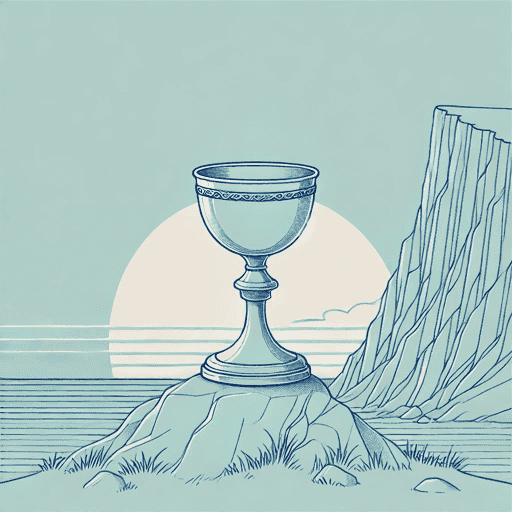
Inspired by Arthurian legend and Celtic mythology, The Dark Is Rising sequence depicts well-known traditions and characters from Anglo-Saxon folklore in modern environments. Although Over Sea, Under Stone is the least explicitly fantastical novel in the series, the story takes place in the myth-imbued landscape of Cornwall and references Arthurian elements such as the Knights of the Round Table, the Holy Grail, and the enigmatic figure of Merlin. The rest of the series also includes elements from Welsh folklore, such as the character of Brenin Llwyd (also known as the Grey King), the legend of the Drowned Hundred, and the tradition of the Mari Llwyd.
As Cooper’s protagonists embark on a mysterious quest to defeat their enemies, the series reflects a narrative structure that draws on the popular treasure-hunt motif, which is often used to symbolize emotional growth in children’s literature and young adult fiction. The suspenseful tone of the story strikes a dark and even morally ambiguous mood as the characters grapple with personal dilemmas. As a whole, Cooper’s writing has been praised for its lyricism and complexity, and her novels blend adventure, mystery, and occasional humor to create a unique blend of adventure and fantasy in a contemporary setting.

Unlock all 45 pages of this Study Guide
Get in-depth, chapter-by-chapter summaries and analysis from our literary experts.
- Grasp challenging concepts with clear, comprehensive explanations
- Revisit key plot points and ideas without rereading the book
- Share impressive insights in classes and book clubs