Over Sea, Under Stone
45 pages • 1-hour read
Susan CooperOver Sea, Under Stone
A modern alternative to SparkNotes and CliffsNotes, SuperSummary offers high-quality Study Guides with detailed chapter summaries and analysis of major themes, characters, and more.
Chapter 13-EpilogueChapter Summaries & Analyses
Chapter 13 Summary
When Rufus returns to the Grey House alone, Simon and Jane realize that Barney is in danger. The dog alerts them to something strange happening near the harbor, where Mr. Hastings and the Withers siblings are on their way to Kemare Head with a subdued Barney. The boy finds himself hypnotized by Hastings’s mysterious powers of persuasion, but he suddenly wakes up when Rufus starts howling. Hearing this, Barney runs to his siblings and they all flee together, pursued by Hastings and his acolytes.
The children hide in a field and watch as their enemies prepare to go to Kemare Head. Simon convinces his siblings to move around the cliff while the tide is out so that they can find the other entry to the cave and get to the grail first. As they make their way through the rocks, they encounter a deep pool of water that they have difficulty crossing. When they finally reach the cave, they decide to split up. Jane stays outside and holds one end of a fishing line while the boys hold onto the other end and enter the cave, carrying matches.
Chapter 14 Summary
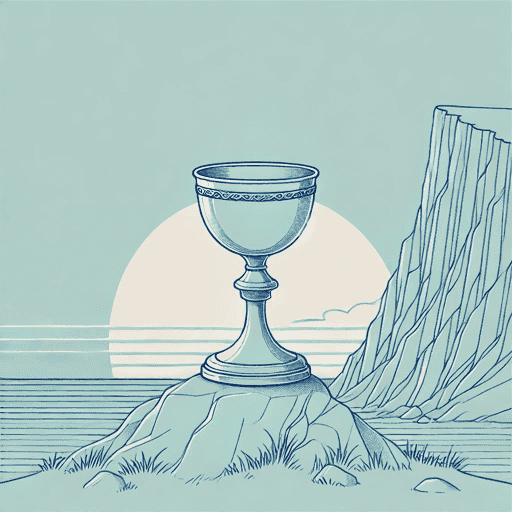
Barney and Simon wade through shallow water and make their way through the dark cave, intermittently lighting matches to see what lies in front of them. After a while, they realize that the cave is dry and they are be going further up into the hill. Eventually, they find themselves at a dead end, facing a fallen boulder. However, a narrow passage under the large stone is big enough for Barney to fit through. After convincing his older brother to let him go, Barney continues on his own. He finally finds the grail, an old dirty chalice, standing on a rocky ledge.
On the other side of the rope, Jane signals her brothers that the tide is coming up. The boys triumphantly make their way out of the cave and show Jane their discovery. Wedged inside the cup is a smaller cylindrical case that contains another ancient manuscript, so they put it inside the bigger one for safekeeping. However, the children are alarmed when they notice the Witherses’ yacht approaching. Simon, Jane, and Barney start running, but Hastings and the Withers pursue them on a dinghy while Bill appears in a boat on the other side, cutting them off.
The children stop, and Barney threatens to throw the grail into the sea. Hastings responds by threatening to leave the children to drown. Hastings and the Withers attack, but suddenly, Mr. Penhallow’s boat appears with Great-Uncle Merry at the prow. Simon throws his great-uncle the grail and the telescope case, and although Great-Uncle Merry catches the cup, the case falls into the water, and the first manuscript immediately disintegrates. Hastings is beaten and cannot retrieve the second manuscript, so he retreats to the Witherses’ boat with his acolytes while Great-Uncle Merry rescues the children.
Epilogue Summary
Some time later, Simon, Jane, and Barney are being honored by scholars and academics for discovering an antique Celtic chalice. After answering a reporter’s questions, they regretfully wonder about the lost secrets of the destroyed manuscript. However, their great-uncle suggests that because the second case was sealed and waterproof, it is probably safe where it landed. Because Jane also saw the case fall right next to the deeper pool that they noticed on their way to the cave, the children now know where to look for it. Great-Uncle Merry then explains that he and Hastings have been enemies for a long time. Hastings has used different names and has changed his appearance many times over the years, so he may return under a different identity. As the scholars begin arguing about the meaning of the grail and its connection to the Arthurian legends, Barney begins to wonder whether his great-uncle may actually be the legendary Merlin.
Chapter 13-Epilogue Analysis
After Barney’s abduction, the tone shifts toward a more fantastical atmosphere, although this pattern is not yet made explicit. For example, when Simon and Jane are looking for their younger brother, Rufus signals that something strange is happening, and the narrator pointedly comments that “[Simon and Jane] could never explain it afterwards” (186). Meanwhile, the description of Barney’s detached, compliant state of mind hints that he may be enchanted. As the narrative states, he “no longer had any thoughts of his own; it was a strange, relaxed feeling, as if he were comfortably half asleep” (187). Finally, the otherworldly nature of these events is cemented when Barney is aroused by Rufus’s “freezing inhuman wail” (188), and because the animal’s is depicted as being morally pure and loyal to Barney, the dog stands as a benevolent force in The Archetypal Battle of Good Versus Evil and decisively breaks through Hastings’s spell. Although the passage then shifts back to more realistic descriptions, these events establish the presence of the supernatural elements that will be developed in subsequent installments of The Dark Is Rising sequence.
Just as Barney is the focal point of these supernatural details, he also takes on a more significant role during the novel’s climactic events, acting as the catalyst for The Archetypal Battle of Good Versus Evil. The narrative describes Barney resisting Hastings’s grasp once again as the two pit “one will against another” (227). Under normal circumstances, a struggle between the powerful, intimidating Hastings and the innocent, young Barney would be significantly unbalanced, but the narrative depicts them as being equally matched, and this choice highlights Barney’s moral strength and loyalty to King Arthur’s mission.
This dynamic is also demonstrated when Barney is the one who finds the grail. Although the three siblings have worked together, only Barney can reach the hidden cave, and in a distant echo of the legend of the sword in the stone, this event symbolically characterizes him as the most morally worthy of the three siblings. In this way, the narrative implicitly equates youth with moral purity, whereas the ancient being, Hastings, bears a weight of greed and corruption that renders him symbolically weak despite his threatening nature.
Finally, the climactic confrontation between Hastings and Great-Uncle Merry also hints at the men’s mystical natures. While they do not directly engage with each other, both characters are depicted as larger-than-life beings with hidden powers, especially when Jane notices “something monstrous [blazing] behind Mr. Hastings’ eyes, something not human, that filled her with a horror more vast and dreadful than anything she had felt before” (228). Likewise, Great-Uncle Merry “looked for a strange moment like some great creature of the rocks and the sea” (231). The contrast between Merry and Hastings clearly establishes their status as lifelong rivals and indicates that they represent The Archetypal Battle of Good Versus Evil in its most elemental form. Their stalemate therefore symbolizes the everlasting tension between morality and destruction. While this conflict is a recurring theme in fantasy literature, the novel frames this struggle as an eternal war that was once fought by King Arthur and is now taken up by contemporary protagonists. This idea sets up the premise that will drive the protagonists in the subsequent books as well.
Notably, Barney once again proves his worth when he deduces that Great-Uncle Merry’s might be the legendary magician, Merlin. His unconditional belief in the Arthurian legend enables him to perceive seemingly unrealistic truths that escape his older siblings. Merry immediately confirms his magical yet advisory role when he suggests that the children may be able to retrieve the second manuscript from the sea. In addition to serving as a plot device that introduces the premise of the next installment in Cooper’s series, this conversation also highlights the fact that the sea is once more providing a safeguard for an ancient artifact. Thus, the author revisits the novel’s thematic focus on the idea of Landscape as a Vessel for Myth and Memory.

Unlock all 45 pages of this Study Guide
Get in-depth, chapter-by-chapter summaries and analysis from our literary experts.
- Grasp challenging concepts with clear, comprehensive explanations
- Revisit key plot points and ideas without rereading the book
- Share impressive insights in classes and book clubs