Over Sea, Under Stone
45 pages • 1-hour read
Susan CooperOver Sea, Under Stone
A modern alternative to SparkNotes and CliffsNotes, SuperSummary offers high-quality Study Guides with detailed chapter summaries and analysis of major themes, characters, and more.
Symbols & Motifs
The Grail
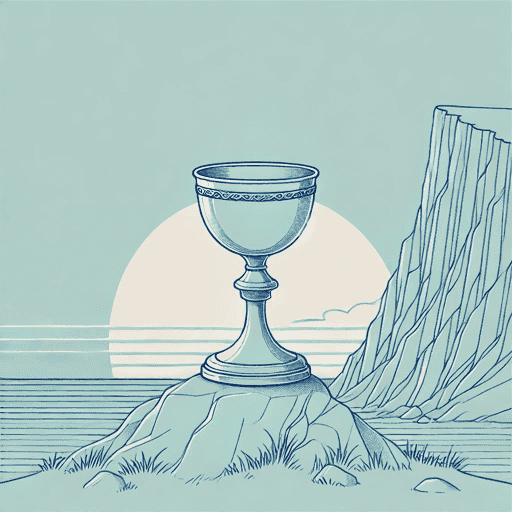
In Arthurian legend, the Holy Grail is a mystical artifact of utmost importance, and it is often depicted as a sacred chalice, which the Knights of the Round Table search for across Great Britain. In The Dark Is Rising series, the protagonists embark on a quest to find a copy of the grail that was hidden by the ancient knight Bedwin, who claims that it “[tells] upon its sides all the true story of Arthur soon to be misted in men’s minds” (77). This premise emphasizes the novel’s focus on the idea of Arthurian Legend as Living Myth in the Modern World, and the young protagonists are therefore framed as spiritual descendants of those heroic knights.
When Barney eventually finds Bedwin’s grail, the artifact looks like “a cup, heavy and strangely shaped” (215). Significantly, it is engraved with a depiction of “the promise and the proof of Arthur’s coming again” (77). This line foreshadows the grail’s narrative role as a prophetic artifact: a common trope in fantasy narratives. In short, the grail is the initiating event that sets the main characters on their series-long quest. Harking back to its mythical origins, the grail in Cooper’s narrative symbolizes The Archetypal Battle of Good Versus Evil. The characters’ various reasons for seeking it therefore underline their true motives; the protagonists want to selflessly protect it, while the antagonists seek control and destruction. At the end of the book, the grail is kept under glass in a museum to symbolically demonstrate its purpose as a repository of myth and history.
The Grey House
Tying in with the theme of Landscape as a Vessel of Myth and Memory, Captain Toms’s Grey House also acts as a repository for memory and history. It is described as “[a] sombre house, painted dark-grey, with the door and window frames shining white” (6). Crucially, the children experience a thrill of excitement when they first see it, and this visceral reaction foreshadows the adventures to come.
As Simon points out, the mysterious, odd-looking building offers an atmospheric background to enhance the children’s adventures. As he exclaims, “What an odd way this house is built […]. All little bits joined together by funny little passages. As if each bit were meant to be kept secret from the next” (21). Th house’s disjointed layout provides endless opportunities for hidden passageways, and the siblings’ discovery of the forgotten attic is therefore portrayed as an inevitability. Symbolically, this progression of events also mirrors the way the map works, for rather than indicating a specific location, the map instead points the children to a series of sequential clues.
When the children first arrive in Trewissick, they make a game out of exploring the house, and this pattern leads to their discovery of the forgotten attic. There, in a climactic conclusion to their first whimsical expedition, they find the ancient manuscript that symbolically transforms their make-believe antics into a real quest with very serious stakes. Amidst this shift, the Grey House remains a safe haven to shelter the children between the various stages of their adventure.
The Carnival
In contrast to the children’s innate sense of moral purity, the narrative introduces the carnival to symbolically accentuate the antagonists’ deceitful nature. For example, Mrs. Palk is eager to attend the carnival and takes pains to don a fancy headdress just before she betrays Great-Uncle Merry. In this way, the symbolic act of donning a mask of sorts echoes the fact that she has already been wearing a “mask” of friendly helpfulness as part of the household at the Grey House. Similarly, the Witherses both wear costumes when they abduct Barney from the chaos of the carnival setting.
Carnivals and costumed parties are often used in fiction as a narrative trope that suspends the usuals rules of behavior and creates an atmosphere of edgy danger in which anything is possible and no one is who they appear to be. Thus, the use of masks and costumes takes on a double edge, as even costumes that are meant to conceal a person’s identity can act as a metaphorical self-portrait. For example, Polly Withers is dressed as a black cat, an image that traditionally bears connotations of slyness and witchery. Likewise, Mrs. Palk’s headdress is only worn in scenes when she is actively seeking to deceive others. Significantly, she wears it when she lies to Great-Uncle Merry about the children’s whereabouts, and she dons it again later during the carnival, and the narrative suggests that she only wears it when she is lying or pretending. Importantly, Simon, Jane, and Barney—unlike their enemies—never hide behind masks or costumes, and this pattern symbolically underlines their honesty and morality, differentiating them from the antagonists.

Unlock the meaning behind every key symbol & motif
See how recurring imagery, objects, and ideas shape the narrative.
- Explore how the author builds meaning through symbolism
- Understand what symbols & motifs represent in the text
- Connect recurring ideas to themes, characters, and events