Pericles
62 pages • 2-hour read
William ShakespearePericles
A modern alternative to SparkNotes and CliffsNotes, SuperSummary offers high-quality Study Guides with detailed chapter summaries and analysis of major themes, characters, and more.
Act IIIChapter Summaries & Analyses
Content Warning: This section of the guide includes discussion of death.
Act III, Chorus Summary
Gower explains that the search for Pericles was long and arduous, until the lords of Tyre receive news that the prince is in Pentapolis. A letter is sent to Pericles, informing him of the death of Antiochus, and the need for him to leave for Tyre immediately to calm his restive people. Realizing their princess’s husband was to be king of Tyre, the lords of Pentapolis rejoice. Thaisa insists on joining Pericles on his journey back to his kingdom.
The first half of their journey is uneventful, but fortune turns on Pericles again. A violent storm descends, shaking the ship. Frightened, Thaisa goes into labor. The rest is best shown rather than told: As Pericles appears, the audience must imagine the theatre as a ship and the stage as the ship’s deck.
Act III, Scene 1 Summary
Pericles prays aloud to the god of the sea, urging him to calm the angry waters, control the wind, and stop the lightning and thunder. He also prays to Lucina, goddess of midwives and childbirth, to help Thaisa during her labor.
Lychorida enters the stage, holding a baby. Pericles asks her about Thaisa. A dejected Lychorida replies that the infant is all that is left of the mother. Thaisa has died in childbirth, and if the motherless baby were lucky, she should have passed away as well, just as Lychorida herself plans to do. Pericles cries out in shock. Lychorida bids him to contain himself as he must be strong for his little daughter.
Pericles tells the baby he wishes for her a calm life, since her birth has been so chaotic. Since the start is so tumultuous, the baby’s life is bound to be better from this point on. He prays that the gods take note of this fact and bless the princess with stability. Sailors enter the stage, informing Pericles of the worsening storm. They believe that Thaisa’s body being kept on board is creating bad energy. As per the custom of the sailors, the body must be thrown overboard. Pericles reluctantly agrees.
He approaches Thaisa’s body, telling her that he doesn’t even have the time to give her a fit burial. Instead of a magnificent grave lit with torches, Thaisa will only meet whales and simple shells for company. Pericles asks Lychorida to bring him paper and ink, spices, perfumes and the best of his jewels while he says goodbye to his wife.
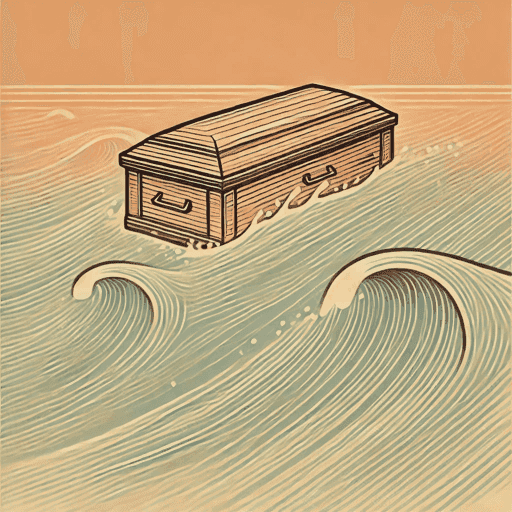
The sailors tell Pericles that they have a waterproof and sealed casket ready as per his orders. Pericles asks the sailors where they are and is told the nearest port is Tarsus. Pericles orders for the ship’s course to be changed for Tarsus, since the baby needs urgent care. If the wind stops, they may be able to reach Tarsus. Now Pericles must lay Thaisa in the casket and send her to sea.
Act III, Scene 2 Summary
In Ephesus, Cerimon, a renowned healer, brings home some men who have been shipwrecked. He asks his attendant Philemon to settle the poor men with food and warm clothes. Somone’s attendant visits Cerimon for a remedy for his ailing master, but Cerimon says no earthly cure can help the master, as the raging storm will make it impossible for the servant to return to him in time.
Two gentlemen show up at Cerimon’s house, seeking a remedy. They marvel at Cerimon’s work ethic as he works tirelessly through the night, even though he is wealthy enough to retire. Cerimon replies that he has always believed true wealth lies in virtue rather than riches.
A couple of servants lug in a chest which has been washed ashore. Cerimon bids them to open it, as it may contain treasure. As the servants try to wrench the casket open, a sweet smell rises from within. The coffin’s lid is finally opened to reveal Thaisa’s body inside. Cerimon notes that the body is dressed in regal clothes and packed with spices and jewels, as befits royalty. The casket carries a letter stating that whoever finds the body must give it a proper burial, as this is the wife of King Pericles.
Cerimon observes that Thaisa must have died very recently as she looks almost alive. Suspecting she was declared dead too soon, he asks for a fire to be prepared to warm her and boxes of his remedies to be fetched. He bids the servants to play music as he applies various potions on Thaisa. Thaisa begins to warm up and show signs of life. The amazed gentlemen state that Cerimon has won everlasting fame for his miracle. Cerimon remarks that the heavenly jewels which Pericles lost (Thaisa’s eyes) are now open, visible between the curtains of her golden lashes.
Thaisa bolts up, startled, asking for Pericles. Cerimon tells the servants to take her to a warm room and cover her with sheets as a relapse can still be fatal for her. He asks Aesculapius—the god of medicine—to guide him and help him keep Thaisa alive.
Act III, Scene 3 Summary
Pericles, who has landed in Tarsus with Lychorida and the baby Marina, tells Cleon that he must rush to Tyre as the one-year period given to Helicanus is nearly up. Since his little daughter cannot withstand the long journey, he requests Cleon and Dionyza to look after her. Pericles has named the babe Marina because she was born at sea. Cleon promises to nurture Marina. When Tarsus was in peril, it was the corn brought by Pericles that sustained its starving people, so Cleon is duty-bound to help the prince. If he fails to be a good guardian to Marina, he asks the gods to punish him and all his following generations.
Pericles assures Cleon that he trusts him; the mayor does not need to make extreme vows to prove himself to Pericles. He asks Dionyza to take care of Marina and bids the child goodbye, promising to cut his hair only when she gets married. Dionyza swears to love Marina like she does her own daughter, Philoten. The group accompanies Pericles to the shore to see him off. Pericles asks Lychorida not to cry for Marina’s sake.
Act III, Scene 4 Summary
In Ephesus, Cerimon shows the letter in her casket to Thaisa and asks her if she recognizes the handwriting. Thaisa states that the writing is of her husband King Pericles. She remembers being dropped into the sea after she gave birth, but has no memory of how she got to Ephesus.
Thaisa expects she will never meet Pericles again. Therefore, she wants to take on the garments of a nun. Cerimon suggests that Thaisa can serve as a priestess at the nearby temple of Diana for the rest of her life. Thaisa thanks Cerimon for his kindness.
Act III Analysis
An elegiac tone colors the middle section of the play, with loss as its prominent motif as it explores The Tensions Between Fortune and Free Will. The atmosphere of loss is catalyzed by the narrative device of peripeteia, or the reversal of fortune, at the beginning of the act. Just as Pericles seems to have finally found stability in Pentapolis, with a father figure (Simonides), a wife, and a child on the way, he and his family are thrust into chaos. The sea, perpetual symbol of uncertainty and misfortune, acts up again, with Pericles beginning Act III just as he did Act II: Asking the sea god and other gods of nature to stop their wrath. However, the stakes for Pericles are much higher now, as he has a wife and child in peril, and a kingdom waiting for him.
Pericles must once again respond to sudden misfortune through attempting to assert some control through the use of his own agency. First, he must address the well-being of his newborn daughter, whom Lychorida hands over to Pericles with the ominous words: “Take in your arms this piece / Of your dead queen” (III.1.19-20). Lychorida’s phrasing presents both Thaisa and Marina as objects tossed around by chance. At the same time, it emphasizes regeneration, as the mother lives on as her “piece,” or her child. Terrible as events may be, Marina’s arrival also symbolizes hope, with Pericles’s description of the newborn Marina emphasizing her redemptive power. He refers to her as, “This fresh-new sea-farer” (III.1.47), a phrase that contains the hope of adventure and discovery, despite the perils of fortune.
Pericles must also act quickly as a leader on the ship, as the sailors are further panicked by the presence of Thaisa’s ostensibly dead body, which they regard as an ill omen. Although it pains him, Pericles acts with his usual decisiveness in agreeing to send the body overboard, albeit with careful provisions to ensure that whoever may find the casket will know that Thaisa is a king’s wife. The process of the sea burial of Thaisa shows Pericles’s love for his wife. Though their relationship has been portrayed only briefly in the play, Pericles’s lament for Thaisa, and the fact that he packs her casket with spice, jewels, and regal silks conveys his feelings and gives Thaisa as dignified a goodbye as possible. The tension between the demands of the crew and his heart’s desire show the opposition between public duty and private self. As Pericles grows into a king, he must learn to balance these oppositional forces when faced with sudden misfortune.
Fortune can also be kind to the characters, as demonstrated by Thaisa’s miraculous survival and revival in Ephesus. When Thaisa wakes up in a strange land, surrounded by strangers, her first experience is loss, as evident in these lines: “Where am I? Where’s my lord? What world is this?” (III.2.128). However, her initiation into a new life as a priestess of Diana shows the continuum between loss and rebirth, indicating that ill fortune can sometimes improve. Though the narrative knows misfortune and death are ever-present realities, it tries to temper them through miraculous coincidences, acts of God, and supernatural occurrences. Thus, the problem of Thaisa’s death is solved by a series of plot devices, such as a watertight coffin that keeps her safe, and a sea that delivers her to a skilled and kind physician. Similarly, Pericles also survives his own perilous journeys at sea, foreshadowing that while fortune is sometimes cruel, Pericles and Thaisa will enjoy good fortune at the play’s end.
This section also introduces the virtuous female characters who embody The Importance of Chastity and Political Virtue. Women like Thaisa and Lychorida—who embody traditionally feminine virtues such as chastity, motherliness, and sacrifice—are lynchpins of the ideal family unit in the play, contrasting with how transgressive women like Antiochus’s daughter threaten the stability of both the family unit and the polity. In keeping with her “good woman” role, Thaisa immediately takes on a nun’s vocation after her rebirth, a profession meant to protect her chastity. The references to Diana, the Greco-Roman virgin goddess of the hunt, is an example of the play’s use of classical allusions to reinforce the emphasis on chastity, as Diana was an example of divine sexual propriety.

Unlock all 62 pages of this Study Guide
Get in-depth, chapter-by-chapter summaries and analysis from our literary experts.
- Grasp challenging concepts with clear, comprehensive explanations
- Revisit key plot points and ideas without rereading the book
- Share impressive insights in classes and book clubs