Pericles
62 pages • 2-hour read
William ShakespearePericles
A modern alternative to SparkNotes and CliffsNotes, SuperSummary offers high-quality Study Guides with detailed chapter summaries and analysis of major themes, characters, and more.
Symbols & Motifs
Content Warning: This section of the guide includes discussion of child sexual abuse, sexual violence, sexual harassment, rape, and death.
Fathers and Daughters
Father-daughter pairs are a recurring motif in the play, highlighting The Importance of Chastity and Political Virtue as well as loss and rebirth. The first father-daughter pair presented in the play is also the most corrupt version of the filial bond. Antiochus and his daughter represent a breakdown of the family unit, and thus, chaos and death. The imagery used to describe them evokes a beautiful façade barely concealing the stench of rot. Not only does the play compare them to cannibalizing serpents, the arena in which the riddle is to be solved is lined with the heads and bones of past suitors. Further, Antiochus’s daughter is unnamed throughout the play, signifying the unspeakable incest taboo.
The second father-daughter pairing is that between Simonides and Thaisa, a bond that meets the parameters of propriety. Unlike Antiochus, who feeds on his own flesh, Simonides wants to marry off his daughter to the man of her choice. However, Simonides and Thaisa’s interactions are still in the worldly realm, with Simonides showing off Thaisa as “beauty’s child, whom nature gat [begat] / For men to see, and seeing wonder at” (II.2.6-7). These words suggest that Simonides treats Thaisa like a status symbol, drawing pride from her beauty. Though a vastly superior father than Antiochus, Simonides is still a pale version of Pericles.
It is in the father-daughter bond of Pericles and Marina that the play presents as a model of chastity and ideal family. As the recognition scene shows, Marina is not just a child or a possession for Pericles, but the very hope for regeneration. Pericles feels reborn through Marina, her virtuous presence ending his spiritual death. Thus, when he is reunited with Marina, Pericles cries out: “I am wild in my beholding / O heavens bless my girl!” (V.1.67-68). Thus, through Pericles and Marina, the father-daughter bond moves out of the realm of worldly corruption, embodying both personal and political virtues.
Sea Voyages
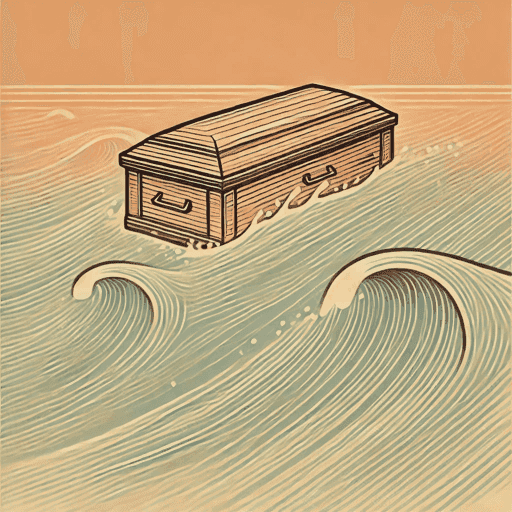
Packed with tempests, sea travels, and shipwrecks, the play uses journeys as a motif for The Tensions Between Fortune and Free Will, inspiring individual growth in the characters. All three of the main characters of the play—Pericles, Marina, and Thaisa—undergo a displacement by sea to catalyze their evolution. Pericles battles storm after storm, while Marina is kidnapped by pirates and brought by ship to Mytilene. Thaisa gives birth on a rocking ship in the middle of a tempest, is taken for dead, and tossed into the sea, the water carrying her to Ephesus. All these journeys are described using vivid marine imagery. For instance, when Pericles considers Thaisa’s burial at sea, he laments that instead of a stately tomb, “the belching whale / And humming water must o’erwhelm thy corpse” (III.1.68-69). The personified “humming water” evokes both beauty and terror, illustrating the creative and destructive powers of the sea and the random cruelty of fortune.
Thus, the sea represents life and the challenges of fate. Marina notes that the motif of the troubled sea describes her life: “Born in a tempest, when my mother died / This world to me is like a lasting storm / Whirring me from my friends” (IV.1.17-19). However, just like life solves the problems it creates, the sea, too, generates hope. It is the sea that brings Pericles to Marina, and finally to Thaisa. This movement shows that the only way for characters to battle the sea of life is to sail on it, face storms, and adapt in order to survive.
Music
A key symbol in the text, music has a dual aspect. When played in its rightful context, music represents harmony, divine grace, and love. However, in the wrong context, music is associated with cacophony and the corruption of family ties.
In its first sense, music is associated with the sweet singing of Marina. Gower describes Marina’s singing to the lute as so exquisite that “She sung, and made the night-bird mute” (V.Chor.26). The song of chaste and virtuous Marina carries such power that it converts sinners into good men, as seen in the brothel sequences. Once frequenters of pleasure-houses, the customers converted by Marina now only want to hear “the vestals sing” (IV.5.7), with vestals referring to the virgin priestesses of the Roman goddess Vesta or, in the Christian context, virginal nuns.
It is also Marina’s singing that first awakens Pericles from his spiritual stasis. Heavenly music also floods Pericles’s ears when he faints to receive Diana’s vision. Both in the case of Marina and Diana, music is associated with purity, Diana being the virgin goddess of the hunt. Music is also instrumental in awakening Thaisa from her deep sleep, as Cerimon bids that music be played as he uses potions on the queen. He thus implores the music to rouse Thaisa: “The music there! I pray you give her air” (III.2.91).
In its negative aspect, music is associated with the breakdown of chastity. An example of this symbolism is seen in Act I, when Pericles describes Antiochus’s daughter as a “fair viol” (I.1.81) or a beautiful instrument, which would ideally have been touched by a husband to make “lawful music” (I.1.82). However, the instrument has been corrupted because it has been played unlawfully and before its time. The phrase “lawful music” is significant, as it establishes that music or physical love is beautiful within the structure of lawful marriage. Without this rightful structure, music—i.e., sex—becomes corruption.

Unlock the meaning behind every key symbol & motif
See how recurring imagery, objects, and ideas shape the narrative.
- Explore how the author builds meaning through symbolism
- Understand what symbols & motifs represent in the text
- Connect recurring ideas to themes, characters, and events