50 pages • 1-hour read
Piglet
A modern alternative to SparkNotes and CliffsNotes, SuperSummary offers high-quality Study Guides with detailed chapter summaries and analysis of major themes, characters, and more.
Symbols & Motifs
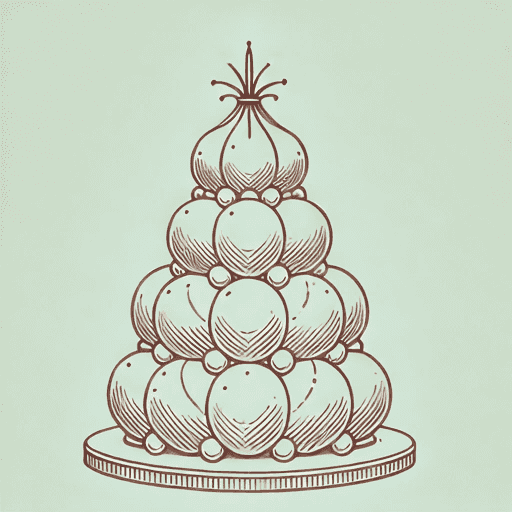
Croquembouche
The croquembouche that Piglet bakes for her wedding acts as a symbol of her desire to present herself as a sophisticated member of the upper class, developing the narrative’s thematic interest in the intersection between Food and Class in Great Britain. The novel explicitly ties the complicated French pastry to her desire to fit into Kit’s sophisticated, upper-class life: “[H]er ambition, her ability, had been so simply distilled by this one decision, this action” (179). On the day of her wedding, Piglet gives herself “two hours to assemble the croquembouches [and] three hours to assemble herself” (201). These passages suggest that Piglet closely associates the perfection of the pastry with the perfect life she hopes to build. As a result, she also sees the croquembouche as a symbol of her growing distance from her working-class family. The sight of croquembouche, “perfect, placed on its prepared cardboard base, foiled in gold” (208), leads her to imagine “her parents with gleeful eyes, arm in arm, walking around the marquee later that day: ‘our Piglet made the cake herself. Well, it’s not a cake. It’s a crock-em-booch’” (208). Her parents’ inability to pronounce the word reflects what Piglet believes is a lack of sophistication.
Piglet’s changing attitude toward the croquembouche reflects her evolving disillusionment with her wedding to Kit. In the days before her wedding, Piglet throws away all the food in her refrigerator to store the prepared custard for the croquembouche. The bowls of custard “fit neatly into the empty space, and Piglet decide[s] to take this fullness, this snugness, as the good omen it surely [i]s” (182). Piglet’s decision to throw away all her food in favor of the croquembouche reflects her devotion to the wedding, which surpasses all other concerns. The fact that Piglet smashes the croquembouche at Margot’s house after fleeing the wedding further demonstrates the connection between the cake and the wedding: Having destroyed the wedding, she feels free to destroy the cake.
Nando’s
The night before her wedding, Piglet and her family eat at the fast-casual chain restaurant Nando’s. The restaurant acts as a symbol of her working-class family’s pedestrian tastes when compared to Kit’s upper-class family. On the eve of her wedding, Piglet “[i]s ushered out of her house by her flat-vowelled family, who [a]re starting to speak loudly about spiced chicken and all-you-can-eat refillable frozen yoghurt” (191). Piglet’s description of her family as “flat-vowelled” suggests their lack of sophistication, while the all-you-can-eat yogurt reflects the budget-friendly nature of the restaurant itself. Additionally, Nando’s is a favored restaurant for young people after a night of drinking—the colloquialism “cheeky Nando’s” refers to eating at the restaurant after having a few pints. As such, the restaurant does not fit in with Piglet’s posh aspirations. When Franny suggests that the family order celebratory champagne, Piglet snidely remarks, “I don’t think they do bubbles” (193). Her father dismisses the idea of a celebratory toast, “not understanding or not caring about the convivial ritual that c[omes] with sharing a bottle of wine, the ceremony of pouring for your counterpart first and then yourself” (193). For Piglet, this lack of ceremony reflects their relative unsophistication during what is supposed to be a celebratory time. Her mother later adds that drinks are “not included in the voucher” they planned to use to pay for the meal (193). The fact that her family is using a voucher to eat at a chain restaurant upsets Piglet, who wonders “what Kit would be eating tonight” (192). The comparison between Piglet’s family and Kit’s reflects the novel’s thematic interest in the connection between food and class in British culture.
Oxford and Derby
Throughout the novel, Piglet’s home in Oxford acts as a symbol of the upper-class lifestyle that she aspires to have with her new husband. As an expensive town and the center of elite higher education in Britain, Oxford offers a stark contrast to Piglet’s working-class hometown of Derby. Piglet made this comparison clear when house hunting, telling Kit that “anywhere in Oxford was better than Derby” (34). At the wedding, she explicitly compares “her Derby relatives” to Kit’s Oxford friends and family (259). While the Derby relatives “[a]re laughing, daring each other to neck oysters, poking one another in the ribs […] the Oxfords look[] on, eyebrows raised discreetly beneath wide-brimmed hats as they tip[] their glasses skywards” (259). This passage suggests that Piglet’s relatives from Derby are less sophisticated than Kit’s family from Oxford. While the Derby relatives are loud and unfamiliar with posh foods like oysters, the Oxford relatives are presented as sophisticated and discreet. The gap between Piglet’s working-class background and the upper-class life that she aspires to creates The Pressure to Build a Perfect Life, which she believes will allow her to transcend class and gain upper-class acceptance.

Unlock the meaning behind every key symbol & motif
See how recurring imagery, objects, and ideas shape the narrative.
- Explore how the author builds meaning through symbolism
- Understand what symbols & motifs represent in the text
- Connect recurring ideas to themes, characters, and events